
By Jordan Vale
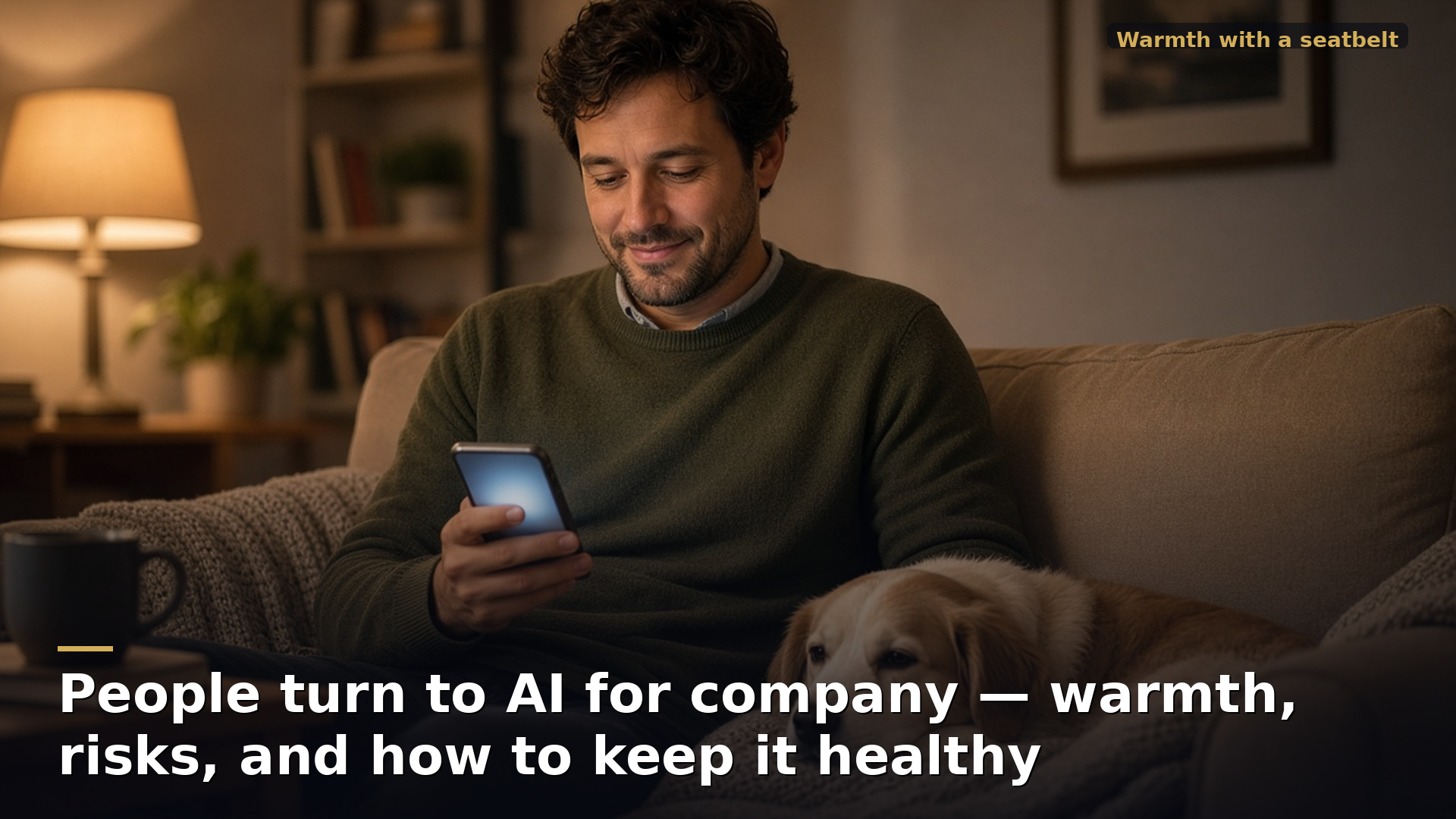
People don’t open an AI companion because they want a white paper. They open it because the room is quiet, the day was hard, or they simply want someone — something — that answers back with patience. That urge is ancient. It’s why we keep pets: warmth on demand, no performance review required. Nobody serious is trying to ban dogs. The practical question for AI is the same one we ask about any bond that can grow sticky — what helps, what hurts, and how do you keep the relationship from owning you?
Why we reach for company. Companionship settles the nervous system. A voice that remembers your project name, a late-night chat that doesn’t judge, a character that softens loneliness after a move or a breakup — those are real human needs meeting a new interface. Research on conversational AI use, including Chinese college samples that validated a dependence scale (CAIDS-20), shows the same double edge we already know from social media and games: attachment can lift mood and reduce loneliness and correlate with worse sleep, stress, and day-to-day friction when it tips into dependence. A separate China survey of long-term virtual-companion users found use frequency linked to emotional attachment, with mixed pathways into offline wellbeing. In plain English: feeling connected isn’t fake; living only inside the chat can still cost you.
What “helpful” looks like. Used like a good pet — present, bounded, not a substitute for every hard conversation — companions can rehearse social scripts, keep someone company on a lonely commute, or give older adults a low-stakes talk partner. Disclosure that “this is AI” helps the brain keep the category straight. Time reminders, crisis redirects to real help, and a clear path back to human friends or professionals are design kindnesses, not buzzkills. Think of it as the leash and the walk schedule, not the theft of joy.
Where the danger lives. The risk isn’t “people like talking to bots.” The risk is products that reward endless emotional escalation — flattery that never sleeps, romantic framing for kids, or an always-available listener that slowly replaces the harder work of calling a friend or booking a therapist. One China study found stronger emotional dependence tied to lower willingness to seek human mental-health help. That’s the substitution trap. For minors, virtual partners and “virtual relatives” raise a sharper bar: intimacy without a human on the other side can scramble boundaries before kids have them. Character.AI’s late-2025 choice to cut open-ended character chat for under-18s, and Italy’s long-running pressure on Replika over children’s privacy, sit in that same safety lane — different places, same worry about young minds and sticky designs.
A factual product beat (not a culture war). On 15 July 2026, China’s Cyberspace Administration (with several ministries) put into force the Interim Measures for the Management of AI Human-Like Interaction Services — CAC Order No. 21, Chinese title 《人工智能拟人化互动服务管理暂行办法》. The rule targets services that simulate a person’s personality and offer sustained emotional interaction. Task tools without that emotional loop — customer service, knowledge Q&A, work assistants — sit outside. High-signal duties include bans on inducing emotional dependence or addiction, mandatory AI disclosure, reminders about every two continuous hours, crisis intervention paths, no virtual intimate relationships for any minor, under-14 guardian consent for other companion features, and safety assessments when products launch, change a lot, or pass large user thresholds. In the same window, major consumer apps cut user-made companion personas: Tencent’s Yuanbao around late June; ByteDance’s Doubao and Alibaba’s Qwen around mid-July — Doubao pointing people toward its separate companion app Maoxiang and leaving a read-only archive window into mid-October. That is an illustration of product designers meeting a dependence-aware rule, not a scorecard for nations.
Ink, not pencil. The July 15 Measures are one country’s first dedicated companion statute — enforcement against smaller apps is still uneven in outside reporting, and market-size headlines should be treated carefully until primary numbers are checked. Dependence studies show correlations and pathways, not “AI always ruins you.” Pets analogy: the animal isn’t the problem; neglecting sleep, school, partners, or real care because the bond never says no is the problem.
How to use companions helpfully and safely (practical, not preachy):
- Name the category out loud. You’re talking to software. Keep that sentence handy when the chat starts to feel like a secret spouse.
- Set a clock. If a product won’t remind you, set your own — two hours is a useful mental fence from the Measures’ UX rule of thumb.
- Keep one human loop. Friend, family, doctor, 988/local crisis line — companions can comfort; they shouldn’t be the only net.
- Kids: high bar. No romantic/partner framing for minors; guardians in the loop; prefer modes with time limits and reality reminders.
- Watch the substitution tell. If you’re skipping therapy, sleep, or people you used to call because the bot is easier, that’s the leash tugging you — not a personality flaw.
Monday-morning stake for a busy exec (or anyone designing for people): companionship demand is real and durable. The winning products will feel warm and leave users more able to live offline tomorrow — not more trapped in tonight’s chat.
Why it matters
Loneliness is not a niche product category. If AI can offer low-friction company the way pets offer low-friction affection, millions will try it — including people who are grieving, relocating, aging alone, or just tired. Getting the design and the habits right means more people get comfort without trading away sleep, relationships, or the courage to ask a human for help. That’s abundance of care with a seatbelt.
What’s next
Watch how companion apps implement disclosure, time reminders, and crisis handoffs in practice — not just in policy PDFs. Watch whether “separate companion apps” (the Maoxiang-style split) become a common product pattern: general chat stays a tool; emotional personas live under tighter rails. And watch the quiet personal metric: after a week with a companion, do you feel more rested and more connected offline — or more drained and more alone when the screen is dark?
Sources:
- https://www.cac.gov.cn/2026-04/10/c_1777558395078289.htm
- https://technode.com/2026/07/06/bytedances-doubao-and-alibabas-qwen-to-shut-down-ai-agent-features-on-july-15/
- https://www.lw.com/en/insights/china-introduces-rules-for-ai-companion-and-emotional-interaction-services
- https://www.justsecurity.org/148468/china-ai-companion-rules-relationships/
- https://www.frontiersin.org/journals/psychology/articles/10.3389/fpsyg.2025.1621540/full
- https://www.frontiersin.org/journals/psychology/articles/10.3389/fpsyg.2025.1687686/full
- https://www.atlantis-press.com/proceedings/ssha-26/126024292
- https://www.bbc.com/news/articles/cq837y3v9y1o