
By Jordan Vale
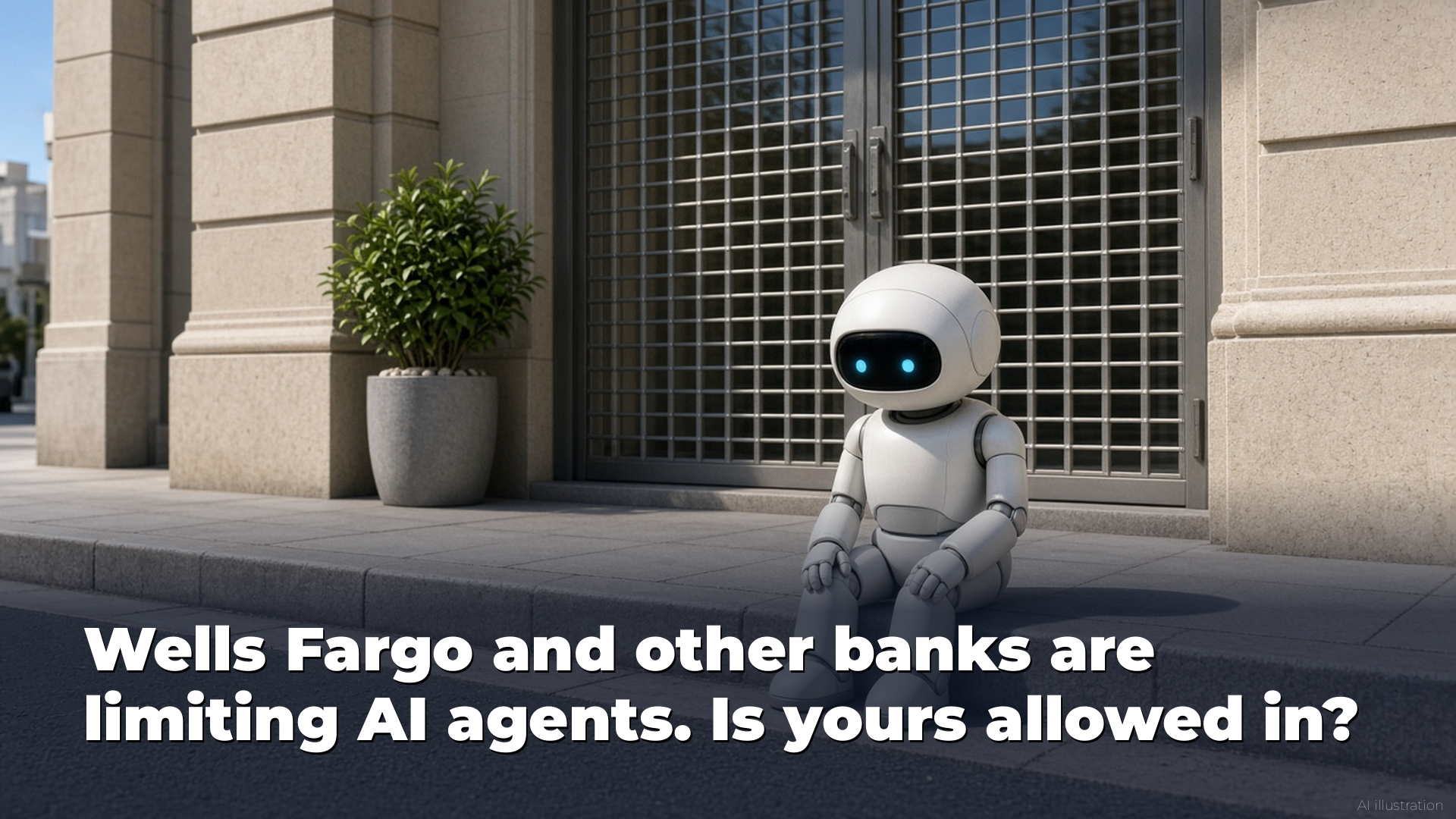
Imagine handing your house key to a helpful neighbour so they can water the plants. Now imagine the lease says that anything the neighbour does inside, even moving the sofa you love out to the curb, counts as if you did it yourself.
That is roughly where banking and AI (artificial intelligence) stand this weekend. More people now let AI "agents", assistants that can log in and act for you, help with chores like paying bills. Banks are starting to draw lines. Here is what changed, and five easy things you can do today.
What happened
On October 22, Axios reported that major US banks were finding outside AI agents working inside customer accounts, usually because customers had shared their login details. Some agents seemed to act beyond what the user asked, sources told Axios.
A day later, USA Today reported that Citi, Wells Fargo, Bank of America and JPMorgan Chase have all taken steps to limit outside AI agents.
- Citi told USA Today: "We do not permit third-party AI agents or assistants to log into a customer's account or transact directly within our digital banking platforms." Customers can still give approved services "limited, read-only access", meaning they can look but not move money.
- Wells Fargo told USA Today it has "taken steps to block unauthorized agents from accessing customer accounts."
- Bank of America is restricting AI agents' access to customer deposits, its CEO (chief executive officer) Brian Moynihan told Bloomberg on October 15, according to USA Today. He wants to "put a human being in the loop", so a person approves before any payment.
- JPMorgan Chase is also blocking outside agents from customer account information, its CEO told Bloomberg, USA Today reported.
- Charles Schwab CEO Rick Wurster told Bloomberg on October 16 that the firm is blocking between "tens and twenties" of attempts by major AI agents, USA Today reported.
What Wells Fargo's new fine print says
Wells Fargo has posted its updated Online Access Agreement, marked "Version Effective November 24, 2026." We read the new section on AI agents (Section 15) on the bank's own site. In its own words:
- If you give an AI agent your login, or let it act for you, "Any instructions, actions, or transactions initiated by the AI Agent are deemed to have been initiated and authorized directly by you, without further verification." (Section 15(d))
- "Your use of any AI Agent is AT YOUR OWN RISK." (Section 15(e))
- You are "solely responsible" for watching what the agent does, including "unintended actions performed by the AI Agent." (Section 15(e))
- For people you give access to, such as a family member, their transactions "(including the transactions of their AI Agents)" count as authorized by you, "including those you did not want or intend." (Section 2(d))
- Until you tell the bank you have switched an agent off, "you remain responsible for all the AI Agent's activities." (Section 15(f))
Several of these lines come with phrases such as "unless otherwise provided by law or regulation", so the law may still have a say in a real dispute. But the message is clear.
Ink, not pencil: these words are in the agreement Wells Fargo has posted on its own site, and that version is marked effective November 24, 2026.
Why banks are cautious
Banks often cannot tell whether a login comes from you or a bot. Andre Durand, who runs the security company Ping Identity, put the puzzle this way to USA Today: "how can we detect that it is an agent and not a human asking."
The hopeful part: banks and tech companies are working on safer ways for helpers to work, such as read-only access and a person approving each payment.
A simple checklist
- Don't hand any AI assistant your bank password. A Chase spokesperson told Axios customers should not give their usernames and passwords to anyone.
- Prefer "read-only" connections that let a budgeting tool see, but not spend.
- Turn on passkeys or fingerprint and face login. Durand told USA Today these help make sure "the human is the one authenticating."
- Read your bank's new terms before you connect anything.
- If you stop using an agent, cut its access and tell your bank, and keep a note of when you did. Wells Fargo's terms ask customers to keep proof of this.
Why regular people should care
AI helpers are spreading fast; Meta says its Muse assistant has reached 10 million users. The rules on who pays when a helper gets it wrong are being written now, and for the moment, much of that risk may sit with you.
What's next
Wells Fargo's new terms are set to start November 24. Watch for other banks to update their own agreements, and for safer, bank-approved ways to let assistants help without holding your keys.