
By Jordan Vale
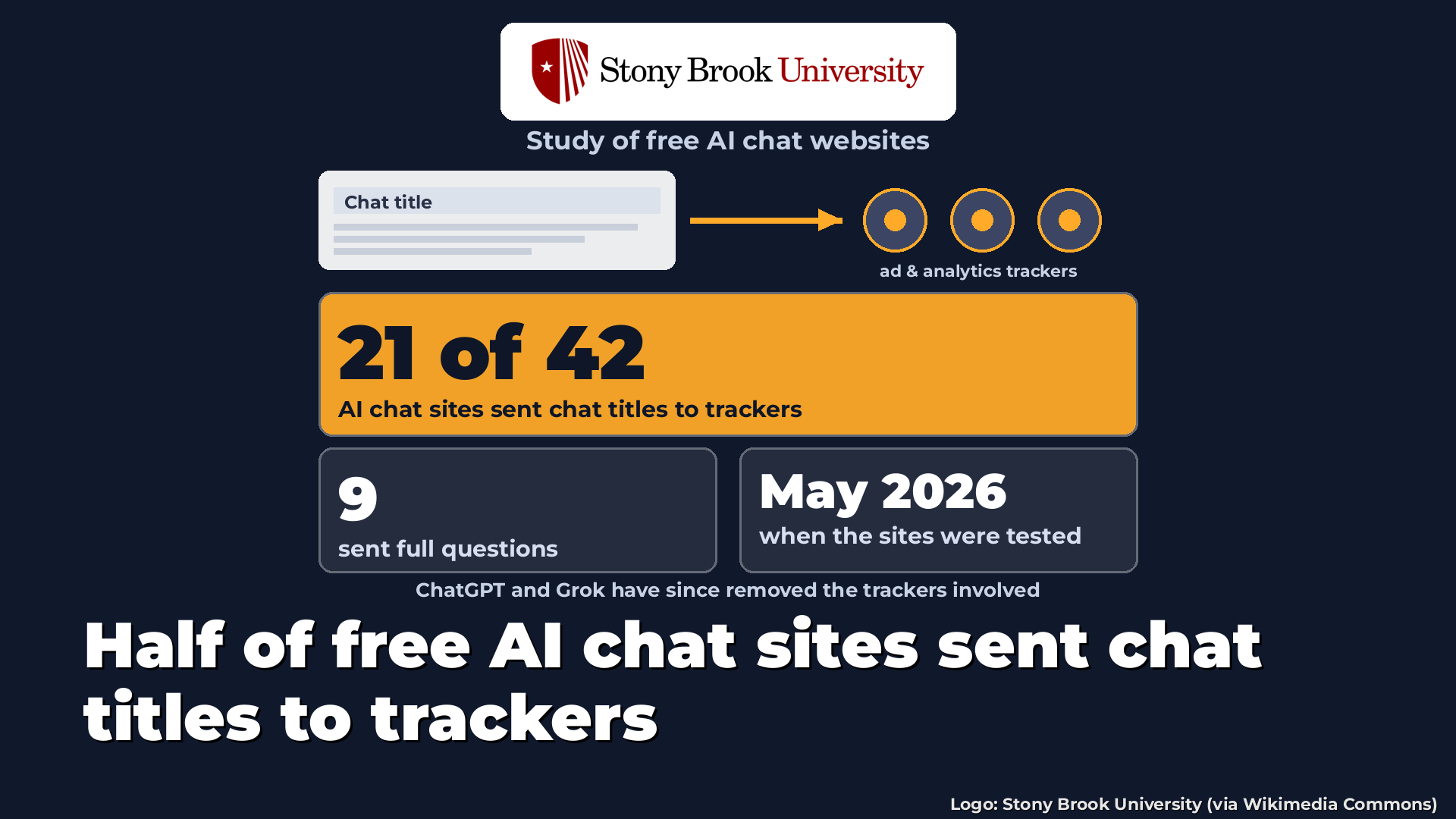
Logo: Stony Brook University (via Wikimedia Commons). Data card: Rich Brew Co.
Say you ask an AI chat website about a rash, a debt or a visa problem. The website gives your chat a short title, so you can find it later. A new study found that on many websites, that little title did not stay between you and the chatbot. Here is what the researchers found, and a few calm things John and Jane can do about it.
What the researchers found
A team at Stony Brook University in New York (Paschalis Bekos, Billy Tsouvalas, Nick Nikiforakis and Michalis Polychronakis) posted their paper, "Penny for Your Prompts", online on October 27. A review note in the paper says it was prepared for the IEEE Symposium on Security and Privacy in 2027.
They tested the free website versions of 42 AI chat services: 25 general chatbots and 17 built for education, health or legal help. They signed up, asked a few planned questions (for example, a dentist recommendation), and recorded where the information went.
- 21 of 42 services sent the chat title to outside tracking or analytics companies.
- 9 also sent the full question the person typed.
- Of the 13 general chatbots that leaked chat information, 11 also sent the user's email address to outside companies, in plain or scrambled form. For eight of them, the same company received both.
The paper says Google received the most of this information, followed by Meta.
Why it happens, in plain words
Most websites carry small pieces of code from ad and analytics companies. This code reads things like the page title, the words in your browser tab, to count visits and measure ads. On a shopping site, the title might be "Men's running shoes". Harmless.
On many chat websites, each conversation is its own page, and the chat title becomes the page title. So the same counting code, doing what it always does, picks up a summary of what you asked. It is a bit like a shop's visitor counter that starts reading people's shopping lists, because someone put the lists where the counter looks.
On some health and legal services, the researchers saw full questions about anxiety and immigration status go out to trackers.
Who has fixed it
The researchers say ChatGPT and Grok had trackers collecting chat information during the study. Both removed them, and the team checked this before submitting the paper. One legal service, TheLawGPT, changed its tracker settings after being told. Several others said they had passed the findings to their teams.
Ink, not pencil: the tests ran from May 6 to May 20, 2026. They covered free website versions only, from one place in the eastern United States, with cookie and tracking pop-ups accepted. Phone apps and paid plans were not tested, and things may have changed since. The study shows the data was sent. It did not check what the companies did with it.
The human side
Think of an older parent quietly asking a chatbot about a worrying symptom at midnight, because it feels more private than calling anyone. That trust is the whole point of these tools. The researchers' message is not "stop using AI". It is that chat websites need to be built for the private things people now tell them.
Why regular people should care
The researchers used each website's default settings. They did not test whether a chatbot's own privacy settings change what these trackers see, so don't count on them for this. A few simple habits help:
- Keep sensitive questions general. Leave out names, addresses and details that point to you.
- Use a tracker blocker in your browser. The paper says blocking these scripts would have stopped the leaks it saw.
- Take extra care on small health, legal and study sites. In the study, a bigger share of their traffic went to trackers than on general chatbots.
What's next
The researchers suggest that chat websites make titles less specific and keep chat text away from analytics tools. They also want ad and analytics companies to build tools made for chat pages. They have shared their data publicly so others can check the work. We will watch for responses from the other services named in the paper.