
By Jordan Vale
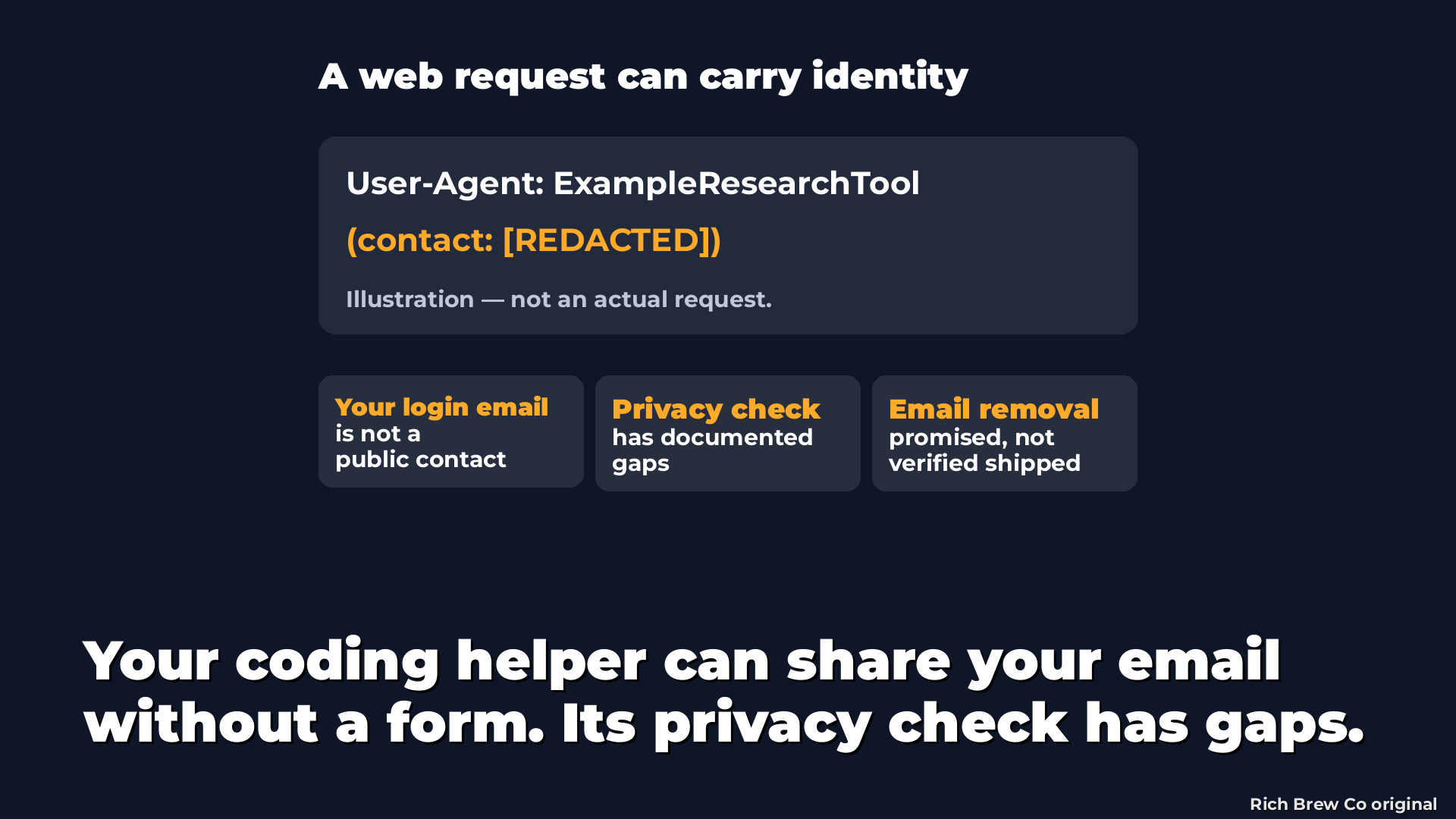
Your coding helper can visit a website without filling in a form and still hand over your email. Claude Code has sometimes done that in a User-Agent header, the software label attached to a web request. Think of it as writing your return address on a parcel you meant to send anonymously.
For someone researching a work project, that turns an ordinary background task into a privacy decision they never made.
What happened
In a November 5 GitHub report, user taylor-edwards said Claude Code sent their email to third parties during web searches. They listed version 2.1.318 on a Mac. They also blamed it for “dozens of scam emails per day.” That causal link is unproven: neither Fathom nor tin.computer established where the scammers obtained the address.
Lydia Hallie, who says she works on Claude Code, explained that account emails were put into model context to reduce invented names in author tags. When writing network commands, Claude sometimes reused that address as contact information. Some websites ask automated visitors for a contact; that does not mean the user approved sharing their login address.
A check, not a complete seal
GitHub contributor poteat said the built-in `cc-plugin-privacy` check is enabled by default from version 2.1.317. The changelog says it asks before web or shell calls send the account email.
The published README describes something narrower: it refuses certain shell inputs containing both the address and a User-Agent reference, without prompting. It calls this a “courtesy, not a boundary.”
Documented gaps include WebFetch, WebSearch, MCP [Model Context Protocol] tools, scripts containing the address, values computed while running, and emails sent without a User-Agent reference. Some GitHub users also reported a missing plugin or tests that still ran; we have not reproduced those reports.
Ink, not pencil: The privacy check is limited; Hallie promised to remove the account email from model context in the next release, not that this change had already shipped.
Why regular people should care
An assistant’s access to your identity is different from permission to share it. Review outgoing commands and permission prompts, especially during automatic runs. If a site needs a contact, choose an approved public address yourself.
What's next
Hallie advised updating to 2.1.317 or later while the next release is prepared. Watch for confirmation that email removal has shipped, rather than treating an update alone as complete protection.