
By Jordan Vale
Maybe you asked an AI to tidy a cover letter, or your teenager used one on an essay. If that AI was one of Anthropic's newer Claude models, the text may carry a hidden "made with AI" pattern that you cannot see. Anthropic says it is working to add the same pattern to its older models too. Here is how it works, and what a "hit" really means.
What Anthropic says it is doing
In its Help Center, updated this week, Anthropic says it signed the European Union's code of practice on marking AI-made content under the EU AI Act. Text from supported Claude models carries an "imperceptible watermark," the company says, across its apps, its API (the tool developers use to build with Claude) and cloud partners such as AWS, Google Cloud and Microsoft Foundry. It applies worldwide, not only in Europe.
Models launched on or after August 2, 2026 get the mark from day one. For older ones, Anthropic says it is "adding watermarks to outputs from models released before August 2, 2026," and its August 14 explainer says this will roll out "over the coming months."
The Independent reported on Monday that older models such as Mythos 5, Opus 4.7, Opus 4.6 and Sonnet 4.6 will get the mark, and that, as before, there is no way to opt out. But on Monday night, Anthropic's own model table still showed the text watermark only on newer models, such as Opus 5, Sonnet 5 and Haiku 5.5. The older ones The Independent named were listed with file labels only. So the change for older models looks still in progress.
How the hidden pattern works
AI writes one word at a time. Often two words work equally well, like "grey" or "overcast" after "The weather today was cold and…". Normally a random number picks one. Anthropic says the watermark swaps that random number for a secret key, so these low-stakes choices leave a pattern only the key can spot.
Think of a board game where, instead of rolling dice, everyone secretly follows a page of numbers. The game feels the same. But someone holding that page could look back at the moves and say, "this game probably used my numbers." That is close to Anthropic's own comparison.
Anthropic says nothing is added to the text, there are no hidden characters, quality does not change, and the mark carries no information about who you are.
What it can and can't prove
Anthropic is clear about the limits:
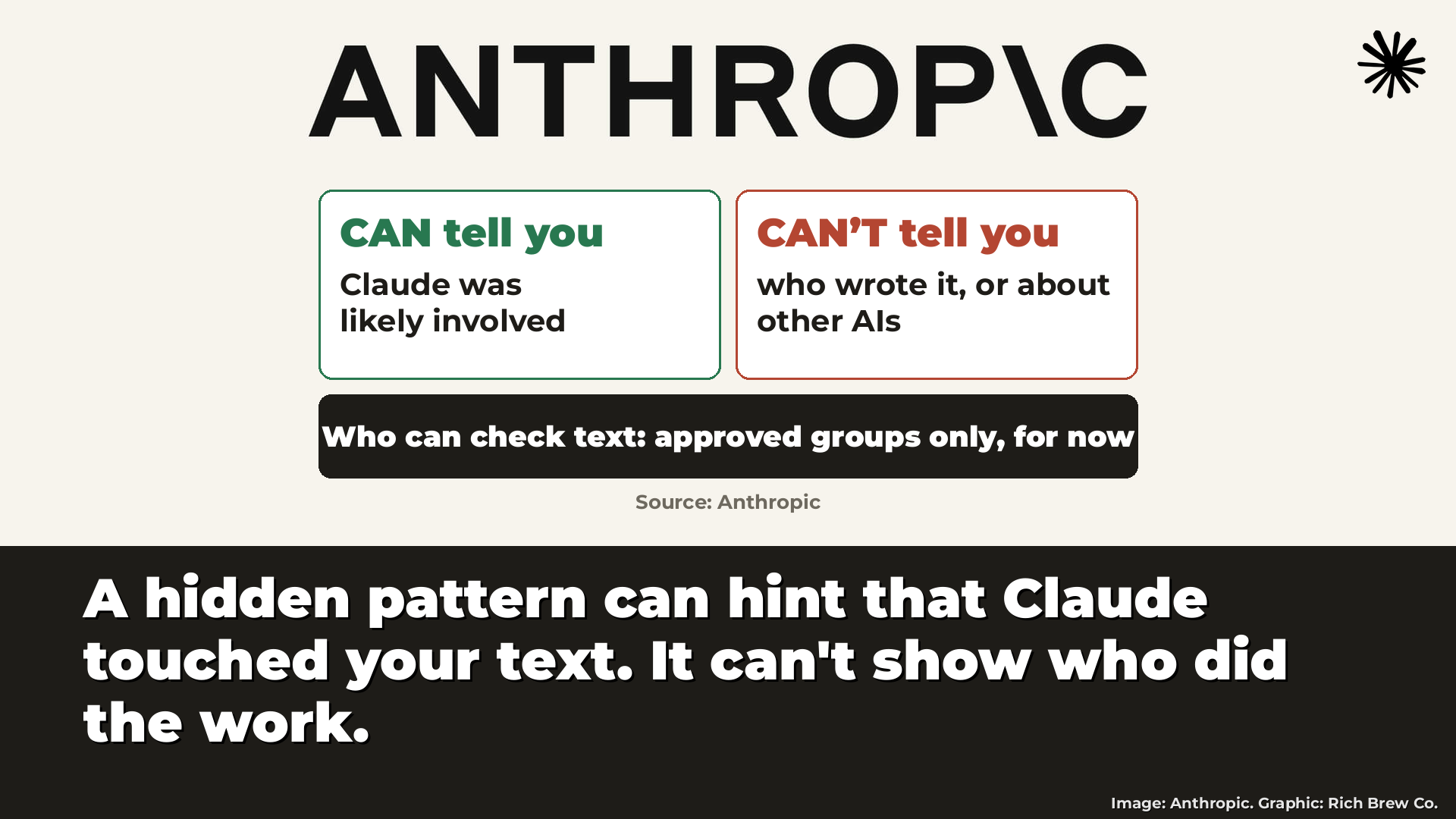
- A hit means Claude was "likely involved." It cannot tell "Claude wrote this" from "Claude heavily edited this."
- No hit does not mean a human wrote it. Short passages, heavy edits, paraphrasing, or translation by another tool may leave too little signal.
- Light proofreading leaves little to find, because most of the words are still yours.
- It only sees Claude. Other AI tools use different keys or methods.
The Anthropic pages we read give no accuracy figures for its detector.
Ink, not pencil: a watermark hit is a clue, not a verdict. Anthropic itself says a detected mark "does not, on its own, confirm the full provenance of the content."
Who can check
Not you, yet. Text checking is in private preview, Anthropic says, for groups named under EU law, such as regulators, police, media, fact-checkers, researchers and educational groups, plus companies with compliance duties. Images and other files Claude creates get a separate signed label, called Content Credentials, which anyone can test with Anthropic's free Claude Content Checker.
The Independent also reports that users can still pick older models in Claude, all the way back to Opus 3, that are not yet covered. It adds that, according to Anthropic, changing some word-choice settings through the API removes the mark on Opus 4.6 and Sonnet 4.6. We could not find that last point on Anthropic's own pages.
Why regular people should care
If you use AI to help you write, a teacher, employer or editor may one day run a check. A result can fairly mean only this: Claude touched the text somewhere along the way, not that you cheated or did no work. If you are the one checking, treat a hit as the start of a conversation.
What's next
Watch Anthropic's model table for the older models to switch over, and for the detection tool to open to more people, which Anthropic says it plans "over time." Other AI companies that signed the same EU code are adding their own marks, so expect more hidden labels.