
By Jordan Vale
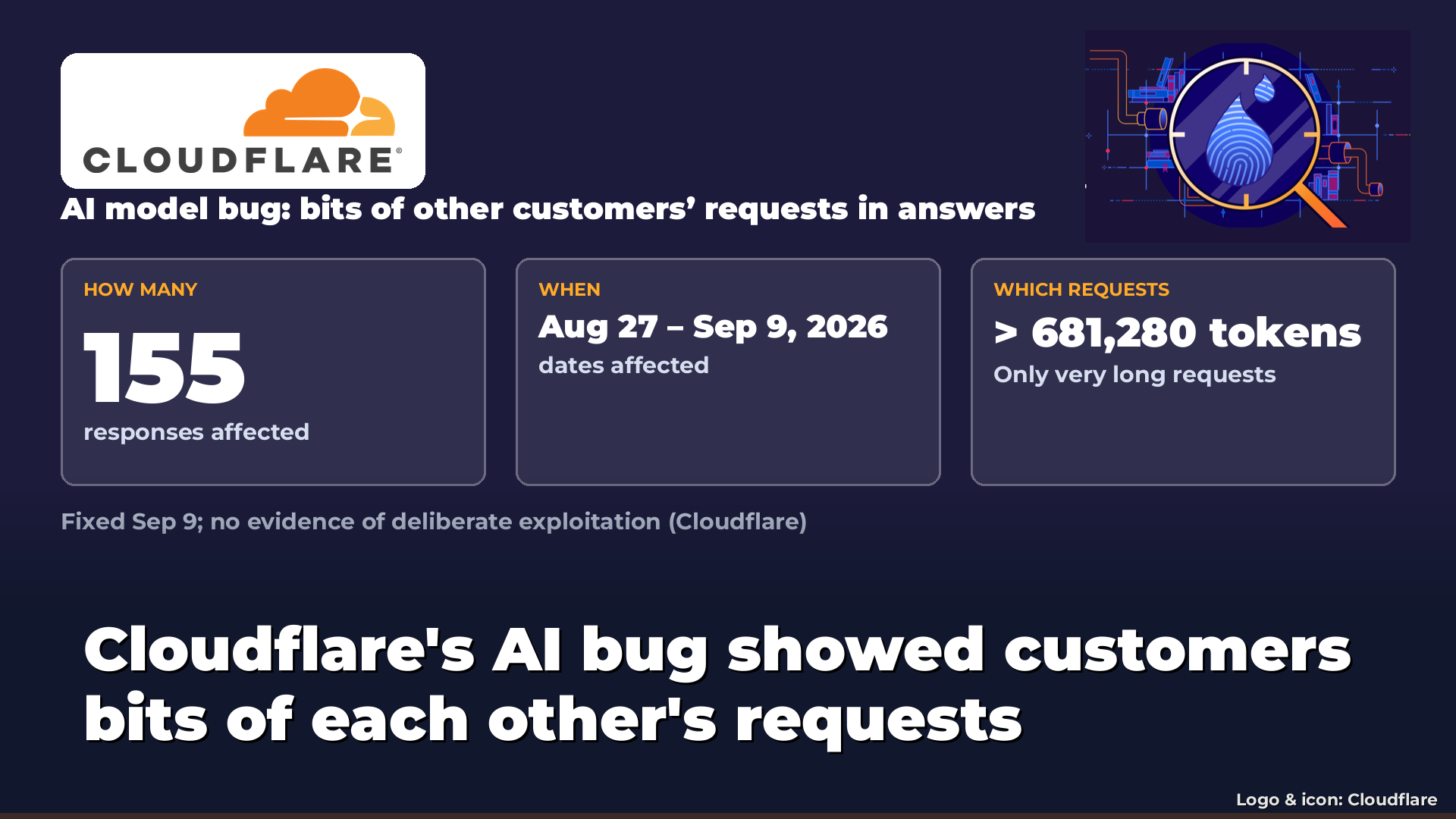
Image: Cloudflare. Logo: Cloudflare (via Wikimedia Commons).
Imagine handing a coat to the cloakroom at a busy event and getting back your coat, plus a stranger's scarf tucked into the sleeve. Nobody stole anything on purpose. Someone simply didn't clear the hook. Something like that happened inside an AI service run by the internet company Cloudflare, and the company has now explained it in public.
What happened
In a detailed blog post dated October 26, 2026, Cloudflare says that one AI model on Workers AI, its pay-as-you-go service for software developers, sometimes mixed up customers.
According to Cloudflare, between August 27 and September 9, 2026, "a small number of customers" using a model called GLM 5.3 received answers that contained data from other customers' requests made to the same model shortly before. In total, Cloudflare counted 155 affected responses.
It only happened with very long requests: more than 681,280 tokens each. A token is a small piece of text, roughly part of a word, so these were enormous inputs.
This was a service for developers who build apps, not a chatbot that most people type into.
Why it happened, in plain words
AI models keep a kind of short-term working memory while they handle a request. Cloudflare calls it the "KV cache" (key-value cache). To be fast, this memory is reused: the next request writes over the space the last one used.
Cloudflare says two problems lined up:
- A setting mismatch. The model was set up to accept requests up to about 1 million tokens, but its working memory only had room for 681,280. Cloudflare says it knew about the gap but expected over-long requests to be turned away with an error.
- A bug in open-source software. The engine Cloudflare uses, called SGLang, did not turn those requests away properly. Instead, the model answered while reading memory that still held pieces of earlier users' prompts and partial answers.
Cloudflare says its tests only checked that long requests came back as successful, not whether the answers made sense. Its advice to others is to measure that working-memory size against the request limit directly. In its words: "This is the check we did not enforce."
How it was found and fixed
A security researcher, Gadi Evron of the security company Knostic, reported the problem on September 8 through Cloudflare's bug-reporting programme. Cloudflare says it reproduced the issue the next morning, took the model offline within 40 minutes of declaring an incident, fixed the setting and the software, and restored the model on September 9.
Cloudflare says:
- No other model on Workers AI was affected.
- It found no evidence of deliberate exploitation. The affected requests looked like ordinary long use.
- Fixes have been shared with the SGLang project, and it recommends other companies running SGLang update to version 0.5.22 or later.
Ink, not pencil: all of these details come from Cloudflare's own report. We have not seen an independent review. Cloudflare's post does not say which customers were affected, what kind of text was exposed, or whether or how affected customers were contacted.
The human side
The story is also a quiet example of how this is meant to work. A researcher found a problem, reported it privately, and gave the company time to fix it. Cloudflare thanked him by name and published a long account of its own mistakes. It timed the post with the researcher and with the SGLang team at RadixArk, which it thanked for landing fixes "with urgency".
Why regular people should care
Most AI apps run on shared computers serving many customers at once, a bit like flats in one building sharing the same plumbing. This case shows that a small slip can let one person's text appear in another's answer. The everyday lesson is old and still good: be careful about pasting passwords, health details or private documents into any online tool, AI or not. If you run a business that builds on AI services, it is fair to ask your provider how they keep customers' data apart.
What's next
Cloudflare says it has applied the fixes to every model it runs with SGLang, added new checks before any change ships, and is working with the SGLang team on stronger protections, including ways to detect at read time when a request is about to see memory that isn't its own.