
By Jordan Vale
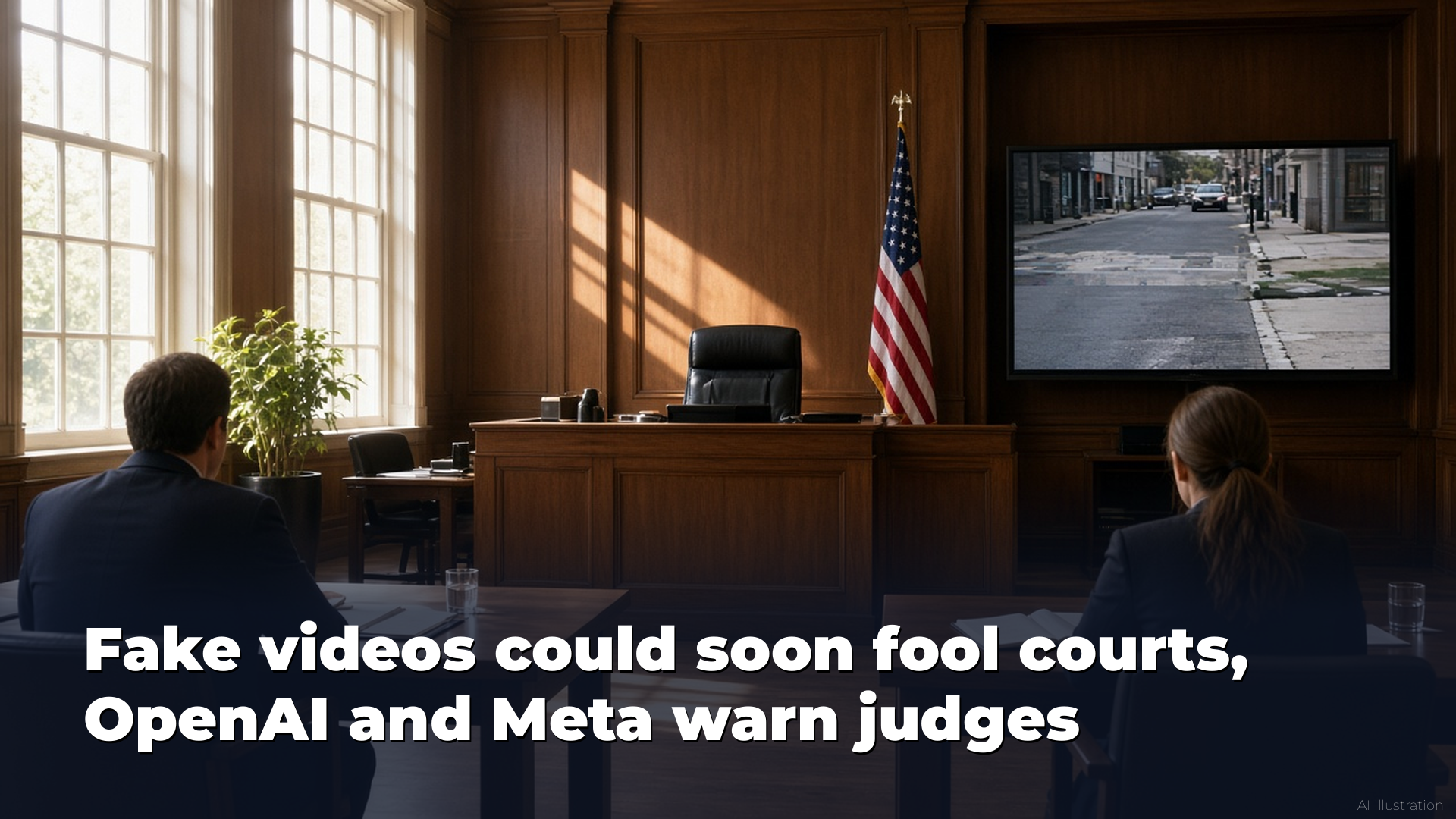
The phone video you took of a car crash may one day need more than your word to count as proof. On Thursday, people from two of the biggest AI companies told a panel of US judges that fake videos and photos are getting so good that checking what is real in court will keep getting harder.
Imagine a tenant in a court fight with a landlord. She brings a video of a leaking ceiling. The landlord's lawyer says, "That's fake." Who has to prove what? That is the question judges are working on.
The news. On October 15 in Boston, the federal courts' Advisory Committee on Evidence Rules heard from OpenAI and Meta, Reuters reported (link is a summary published by Investing.com).
What the companies said
A gloomy forecast. Shira Anderson, policy counsel at OpenAI, said AI images keep getting better, and that she does not believe a scientific method to detect them will exist in the future. That is her prediction, not a proven fact.
Cheap and convincing. Devin Norder, a director of product management at Meta, said people cannot tell media from recent AI models apart from real content, and that making it now takes little time or money.
No single watermark. A watermark is a hidden mark that shows a picture was made by AI. New laws in California and the European Union require them. But Anderson said each company uses its own system, so there is no one way to check them all, and these systems will never be completely reliable.
What judges are considering
A draft rule, not a final one. The committee, chaired by US District Judge Jesse Furman of Manhattan, has worked on deepfakes (fake media made with AI) since 2023. Its agenda describes a draft Rule 901(c), not yet approved: if one side shows enough evidence that an exhibit could be a deepfake, the side that brought it must then show it is more likely real than not. A separate draft, Rule 707, deals with AI-made evidence offered without an expert. Neither is final, and the meeting record shows some members, including the Justice Department, think 901(c) is not ready.
Rare, for now. In a March survey by the Federal Judicial Center, the courts' research arm, only 15 of 931 judges who answered had seen a case where someone challenged evidence as a deepfake. Furman said many have predicted courts will face deepfakes, but few such cases have shown up yet.
Ink, not pencil: the quotes come from Reuters' report of the meeting as republished by other outlets, and no new rule has been adopted.
Why regular people should care
Most of us will never stand in a courtroom. But many of us record things that could matter later: a fender-bender, damage to a rental, a dispute with a contractor. Simple habits help. Keep the original file, not just a copy sent through a chat app. Note the date, time and place. If you can, have a witness, or take photos from more than one angle. Those steps make your evidence harder to question, whatever the rules become.
What's next
Slow and careful. Court rule changes in the US take years, with drafts, public comment and more meetings. Expect the committee to keep working on 901(c) and 707. Meanwhile, the message from the AI makers themselves is plain: seeing should not always mean believing.