
By Jordan Vale
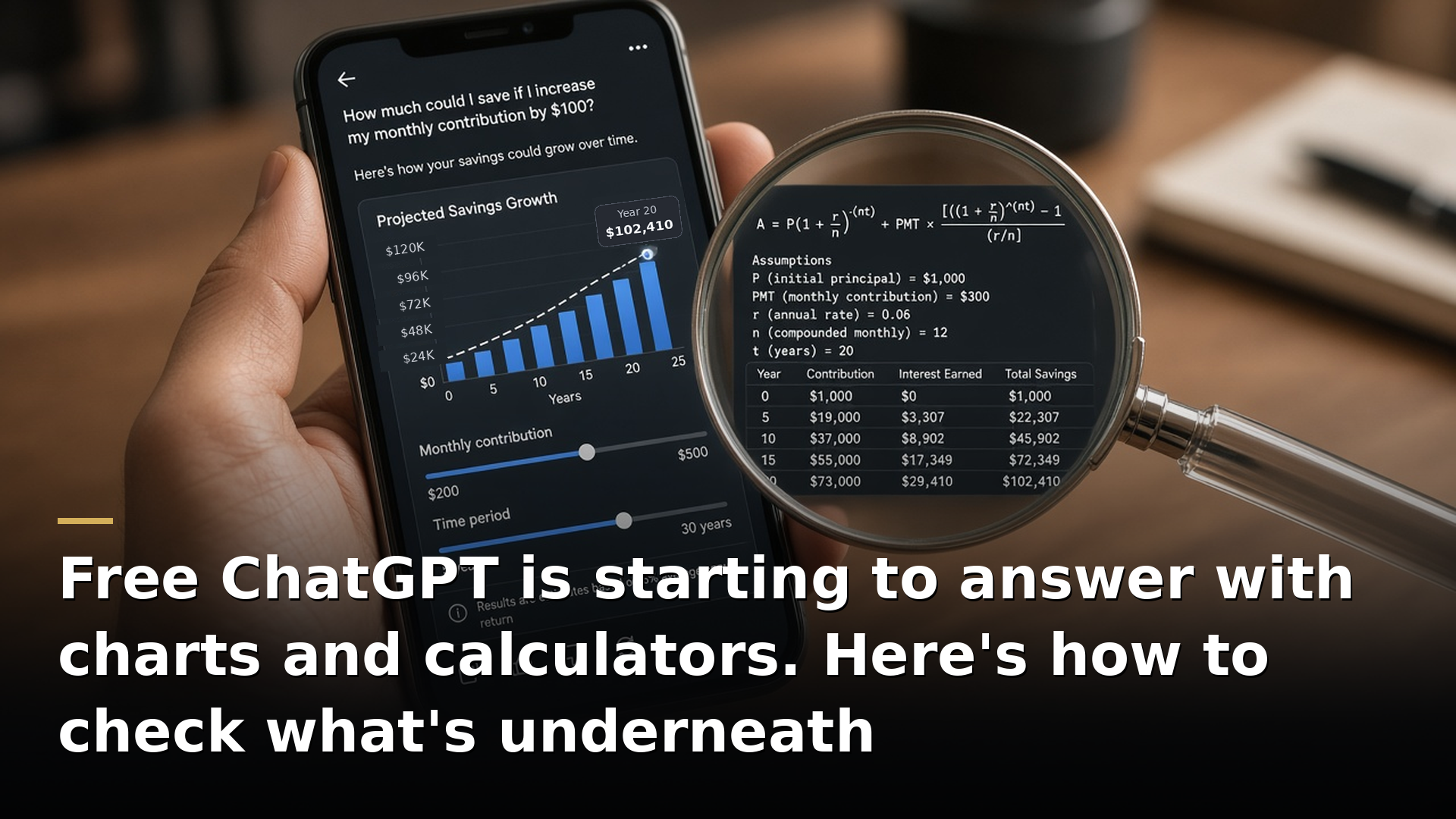
Starting today, Oct. 8, OpenAI says free ChatGPT users will begin getting GPT-6, which can answer with charts, maps, forms and small calculators built on the spot. Those tools look like proof, but they are only a presentation, so here is how to check the numbers underneath and how to turn the visuals down.
What changed. On Oct. 7, OpenAI said GPT-6 with "Intelligent UI" (UI is short for user interface: the buttons, sliders and screens you tap) began rolling out to paid ChatGPT plans that day. Starting Oct. 8, the rollout expands to the Free and Go plans. Paid plans get a version called GPT-6 Sol. Free and Go users get GPT-6 Luna. OpenAI says more than 1.2 billion people use ChatGPT every week.
It may not reach you today. The rollout is gradual. As of Thursday morning, OpenAI's help center still described Free and Go users as getting an older model, GPT-5.6 Luna, so your account may look the same for a while. On a phone, you will need the latest version of the ChatGPT app.
What it looks like. OpenAI's own examples are everyday ones: road-trip stops on a map, the timing for a Sunday roast next to the recipe, a bill splitter for dinner with friends, and a calculator "to explore how savings could grow." Ask how a seven-speed bike works and you may get a drawing you can tap, part by part. When plain text is the most useful answer, OpenAI says ChatGPT can still give you that.
How it's built. OpenAI says it made a library of ready-made building blocks, plus a system that puts them together while the answer is still being written, so the answer appears piece by piece. It trained GPT-6 to choose a layout and to decide when text alone is enough.
The catch, in OpenAI's own words. "There's still work ahead to improve the model's design judgment and expand what it can create," the company writes. Keep that line in mind. The polish comes from a design kit. The numbers inside come from the same artificial intelligence (AI) model that can get a plain paragraph wrong. A good-looking calculator is like a neatly printed receipt: the font tells you nothing about whether the total is right.
Three habits for checking what's underneath:
- Ask for the recipe. Have ChatGPT state, in plain words, the formula and the assumptions behind any tool it builds: the interest rate, the tax rate, the time period.
- Test it on something you know. Before you trust a bill splitter, split $100 four ways. If the easy case is wrong, the hard case can't be trusted either.
- Go to the source for big decisions. For money, health or legal questions, check the numbers against an official source or a person whose job it is to know.
You can turn it down, but not fully off. OpenAI's help center says ChatGPT on the web has a setting called Layout and visuals. Turn it off in Settings to reduce visual elements. It works like a dimmer, not a switch: OpenAI says some visual elements may still appear and the setting "does not switch the entire answer experience to a classic or text-only mode." The help center also says the older ChatGPT desktop apps for Mac and Windows don't support the new answers, and points people to the web instead.
Ink, not pencil: the free rollout starts Oct. 8 and is gradual. OpenAI's speed and quality claims, such as GPT-6 Instant starting to answer web-search questions 44% sooner on average than GPT-5.6 Instant, come from its own internal tests and have not been checked by outside testers. OpenAI also says this release covers the Chat part of ChatGPT only. The models behind its Work and Codex tools are not changing.
Why regular people should care
Looking official is not the same as being right. We have learned to trust things that look like apps, because the apps in our lives (banking, maps, weather) are usually built and checked by teams of people. An AI answer can now look like one of those apps in seconds, without that checking. For free users, this may be the first time ChatGPT hands them a tool instead of a paragraph. The fix is a small habit: treat every chart and calculator as a first draft you check, not a final answer you sign.
What's next
What to watch. How quickly free accounts actually switch over. Whether free users get the same building blocks as paying ones. And whether outside reviewers test the math inside these mini tools, not just their looks. OpenAI frames the bigger goal this way: "Instead of people adapting to software, software will adapt to people." That's a promising idea, as long as people keep checking the software's work.