
By Jordan Vale
Imagine hiring a very sharp personal assistant who sits in your kitchen and reads every letter that arrives — including the ones your friends never meant for a stranger. That is the everyday trust problem behind OpenAI's new always-on assistants, called Dots.
What Dots are meant to do
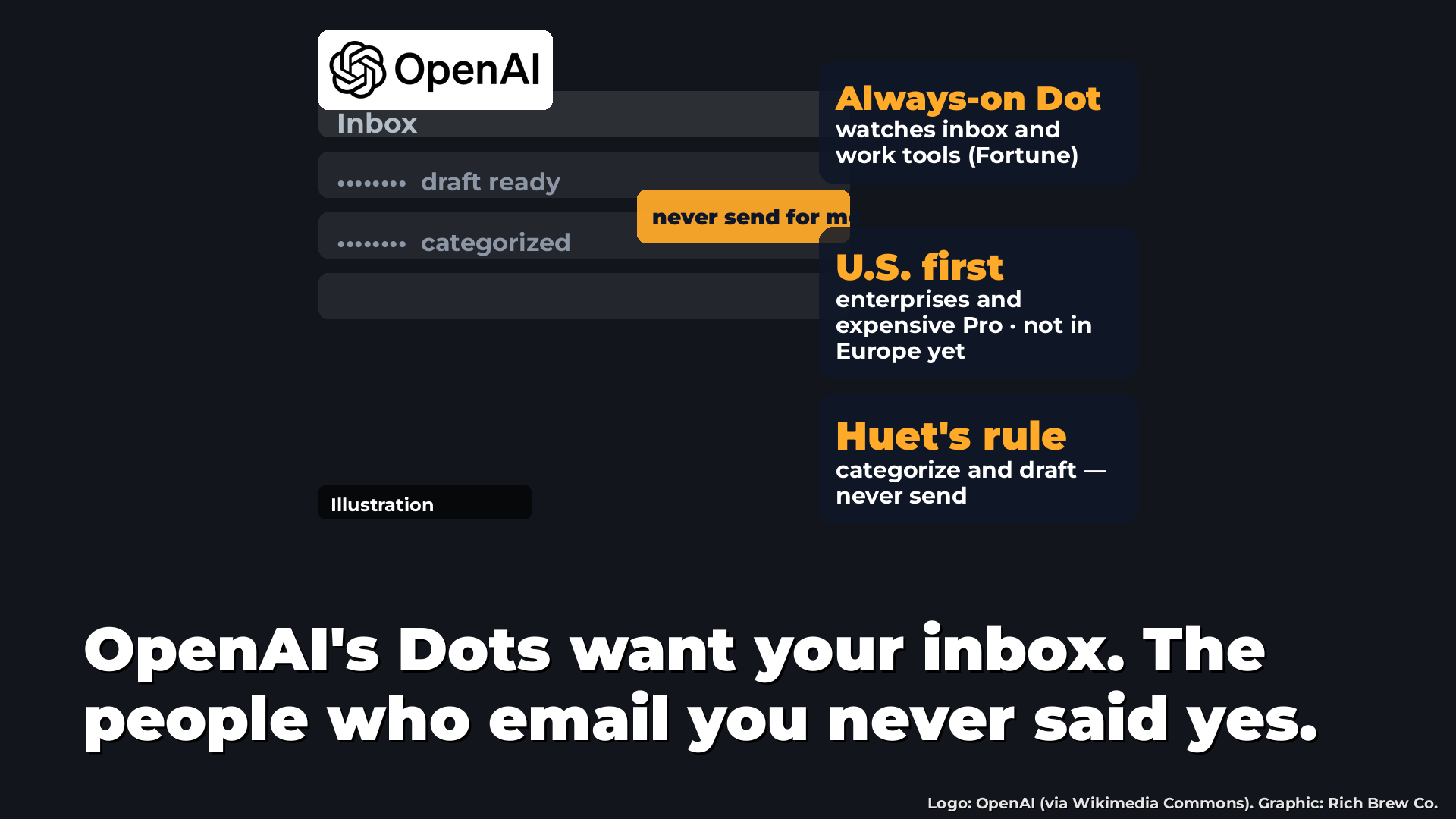
According to Fortune's Eye on AI newsletter by Beatrice Nolan (November 5), OpenAI pitched Dots at a London Dev Day roadshow as a proactive helper. Unlike coding tools that wait for instructions, a Dot is meant to learn your goals, watch your inbox and work tools, and start tasks before you ask.
Fortune says OpenAI first announced Dots at its San Francisco Dev Day about a month earlier. The company is rolling them out first to U.S. enterprises and its most expensive Pro subscribers. Dots are not available in Europe yet, Fortune reports, while OpenAI talks with European regulators.
Romain Huet, OpenAI's head of developer experience, told Fortune the company wants to "nail the enterprise and pro use case first." Fortune notes the crowded field already includes Meta's Muse, xAI's Grok Bot and Anthropic's Duet.
The price of compute — and of privacy
These agents are expensive to run. Fortune cites OpenAI's Adam Fry saying Dots are "on the compute-heavy side," and says some Dot tasks go to a smaller Terra model (described in Fortune as a GPT-6.1 model) instead of the larger GPT-6 Astra. Huet told Fortune that Terra can perform better than Astra in some areas, such as computer use and writing, at "a tenth of the price."
Cost is not the only catch. Signal president Meredith Whittaker has warned that personal agents need deep access to your data — and that they can log contact lists and conversations of people who never consented. Fortune quotes her Masters of Scale Summit remarks about Muse: if you install it and someone is in your contacts, the agent may now have their information. She flagged that risk for human-rights workers trying to communicate safely.
The people who email or message you never agreed to have an AI read what they send. That is Whittaker's core consent point, as Fortune reports it.
A hopeful rule you can use today
Huet's own advice, per Fortune, is to build trust slowly: connect a calendar first, then Slack, then Gmail. He also keeps a hard personal limit.
"I personally said to my dot: I would love for you to categorize my email all the time. I would like for you to prep, possibly, what my answer might be, but don't send any emails on my behalf ever, and don't send any Slack messages on my behalf ever," he told Fortune. "I want to do that myself."
Fortune says OpenAI leadership told a later Q&A that users can already see what their Dot accesses, and that the company is thinking about easier ways to pick which connections a Dot can use.
Ink, not pencil: Fortune reports that Dots need deep tool access to help you, that people who message you never opted in, and that Huet's own rule is categorize and draft — never send.
Why regular people should care
Always-on agents will show up in offices and homes the way email did: useful, sticky, and easy to over-trust. Before you connect your mail, ask three plain questions: what did I connect, who can this agent message, and can I see the log? Your friends and clients did not sign up for your AI.
What's next
Watch whether OpenAI ships clearer connection pickers, and whether European access arrives after regulator talks. Until then, treat "connect everything" as a choice, not a default.