
By Jordan Vale
Asking your phone to find dinner is one thing. Letting it place the order is another. A new report suggests Siri is moving toward that second role, making permission to act as important as the answer it gives.
For a parent arranging dinner after work, that could save several taps. It is like asking someone to write a shopping list versus handing them permission to buy it: the convenience grows, but so does the importance of clear limits.
A reported roadmap, not an announcement
The Verge’s November 8 report, by Terrence O’Brien, summarizes reporting from Bloomberg’s Mark Gurman. This is a report, not an Apple announcement.
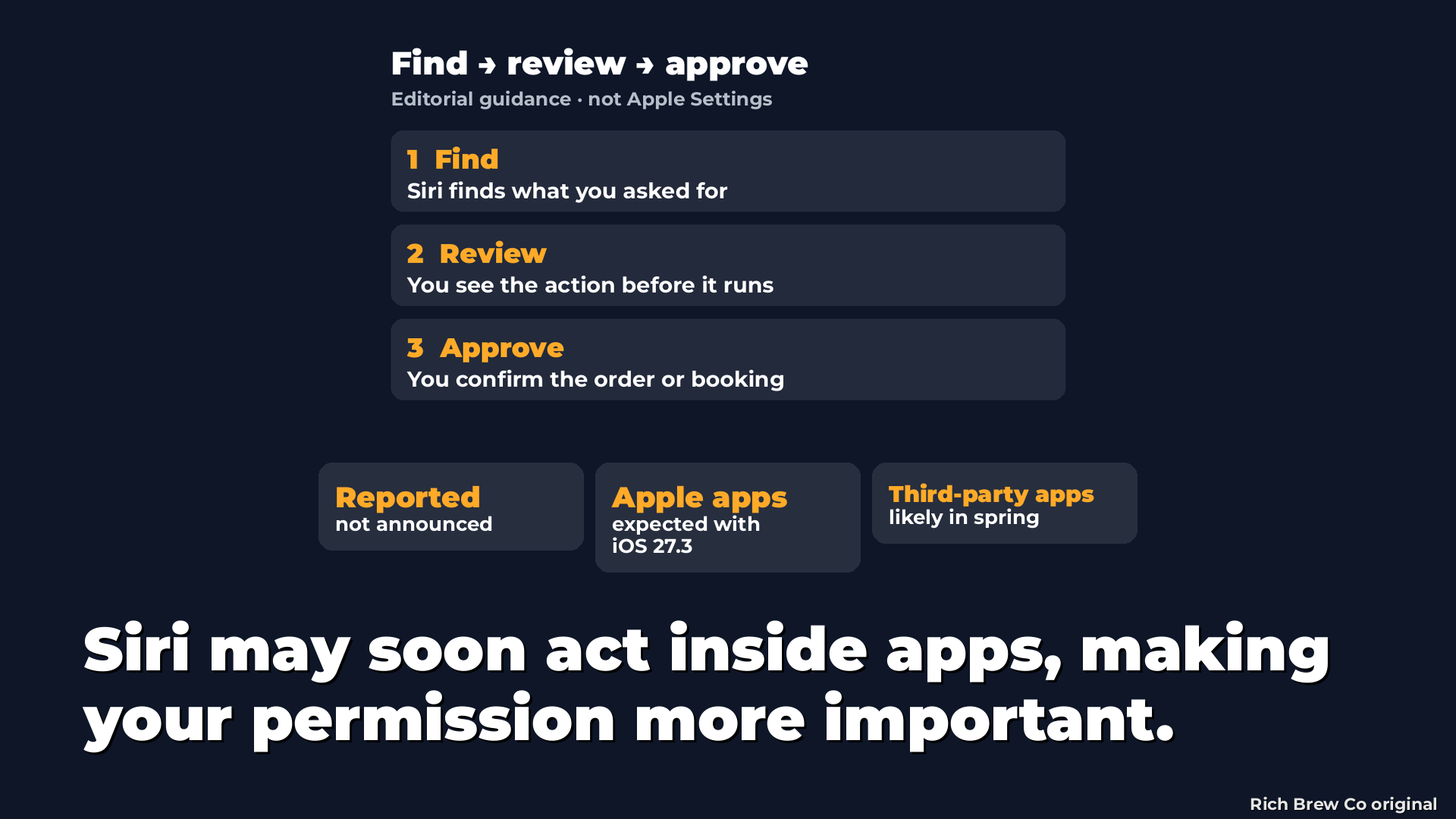
Two improvements are expected. Finer control of Apple’s own apps is expected with iOS 27.3. Examples include rotating and cropping images in Photos and organizing Safari tabs.
Integration with third-party apps is likely to arrive later, in spring, according to Gurman as reported by The Verge. Examples include placing an order through Grubhub or booking a dinner reservation through OpenTable. Those examples describe expected abilities, not services Apple has confirmed as available today.
The longer-term direction is an artificial intelligence (AI) assistant that keeps pursuing a goal, rather than waiting for a separate instruction at every step. Gurman says, “I believe the company could make Siri more like an agent as early as next year,” in the passage quoted by The Verge. That remains his assessment, not a guaranteed delivery date.
Permission is the everyday story
The useful distinction is between access and approval. Permission to work inside an app need not mean permission to finalize every purchase or booking.
Before relying on such features, readers should look for clear explanations of what Siri can read, what it can change and which actions require confirmation. For an order, that means checking the items, delivery details and total before agreeing.
Those are expectations for trustworthy design, not descriptions of an Apple permission screen. The report does not establish the exact settings or approval flow.
Ink, not pencil: The app-control timeline is reported and hedged; the permission experience still needs to be shown.
Why regular people should care
A useful assistant should reduce effort without making consent harder to understand. Clear boundaries could help people enjoy the convenience while staying in charge of commitments made in their name.
What's next
Watch for Apple’s own feature details and demonstrations. The practical milestone is not just Siri doing more, but showing where it pauses for your approval.