
By Lena Hart
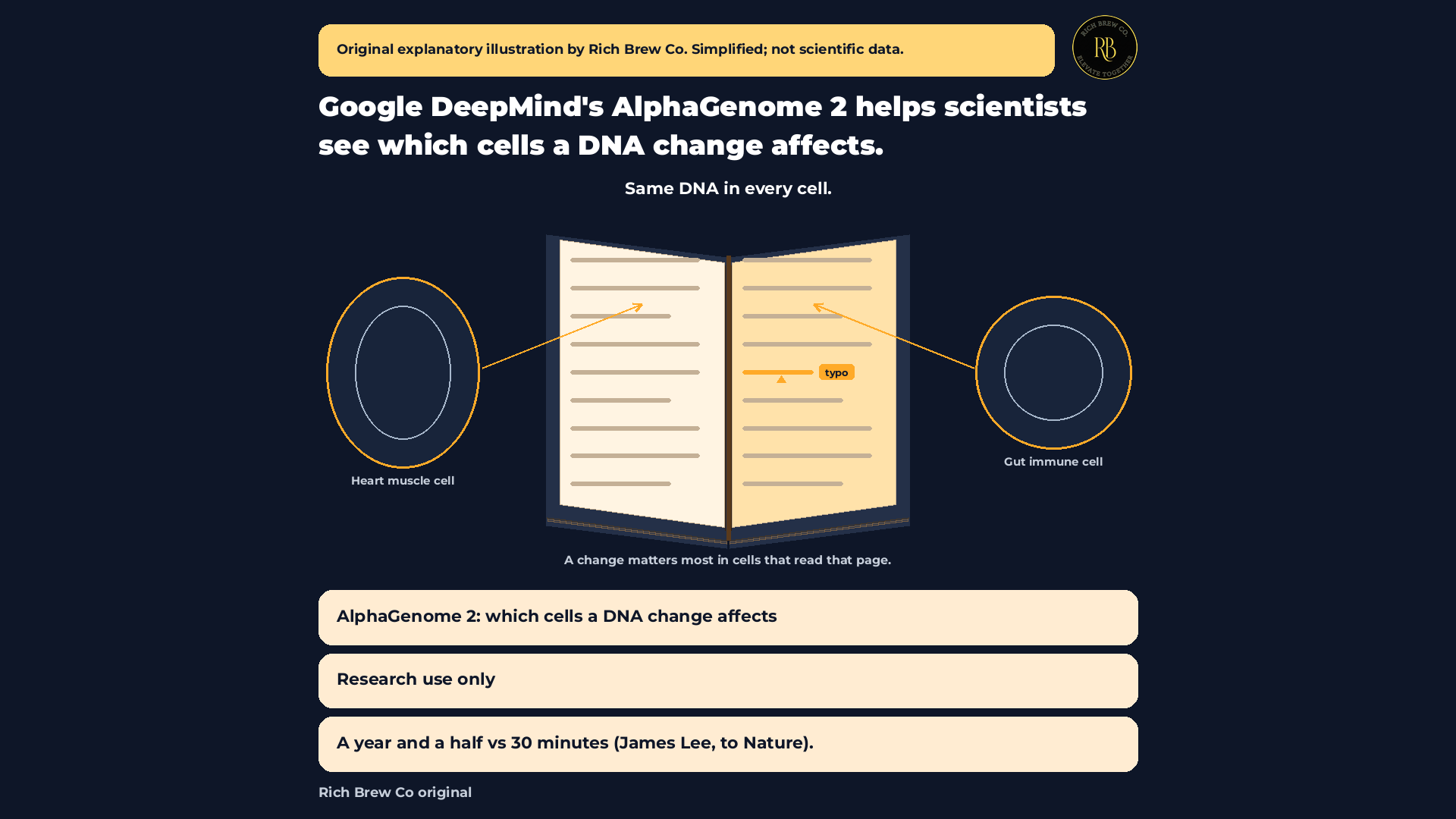
Image: Original Rich Brew Co illustration. Simplified; not scientific data.
In 2024, a team of scientists in London tracked down a hidden driver of inflammatory bowel disease (IBD), a long-lasting condition that inflames the gut. It took gene editing, careful lab work and many months. This week, an artificial intelligence (AI) model pointed to the same driver from the DNA (deoxyribonucleic acid) sequence, without new lab experiments.
“They’ve managed to figure out the answer in 30 minutes, and it took us a year and a half of experiments,” James Lee, the immunologist and geneticist at the Francis Crick Institute in London who led the 2024 study, told Nature. “It’s reassuring from our perspective.”
The model is AlphaGenome 2, which Google DeepMind announced on November 11. It does not treat anyone. What it offers is something researchers badly need: a faster way to narrow down which tiny DNA changes matter, and in which cells, before they spend months in the lab.
Same DNA book, different pages
Every cell in your body carries the same DNA. Yet a heart muscle cell and an immune cell do very different jobs. The difference is which genes each cell switches on or off.
Think of your DNA as one big book that every cell owns a copy of. A heart cell reads some pages. A gut immune cell reads others. A small typo might not matter on a page a cell never opens, but it can matter a lot on a page that cell reads every day.
That is why so many disease clues are hard to follow. According to Nature, 98% of the human genome is "non-coding" DNA, which does not hold the instructions for making proteins. Much of it acts like switches and dimmers that control other genes. These stretches are among the hardest parts of the genome to understand, and a change in one may only matter in one type of cell.
What is new in AlphaGenome 2
The first AlphaGenome model, released last year, predicted how DNA changes affect activity across broad tissues, like an average across all the cells in a sample. AlphaGenome 2 zooms in to individual cell types and cell states, such as an immune cell that is fighting an infection versus one at rest.
It learned from a very large amount of cell data. DeepMind trained the model on bulk and single-cell data from human and mouse samples. Its announcement describes more than 100 million individual cell profiles across 68 tissues, and also gives a figure of over 107 million cell profiles. DeepMind's research paper, a preprint that has not yet been through a journal's formal review, is more specific: the last training stage used single cells taken from 107 million human profiles. Nature reports the model was trained on 637 human and 311 mouse cell types.
It reads one cell type at a time. DeepMind redesigned the model so that, along with a stretch of DNA about a million letters long, it is told which tissue, cell type or cell state to focus on. That helps it learn how the same stretch of DNA is read differently in different cells.
It can handle new cell types without starting over. DeepMind says researchers can upload gene activity data from as few as a few dozen cells, for example from a disease or after a vaccine, and the model can make predictions for that new state without being retrained.
It fills in missing measurements. If a scientist has measured one thing in a cell, the model can predict some other properties that were not measured. DeepMind says this can help researchers decide which experiments to run next. It also now predicts DNA methylation, a type of chemical tag on DNA.
How it did in DeepMind's tests
The gut disease example. The 2024 study, published in Nature by Lee's team, found that a DNA variant in a "gene desert," a region far from any protein-making gene, raises disease risk by turning up a gene called ETS2 in immune cells called macrophages. Macrophages are cells that swallow germs and help drive inflammation.
DeepMind tested whether AlphaGenome 2 could find the same thing. In DeepMind's research paper, the team scored seven candidate variants in that region across immune cell types from the gut. The model predicted a strong effect for only one of them, the same variant the lab team identified. It linked that variant to ETS2, even though the gene sits about 290,000 DNA letters away, and it placed the effect in monocytes and macrophages. Nature describes this as replicating "aspects" of the 2024 finding.
A larger immune-cell test. DeepMind also tested the model on TenK10K, a large study that mapped how DNA variants affect gene activity in 28 types of blood immune cells. In its own evaluation, when the model had to be right at least nine times out of ten, AlphaGenome 2 picked out 30% of known causal variants, compared with 16% for a version of the original AlphaGenome tuned on single-cell data. For predicting whether a variant turns a gene up or down, the figures were 43% versus 23%. That is roughly twice as many useful hits, by DeepMind's measure.
A vaccine example. Using data from a COVID-19 (coronavirus disease 2019) vaccine study that the model had not seen before, DeepMind says AlphaGenome 2 could tell vaccine-activated immune T cells from resting ones. It also found that a variant linked to severe COVID-19 disrupts gene activity more strongly in the activated cells.
Ink, not pencil: AlphaGenome 2 matched a known lab discovery about a gut disease from DNA sequence alone, but it is a research tool that suggests where to look, not a test or a treatment.
What it could mean for research
Big genetic studies often find a stretch of DNA linked to a disease, but not the exact variant, gene or cell type behind it. That leaves researchers with many possible leads and limited time and money to test them.
To help, DeepMind says it has already run predictions for trait-linked variants, for conditions ranging from height to type 2 diabetes, across hundreds of human cell and tissue conditions. Researchers can download these instead of running large computer jobs themselves.
Outside groups are interested. Sarah Teichmann, co-founder of the Human Cell Atlas consortium and a professor at the University of Cambridge, said in DeepMind's announcement, “What makes AlphaGenome 2 exciting is how it adapts directly to new single-cell data without retraining.” Peter Donnelly, chief executive of Genomics Limited, said in the same announcement, “We look forward to incorporating it in our Mystra platform.”
Who can use it, and the limits
- Free for non-commercial research. DeepMind says AlphaGenome 2 is available now for non-commercial research through the AlphaGenome API (application programming interface), a way for researchers' software to send it questions. The project's code page says the API is free of charge for non-commercial use.
- Commercial research is in private preview. That is how DeepMind describes access for companies right now.
- The model weights are not public yet. DeepMind's paper says the model source code and weights will be provided upon final publication.
- Research only. DeepMind says AlphaGenome and AlphaGenome 2 are intended for research use only and have not been validated or approved for clinical or diagnostic purposes.
- The results come from DeepMind. The benchmark figures are from DeepMind's own evaluation, described in a preprint, a paper that has not yet been through a journal's formal review. Matching a known discovery is encouraging, but it is not the same as making a new one.
A plain health note: this tool cannot read your DNA test or tell you anything about your own health or risk. If you have questions about a genetic result or a gut condition, talk to your doctor or a genetic counsellor.
Why regular people should care
Many common conditions, from inflammatory gut diseases to type 2 diabetes, are shaped partly by small DNA differences that are hard to trace. Finding which change matters, in which cell, has often taken years. Tools like AlphaGenome 2 could help researchers cut down the list of suspects faster, so lab time and funding go to the most promising leads.
That does not mean new treatments next month. It does mean the slow first step of genetic research, working out where to look, may be getting quicker. As James Lee put it, the result was “reassuring.” That is a hopeful sign for science that starts with a model and ends in the lab.
What's next
- Independent testing: watch for outside researchers to use the model and report whether its predictions hold up in their own experiments.
- Journal publication: DeepMind says it will release the model code and weights when the work is formally published.
- Commercial access: commercial research use is in private preview for now.
- New tools: DeepMind says it will "soon" release AlphaGenome 2 Skills in Google Antigravity, its platform for AI agents that help with research work.