
By Lena Hart
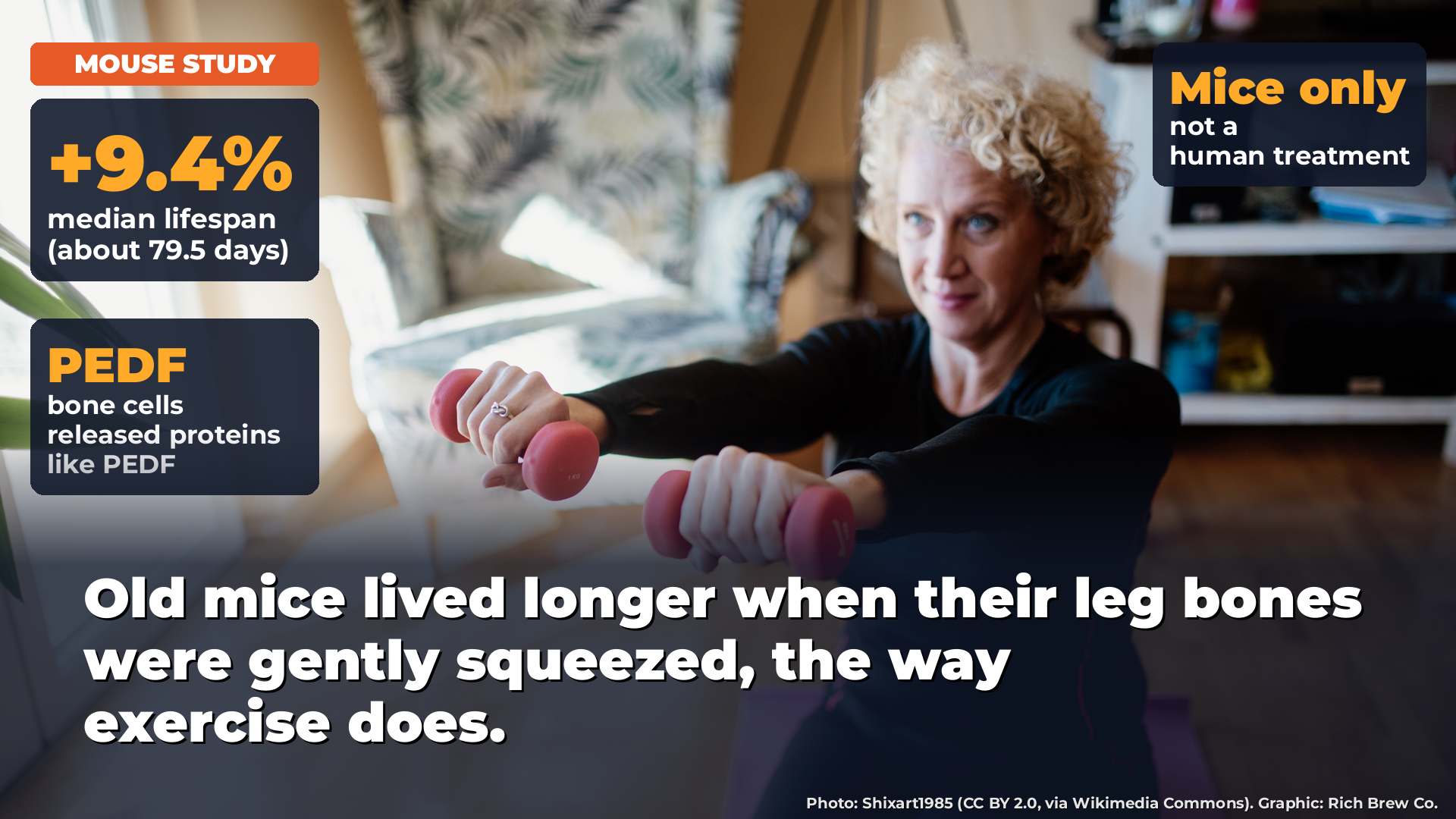
We all know someone in their eighties who still carries the groceries, climbs the stairs and walks everywhere. Research has long linked staying active with ageing well, but nobody fully knows why. A new study in old mice points to a surprising helper: the bones themselves. When scientists gently squeezed the leg bones of elderly mice, the way movement does, the mice stayed stronger and sharper and lived longer.
What the researchers did
The study appeared in the journal Cell Metabolism in late October. The team was led by bone biologist Xiaochun Bai at Southern Medical University in China. Science magazine reported on it on October 30.
The researchers started with mice 20 months old, which is senior-citizen age for a mouse. Twice a week for four months, until the mice were 24 months old, a machine gently pressed on both ends of the mice's leg bones. This kind of squeeze is called dynamic tibial axial loading (DTAL). It copies the push and pull that bones feel when we walk, run or lift.
What they found
- Longer lives. The loaded mice's median lifespan rose by 9.4%, or about 79.5 days, the paper says. (The median is the middle value: half the mice in a group lived longer than it, half shorter.) Science describes the gain as nearly three months and calls it "the equivalent of about nine human years." That is a rough comparison, not a measured human result.
- Healthier, too. Both male and female mice had stronger bones, faster reflexes, sharper memory and younger-looking organs than mice that were not loaded, Science reports.
- The bones send messages. Bone cells called osteocytes sense force. When they feel it, they appear to release proteins into the blood that slow ageing in other organs. One protein, PEDF (pigment epithelium-derived factor), gave similar benefits when injected into old mice.
- The flip side. When the team switched off a force-sensing gene in the bone cells of middle-aged mice, those mice aged faster and died, on average, 105.5 days earlier.
Think of bones like a building's smoke detectors. They are not just walls holding things up. They sense what is happening and send signals to the rest of the house.
"Bone is not just a passive scaffold; it is an active, mechanically responsive organ that helps set the pace of aging throughout the body," Bai told Science.
The human side
Outside experts were hopeful and careful. An earlier mouse study found that running on a wheel slowed ageing but did not extend life, Science notes. Mei Wan, an orthopaedic surgery researcher at Johns Hopkins University who was not part of the study, said the new results suggest exercises that put load on the bones, "such as weightlifting and resistance training, may provide additional antiaging benefits."
Bai's team has started looking at PEDF in people. They found it at lower levels in older people and in people with osteoporosis, a disease that makes bones weak.
Ink, not pencil: this is a mouse study. It is "an intriguing proof of concept in mice," not "a demonstration of a new antiaging treatment for people," said Sundeep Khosla, an endocrinologist at the Mayo Clinic who was not involved. Wan says future studies need to show whether this is safe and works in humans, especially older adults.
Why regular people should care
There is nothing to buy here, and PEDF is not a treatment. But the study adds a possible reason why movement that puts gentle weight on our bones, like walking, climbing stairs or lifting, may matter as we age. It is a good nudge to keep moving, in ways that feel safe for you. This is not medical advice; talk with your doctor before starting a new exercise plan.
What's next
The researchers want to learn more about PEDF and the other bone proteins. The big questions are whether bone loading helps people live healthier, and whether those proteins could one day help people who cannot exercise easily, which the authors say is a possible future use. Those answers will take human studies, and years.