
By Lena Hart
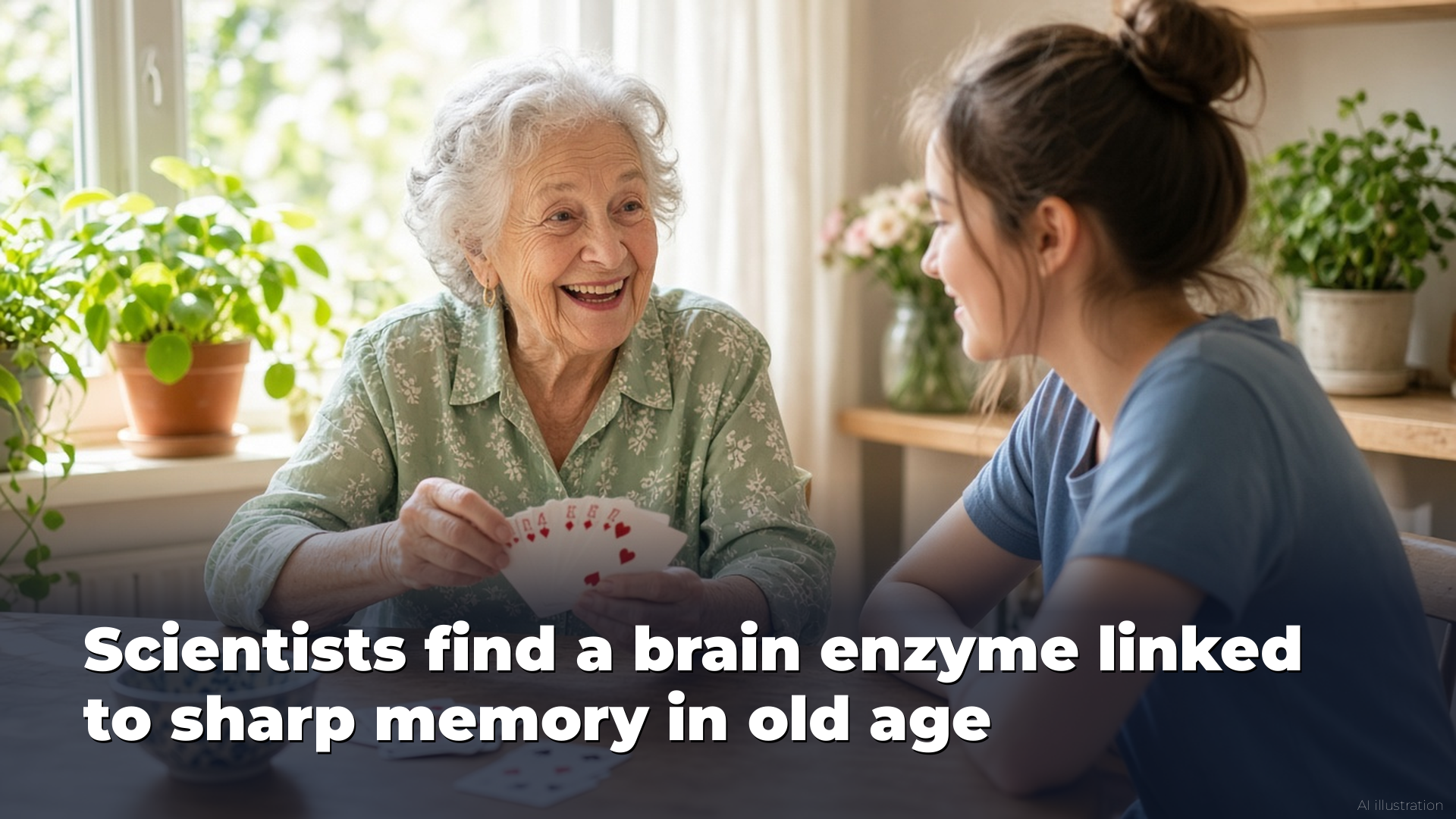
Some people reach their 80s still quick with names, dates and crossword clues, even when their brains show the kind of changes linked to Alzheimer's disease. Scientists have long wondered why. A new study points to one possible helper the brain makes on its own.
Picture two grandmothers of the same age. Under a microscope, their brains might look alike. Yet one forgets her grandchildren's birthdays while the other still beats them at cards. Scientists call that second kind of luck "cognitive resilience": keeping your thinking skills despite changes in the brain.
The news. On October 15, researchers led by Amar Sahay at Massachusetts General Hospital in Boston published the study in the journal Nature Neuroscience. The journal Nature covered it in a news story on October 16.
What the scientists found
An enzyme that rises with age. The team found an enzyme called PLA2G2F. It is a phospholipase, which means it breaks down certain fats. In mice, it is barely found in the adult brain, but its levels slowly rise with age in the hippocampus, the brain's memory centre.
Take it away, and memory slips. When the scientists removed the enzyme from the memory cells of middle-aged mice, the animals' brains showed more inflammation and lost connections between nerve cells. Those mice also did worse on a memory test, which asked them to notice when an object had been moved.
Add more, and memory holds. When the team boosted the enzyme in older mice, inflammation dropped, nerve cells stayed better connected, and the animals passed the same memory test. Older mice without the boost did not.
It seems to help clean up fat. The enzyme appears to help the brain manage fat. In lab dishes, the team made human brain cells grown from stem cells produce extra enzyme. Fluid from those cells cut the build-up of fat droplets in human immune cells of the brain.
The human link
Rising with age in people too. In large sets of human brain data, activity of the same gene also rose with age.
Highest in the "resilient." The team also looked at brain tissue from donors who had taken thinking tests before they died. Activity of the gene was highest in people whose thinking stayed intact even though their brains had amyloid-beta deposits. Amyloid-beta is a sticky protein that builds up in the brain in Alzheimer's disease.
An outside view. "This is a fantastic, very thoughtful approach to get at what could be protecting neurons," Timothy Hohman of the Vanderbilt Memory & Alzheimer's Center, who was not involved, told Nature.
Ink, not pencil: most of this work is in mice, and the human brain-donor data came from only 13 people, so this is an early clue, not a treatment.
Why regular people should care
Think of the enzyme as a cleaning crew that clocks in more often as the house gets older. The hopeful idea is that the brain already has its own ways to protect memory, and that some people's work harder or for longer. If scientists can learn how to support that crew, it could one day help more people keep their memories longer. The authors say boosting the enzyme "may offer a novel therapeutic strategy." For now, it adds to the picture of why two people with similar brain changes can age so differently.
What's next
More people, more proof. The authors say larger human samples are needed to firmly link the enzyme to how well people think as they age. Any treatment would have to be tested for safety in people first, which takes years. Until then, this is a reason for hope, not something to buy or take.