
By Lena Hart
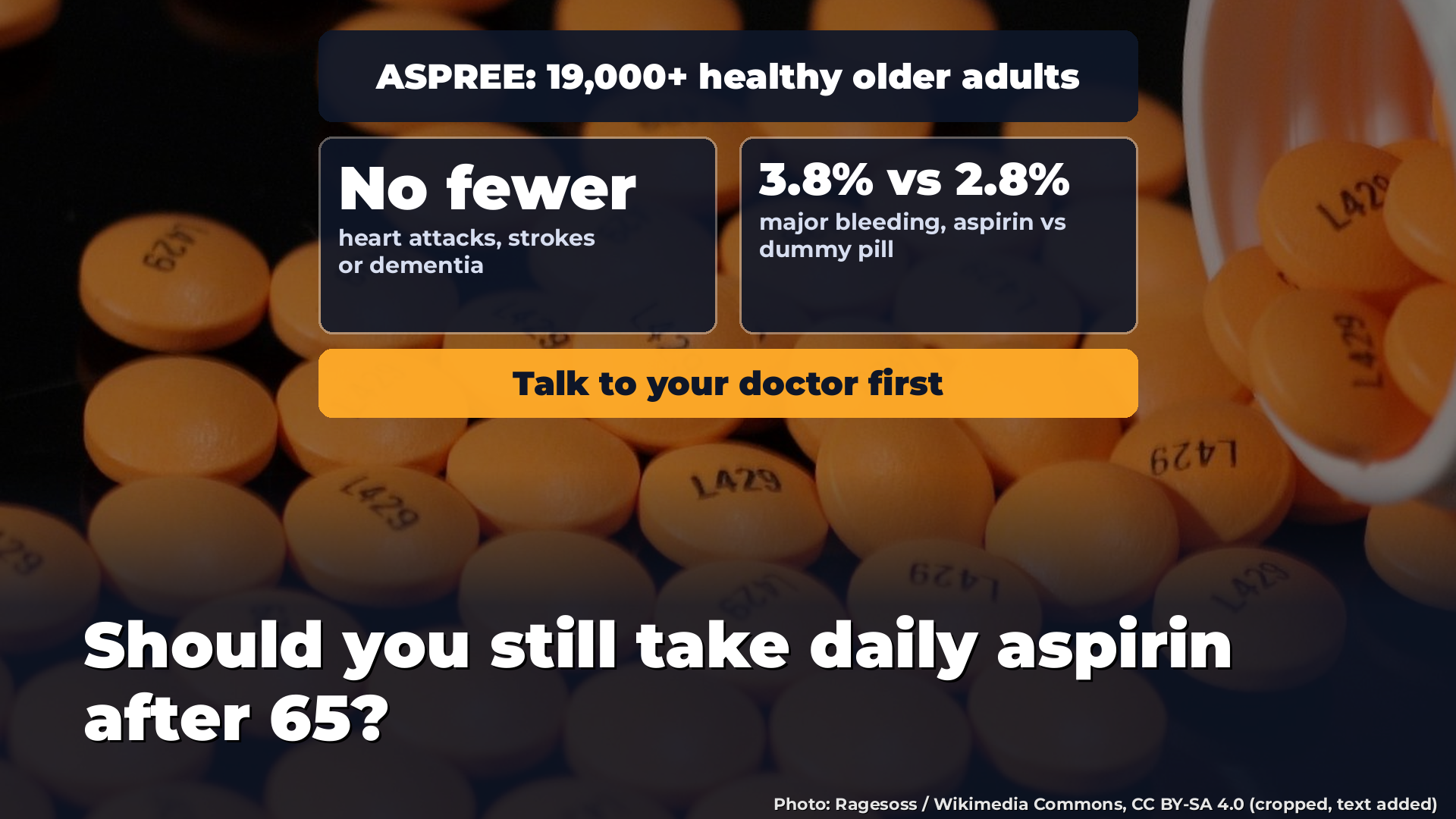
Photo: Ragesoss / Wikimedia Commons, CC BY-SA 4.0 (cropped, text added).

For years, "an aspirin a day" sounded like the easiest healthy habit there was: a tiny, cheap pill to keep the heart doctor away. If you or a parent take one, you may wonder if it still makes sense. Big studies have now given clearer answers about who it helps and who it may not.
First, the most important line: this article is not medical advice. Do not start or stop aspirin on your own. If you take it, especially after a heart attack, a stroke or a heart procedure, it may be doing important work. Talk to your doctor.
Why aspirin was ever a heart pill
Most heart attacks and many strokes happen when a blood clot blocks a blood vessel. Aspirin makes the blood a little less "sticky", so clots form less easily. For people who have already had a heart attack or stroke, studies show it can help prevent another one, the US National Institutes of Health (NIH) explains.
The open question was healthy people. Does a daily aspirin help them too?
The big trial: ASPREE
To find out, researchers ran the ASPREE trial (Aspirin in Reducing Events in the Elderly), led from Monash University in Australia and supported in part by the NIH's National Institute on Aging (NIA). It enrolled more than 19,000 people in Australia and the US, mostly aged 70 and older (65 and older for Black and Hispanic participants in the US). None had heart disease, dementia or a physical disability when they joined.
Half took 100 mg of aspirin a day; half took a dummy pill. They were followed for about 4.7 years. The first results were published in 2018 in the New England Journal of Medicine. According to the NIH's summary:
- No clear benefit: rates of heart attacks, strokes, disability and dementia were about the same in both groups.
- More serious bleeding: 3.8% of people on aspirin had major bleeding, such as in the stomach or brain, compared with 2.8% on the dummy pill.
- An unexpected signal: slightly more people on aspirin died (5.9% compared with 5.2%), mainly from cancer. The NIH said this needs more study, because earlier trials had not seen it.
What the guidelines now say
In 2022, the US Preventive Services Task Force (USPSTF), an independent expert panel, recommended against starting low-dose aspirin to prevent a first heart attack or stroke in adults aged 60 or older. The reason: the risk of bleeding grows with age and cancels out the small benefit.
Two details matter. This advice is about people without heart disease. And the panel says people already taking aspirin should not stop without talking to their clinician.
The newest piece: staying strong and sharp
On October 29, the journal GeroScience published a new analysis of 18,581 of the same ASPREE volunteers, led by researchers at Monash University. They built a yearly score from four everyday abilities: walking speed, grip strength, memory and thinking, and mood.
- Aspirin did not slow the normal, gradual decline in these abilities.
- In women, aspirin went with a small extra decline, which the authors say equals about one to two months of ageing. In men, there was no effect.
- The hopeful part: people with the highest scores at the start were far more likely to stay alive and free of dementia and disability during the trial. These everyday abilities really do track healthy years.
Ink, not pencil: this was a second look at old trial data, not the trial's main question, and most volunteers were white Australians. The difference between women and men was also not clear-cut in the overall statistics. So treat the finding for women as a question for researchers, not a reason to change anything on your own.
The human side
Picture a 72-year-old who started a daily aspirin years ago because a friend did. She feels fine. Should she keep going? It depends on her heart risk, bleeding risk and other medicines, which is exactly what her doctor can help weigh.
Why regular people should care
It is a little like wearing a raincoat on a sunny day: for most healthy older people, the trials suggest it adds little and can get in the way. The good news is that staying well for longer does not hang on one pill. The abilities in that new score, such as walking, strength, memory and mood, are worth talking about with your doctor too. Good questions to bring: "Why am I taking aspirin?" and "Is it still right for me?"
What's next
The ASPREE researchers are still studying their volunteers and publishing new findings. Until the advice changes, the simplest rule holds: talk to your doctor before you start or stop.