
By Lena Hart
Every day, the DNA inside your cells gets nicked and broken, and every day your cells quietly fix most of it. As we age, that repair crew slows down. A new study from Portugal shows that an experimental molecule can help the repair crew work better, and that mice with a rare rapid-ageing disease lived longer and healthier when they got it.
What the researchers did
The study was published in the open-access journal Nature Communications on November 1. It was led by Joana C. Macedo and Elsa Logarinho at i3S (Instituto de Investigação e Inovação em Saúde), a research institute at the University of Porto. Vera Gorbunova and Andrei Seluanov of the University of Rochester in New York also took part.
The team focused on KIF2C, a protein that helps repair DNA. They had found earlier that it is turned down in aged cells. So they used a small molecule called UMK57 to boost it.
They tested it on cells from people with Hutchinson-Gilford progeria syndrome (HGPS), a very rare genetic disease that brings on signs of ageing early in life, and on cells from people with Down syndrome. Both conditions involve lots of DNA damage. Then they gave it to progeria mice, through tiny pumps under the skin.
What they found
- Better repair. UMK57 helped cells fix a serious kind of DNA damage called double-strand breaks, where both sides of the DNA ladder snap.
- Healthier mice. In the progeria mice, it "mitigates aging phenotypes," the authors write, which means it eased signs of ageing. It "extends both health and lifespan," they report.
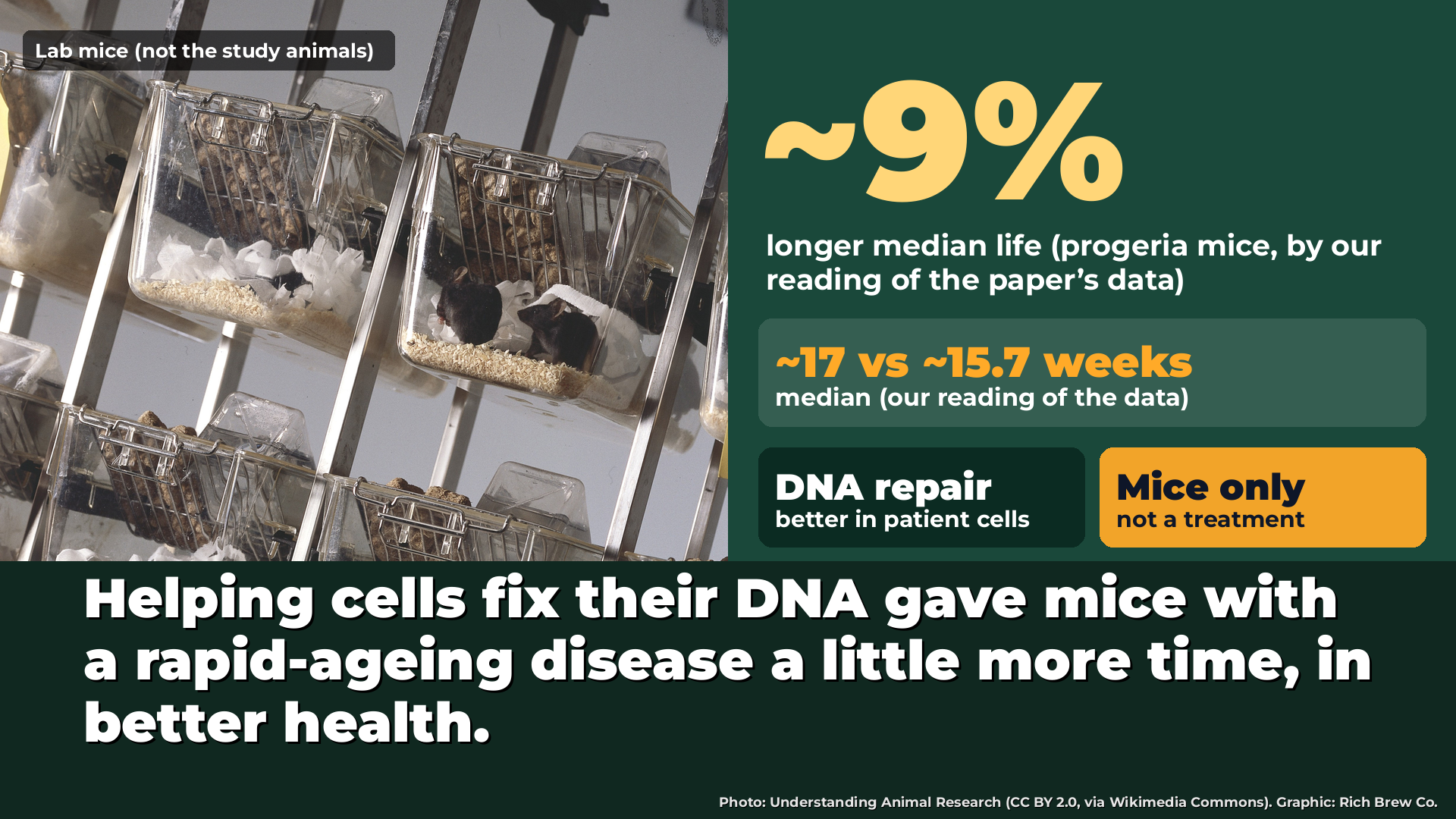
- A modest lifespan gain. By our reading of the paper's published source data, the 16 treated mice lived a median of about 17 weeks, compared with about 15.7 weeks for 14 untreated mice. That is roughly 9% longer, or about nine extra days. (The median is the middle value: half lived longer, half shorter.) The paper's own summary does not give the figure; we worked it out from the authors' data.
Think of DNA repair like a road crew fixing potholes. Ageing is like the crew getting smaller each year. This molecule does not fill the holes itself. It seems to help the crew reach them faster.
The human side
Progeria is rare and hard on families. This study was partly funded by the Progeria Research Foundation and the Jérôme Lejeune Foundation, with support from the Maximon Longevity Prize as well. For families living with these conditions, any new idea worth testing brings a little hope. (The paper also discloses that Logarinho is named as an inventor on a patent for a use of UMK57.)
Ink, not pencil: this is early work in mice with a rare disease, not normal ageing in people. In the journal's published peer-review file, the authors agree UMK57 is a "proof-of-concept" compound and say more chemistry work and safety testing would be needed before any treatment.
Why regular people should care
DNA damage is "a central driver of the aging process," the authors write. This study adds to the idea that helping the body repair itself, not just slowing damage, could one day be a way to age more healthily. There is nothing to buy here, and UMK57 is not a medicine. Be careful with any product that claims to "repair your DNA." This is not medical advice.
What's next
The big questions are whether this approach works in normal ageing, in other animals, and safely over a longer time. Researchers will also need better versions of the molecule. Any test in people would come later, and would take years.