
By Lena Hart
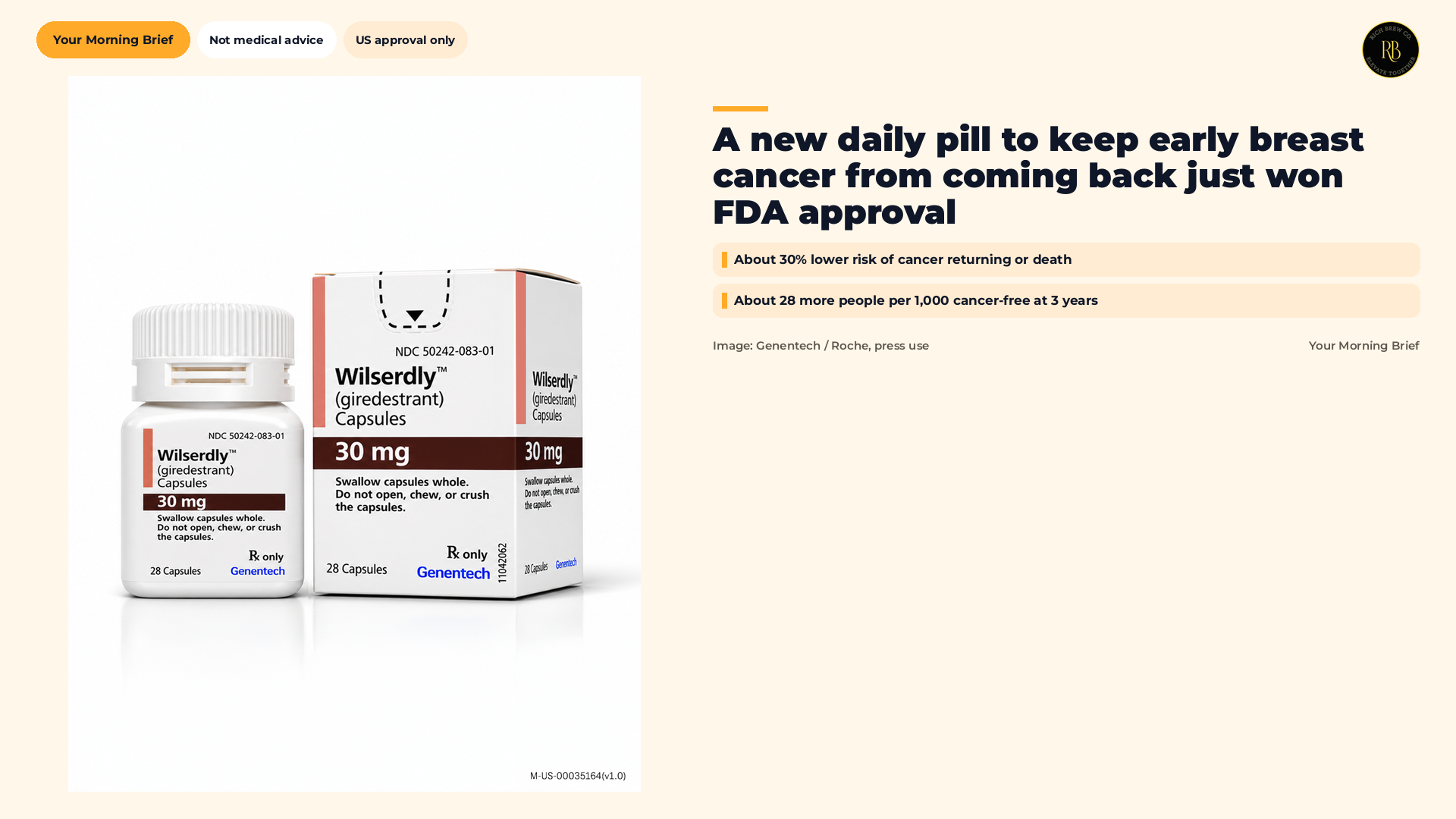
Image: Genentech / Roche, press use. The official Wilserdly (giredestrant) pack shot.
For more than 20 years, people finishing treatment for the most common type of early breast cancer have been offered the same few hormone pills to keep it from coming back. On Nov. 23, 2026, the United States (US) Food and Drug Administration (FDA) approved a new one: Wilserdly (giredestrant), a once-daily pill made by Genentech, part of Roche.
The FDA calls it the first new hormone therapy for early-stage breast cancer in more than 20 years. In a trial of more than 4,000 people, it beat the standard pills at keeping invasive cancer away for three years. It does not yet have proof that people live longer, and that caveat matters.
One trial volunteer's reason
Jeanette Barbosa, a two-time cancer survivor, was one of the trial's volunteers. According to a profile published by UCLA Health, she was diagnosed with thyroid cancer at 33 and, more than 16 years later, found a lump in her breast. Surgery showed the cancer had reached her lymph nodes, and it was restaged as stage 3. Near the end of chemotherapy and radiation, a UCLA Health oncologist suggested the trial.
"I don't want to get cancer again, so I knew this is the route I want to go," she said in the profile. She added: "I didn't just do this for myself. I'm doing it for other women, too, to potentially combat cancer for the rest of our lives." The UCLA article does not say whether she received giredestrant or a standard hormone pill in the trial.
Who the approval covers
This is not a pill for every breast cancer. The FDA approved it on its own for adjuvant treatment, which means treatment given after surgery to lower the chance the cancer returns. It covers adults whose cancer is:
- Estrogen receptor (ER)-positive, meaning estrogen helps fuel its growth.
- Human epidermal growth factor receptor 2 (HER2)-negative, meaning it lacks extra amounts of the HER2 protein.
- Stage I, II or III, and at intermediate to high risk of coming back.
The FDA says about 70 percent of breast cancers in the US are this ER-positive, HER2-negative type.
The dose is 30 milligrams once a day, with or without food, for five years, or until the cancer returns or side effects become too much. The FDA says women who have not gone through menopause should also get a hormone-suppressing medicine alongside it; men may get one too, as their doctor decides.
A separate, earlier approval is not the same thing. On Nov. 16, 2026, the FDA cleared the same drug with another medicine, everolimus, for certain adults with advanced breast cancer carrying a change in the estrogen receptor 1 (ESR1) gene. That approval requires an ESR1 test. Today's early-stage approval does not.
How it works
In ER-positive breast cancer, estrogen latches onto receptor proteins on cancer cells and tells them to grow. Wilserdly blocks that receptor and also breaks it down, the FDA says. Researchers call this kind of drug a selective estrogen receptor degrader (SERD). The older standards, tamoxifen and a group called aromatase inhibitors, block the receptor or lower estrogen instead.
What the trial found
The evidence comes from lidERA (NCT04961996), a Phase 3 trial run by Roche. 4,170 adults were randomly split into two groups: about half took giredestrant, and half took a standard hormone pill (tamoxifen, anastrozole, letrozole or exemestane).
The main goal was invasive disease-free survival (iDFS). In plain words, that means staying alive without invasive breast cancer returning in the breast, spreading elsewhere in the body, or appearing in the other breast.
At three years, 92.4 percent of people on giredestrant were alive and free of invasive breast cancer, compared with 89.6 percent on standard pills. The hazard ratio was 0.70. Put simply, at any point during follow-up, people on the new pill were about 30 percent less likely to have invasive cancer return or to die.
In everyday numbers, the FDA puts it this way: about 28 more people out of every 1,000 were alive and free of invasive breast cancer at three years. That is a modest gain for any one person and a meaningful one across the many people diagnosed each year.
The trial's results summary, presented at the San Antonio Breast Cancer Symposium in December 2025, adds that the cancer was also less likely to spread to distant parts of the body. People were followed for a median of about 32 months.
The caveats, in proportion
- Survival is still an open question. The overall survival data are immature, the FDA says, meaning too few deaths have happened yet to judge. The meeting abstract reports a trend favoring the new pill that is not statistically significant. Genentech calls it "a clear positive trend." The company has agreed to send the FDA longer-term results.
- Follow-up is short next to a five-year course. The approval rests on a planned early look at the data.
- The trial was open-label. Patients and doctors knew who was taking which pill, which can shape how side effects are reported.
- It was not compared with a newer add-on approach. The trial registry says people taking CDK4/6 inhibitors (cyclin-dependent kinase 4 and 6 inhibitors, an add-on some higher-risk patients receive) after surgery could not join, apart from a short course. lidERA does not show how the two compare or combine.
- There is no full journal paper yet. The main public results are a meeting abstract and the FDA's review.
Side effects
The prescribing information warns of a slower than normal heart rate (bradycardia) and of harm to a developing baby during pregnancy, according to the FDA. Genentech's information for doctors says a slower heart rate occurred in 11 percent of trial patients on the pill, with symptoms in 0.7 percent.
The FDA lists the most common side effects as muscle and joint pain, hot flashes, tiredness, headache, nausea, a slower heart rate, dizziness, and numbness or tingling in the hands and feet, plus blood test changes in liver enzymes, blood counts, blood fats, minerals and kidney function. Roche and Genentech say 5.3 percent of people on Wilserdly stopped treatment because of side effects, compared with 8.2 percent on standard pills.
"For patients with early-stage hormone-driven breast cancer, the goal after surgery is to keep the cancer from coming back," said Angelo de Claro, director of the FDA's Oncology Center of Excellence.
Ink, not pencil: On Nov. 23, 2026, the FDA approved Wilserdly (giredestrant), a once-daily pill taken after surgery, for adults with ER-positive, HER2-negative, stage I to III breast cancer at intermediate to high risk of returning. In the 4,170-person lidERA trial, 92.4 percent on the pill were alive and free of invasive breast cancer at three years, versus 89.6 percent on standard hormone pills. Survival data are still immature, and this is a US-only approval.
Price and access
The Nov. 23 announcements did not include a price. After the earlier Nov. 16 approval, a Roche spokesperson told BioPharma Dive the drug's list price is $22,500 a month. A list price is not what most patients pay after insurance. Genentech says the pill should be available in the US in the coming days, and that eligible people with commercial insurance may pay as little as $0 through its co-pay program.
This is a US approval only. Roche and Genentech say filings in other countries are underway.
Why it matters
The FDA estimates 321,910 new breast cancer cases in US women and 2,670 in men in 2026. For many families, the long stretch after surgery, taking a daily pill while getting back to work and ordinary life, is where the worry lives. A new option that beat the long-standing pills in a large trial is a real step. Longer follow-up, price and insurance coverage will decide how far it goes.
This article is not medical advice. Anyone facing this diagnosis should ask their own care team whether this medicine fits them.
Sources
- US Food and Drug Administration, "FDA Approves First New Hormone Therapy for Early-Stage Breast Cancer in More Than 20 Years," Nov. 23, 2026: https://www.fda.gov/news-events/press-announcements/fda-approves-first-new-hormone-therapy-early-stage-breast-cancer-more-20-years
- US Food and Drug Administration, "FDA approves giredestrant for adjuvant treatment of ER-positive, HER2-negative, Stage I, II, and III breast cancer at intermediate to high risk of recurrence," Nov. 23, 2026: https://www.fda.gov/drugs/cancer-approvals/fda-approves-giredestrant-adjuvant-treatment-er-positive-her2-negative-stage-i-ii-and-iii-breast
- Roche, "FDA approves Roche's Wilserdly (giredestrant) for early-stage ER-positive breast cancer," Nov. 23, 2026: https://www.roche.com/media/releases/med-cor-2026-11-23
- Genentech, "FDA Approves Genentech's WILSERDLY (giredestrant) for Early-Stage ER-Positive Breast Cancer," Nov. 23, 2026: https://www.gene.com/media/press-releases/15145/2026-11-23/fda-approves-genentechs-wilserdly-girede
- Genentech, Wilserdly information for healthcare providers (lidERA bradycardia figures): https://www.gene.com/medical-professionals/medicines/wilserdly
- ClinicalTrials.gov, lidERA Breast Cancer (NCT04961996): https://clinicaltrials.gov/study/NCT04961996
- Bardia A, et al., Abstract GS1-10, lidERA Phase III results, San Antonio Breast Cancer Symposium 2025, Clinical Cancer Research 32 (4_Supplement): https://aacrjournals.org/clincancerres/article/32/4_Supplement/GS1-10/772276
- UCLA Health, "FDA approval offers a new endocrine therapy option for people with early-stage breast cancer" (Jeanette Barbosa profile): https://www.uclahealth.org/news/release/fda-approval-offers-new-endocrine-therapy-option-people-with
- BioPharma Dive, "Roche breast cancer pill cleared by FDA," Nov. 17, 2026 (list price, per a Roche spokesperson): https://www.biopharmadive.com/news/roche-fda-approve-wilserdly-giredestrant-breast-cancer/874884/
- US Food and Drug Administration, giredestrant plus everolimus approval (separate advanced-cancer use), Nov. 16, 2026: https://www.fda.gov/drugs/cancer-approvals/fda-approves-giredestrant-combination-everolimus-er-positive-her2-negative-esr1-mutated-locally
- Wilserdly official patient website (Genentech): https://www.wilserdly.com
Like, follow and subscribe for more podcasts from Richbrewco.com