
By Lena Hart
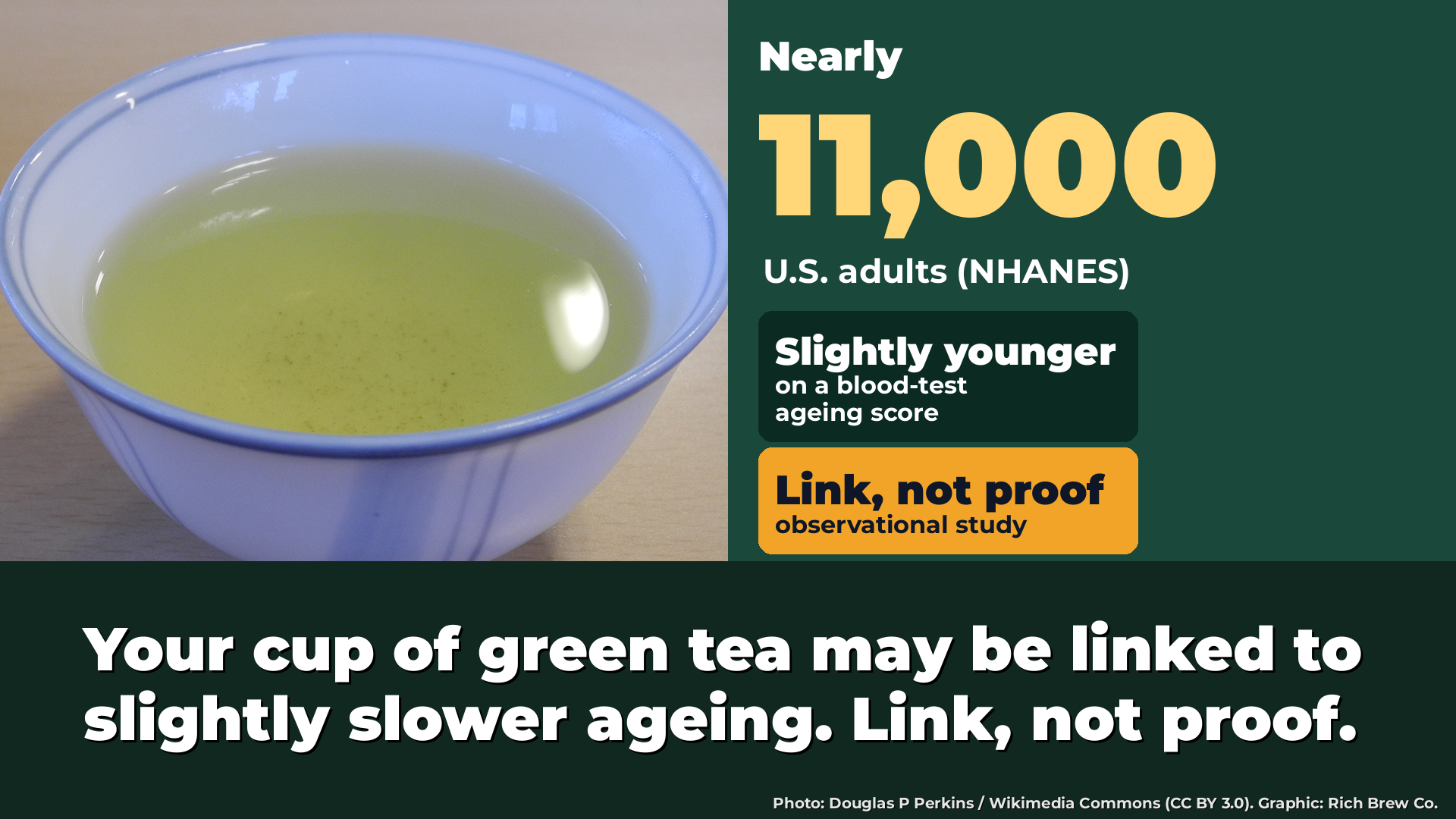
For many of us, the day starts, or slows down, with a cup of tea. A new study in the journal Aging Cell links EGCG (epigallocatechin gallate), the main natural compound in green tea, to a slightly younger "biological age" and a lower risk of death in nearly 11,000 American adults. It is encouraging news for tea lovers, with one big, honest caveat.
What the researchers did
The team is based at Shengli Clinical Medical College of Fujian Medical University and a partner hospital in Fuzhou, China, according to the study's PubMed listing. The senior author is Pengli Zhu.
They used data from 10,977 adults in NHANES (the National Health and Nutrition Examination Survey), a long-running U.S. health survey. People reported what they ate and drank, and the researchers estimated how much EGCG each person took in.
They then compared that with PhenoAge, a score based on blood tests that estimates how old your body seems compared with your actual age. If the score runs ahead of your birthday age, your body looks like it is "ageing faster" on this measure.
What they found
Compared with people who took in no EGCG, both lower- and higher-intake groups had lower PhenoAge acceleration, lower risk of death from any cause and higher estimated remaining life expectancy, according to the study summary on PubMed.
The differences were modest. According to passages from the full paper published by AgingResearch.News, high consumers scored about 0.62 years "younger" on the blood-test measure than non-consumers. Over an average of 7.9 years of follow-up, 1,276 people died, and both intake groups had about a 17 to 18 percent lower risk of death than non-consumers. We could not open the full paper on the publisher's site to check these figures ourselves.
Think of it like a used car. Two cars can show the same kilometres on the dashboard, but one has been looked after a little better. PhenoAge tries to read the car's condition, not just the odometer.
Inside worms and cells
The team also tested EGCG in tiny worms called C. elegans, which are often used in ageing research. EGCG extended their lifespan and "health span," the time spent in good health. It seemed to work by boosting peroxisomes, small parts inside cells that help break down certain fats. When the researchers switched off key genes in that pathway, the benefit disappeared. In lab-grown liver cells, EGCG reduced signs of worn-out, "senescent" cells.
Ink, not pencil: the human part of this study is observational. It shows a link, not proof that EGCG slows ageing. People who take in more EGCG may differ in other ways, such as diet, income or exercise, and intake was based on what people remembered eating and drinking. Results in worms and cells do not show the same thing happens in people.
Why regular people should care
Tea is cheap, familiar and part of daily life for many families. Research like this helps explain how everyday foods might relate to healthy ageing, and it points scientists toward what to test next. It is not a reason to change your diet or to buy anything.
What's next
The next step would be careful studies in people that follow biological age over time, ideally trials that can test cause and effect. Until then, enjoy your cup for what it is: a warm, pleasant habit, with some intriguing science behind it.