By Lena Hart
Most of what we call “health care” in North America shows up after something already hurts. Longevity science is the quieter idea: keep the body working longer, on purpose — through food, movement, sleep, careful supplements, and research that tries to slow the wear itself.
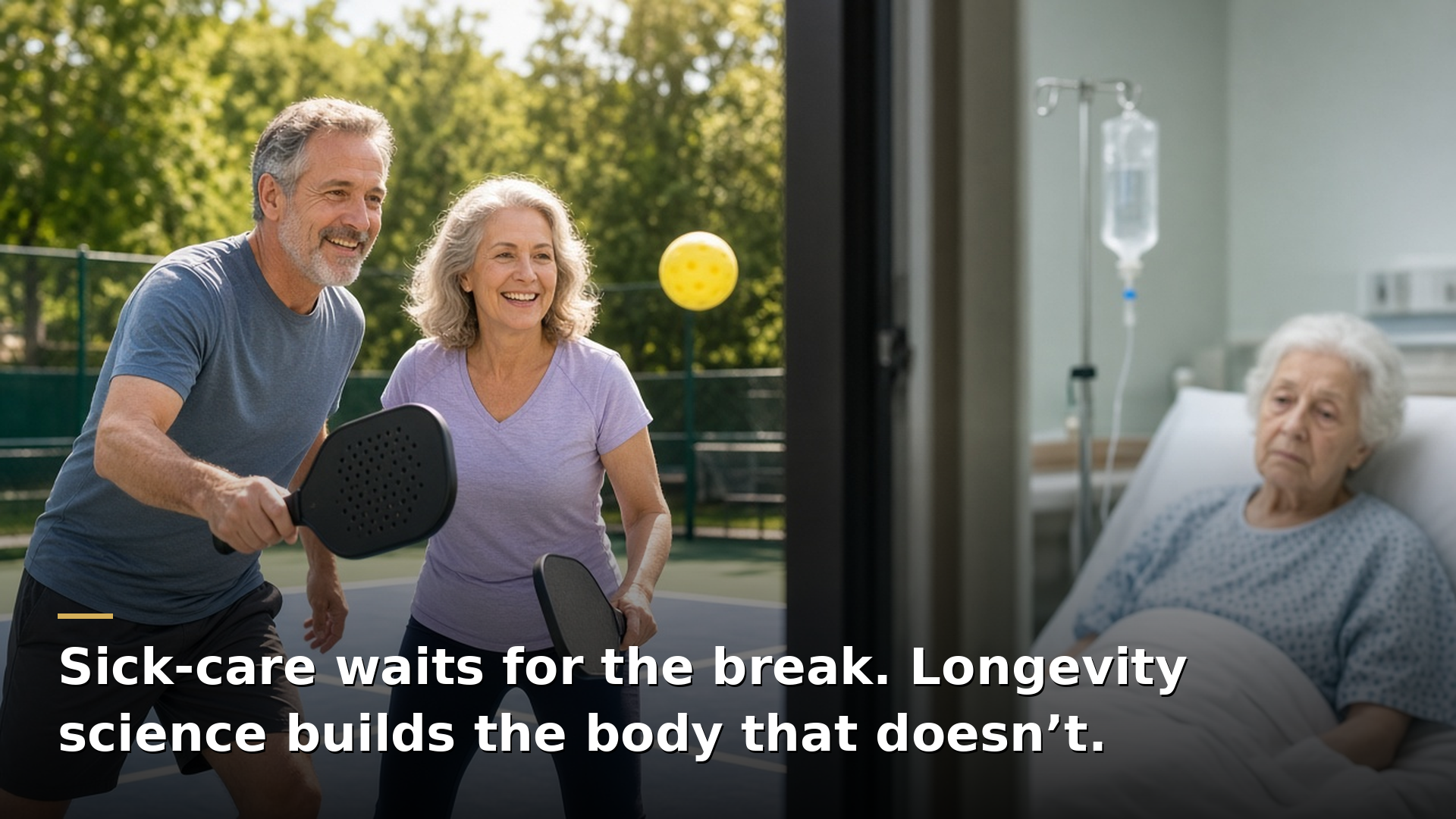
Think of a house, not a hospital chart. When a wall fails, you call a crew. That is sick-care: brilliant, necessary, and late. Longevity science is closer to building a house that doesn’t crack — strong foundations, materials that hold, habits that keep the structure from failing in the first place. Both matter. One is what our clinics are built for. The other is what most adults actually want when they say they want to stay sharp, strong, and independent.
The “sick care” line is older than the longevity boom. Former U.S. Surgeon General Joycelyn Elders put it plainly in 2008: “We don’t have a health care system. We have a very expensive sick care system, and we’ve got to change that.” Senator Tom Harkin said the same year that America has a “sick care” system and spends only a thin slice of health dollars on prevention. A July 2025 discussion paper from the National Academy of Medicine (NAM) — one author’s view, not a full academy vote — still lands in the same place: the industry prioritizes treating disease and acute care over prevention and healthy aging, and needs to move from reactive sick-care toward keeping people well for more years. More good years. Not only more years.
The gap you can feel. Across the world, people live nearly a decade with disease or disability after their healthy years run down. In the United States that gap is about 12.4 years — the largest among countries measured in a 2024 analysis. Most adults over 65 already carry at least one long-term condition; many carry two or more. Longevity science is the bet that we can shrink that stretch of “alive but worn down.”
Longevity is healthcare with a longer calendar. The agenda is wider than a prescription after a diagnosis. It includes how you eat, how you move, what you take only when the evidence is honest, and — for researchers — whether a medicine can slow the biology that feeds several diseases at once. Scientists call that geroscience. The kitchen version is simpler. If one root cause feeds heart trouble, frailty, and memory strain, fixing only the emergency is like mopping while the tap runs.
U.S. drug regulators just said aging will join their “important topics” list — a signal, not a green light. On October 1, 2026, at a major aging-research meeting in Boston, the Food and Drug Administration’s (FDA) Chief Scientist, Steven Kozlowski, said the agency’s next Focus Areas of Regulatory Science (FARS) update will include aging and longevity. FARS is a high-level map of the science topics that matter most to the agency; the update is aimed for early in the government’s 2027 budget year. Kozlowski has also said the outcome that matters most to patients is healthspan — years lived healthy and able — not lifespan alone.
Check the date on the document. Trade press reported the panel. The public FARS document on the FDA website is still the 2022 version, and it does not list aging or longevity. So the honest headline: leaders said aging is becoming a priority. The new document is not published yet — and a priority list is not an approval pathway.
What that does not mean. There is still no FDA-approved product for “aging” as a disease. A May 2026 public meeting hosted by the Reagan-Udall Foundation for the FDA — a nonprofit that supports the agency’s mission but is not the FDA itself — included FDA speakers who said the same out loud: no aging indication, and no aging blood test or “biological age” clock accepted as a stand-in for approval. Early trials, officials said, will likely lean on hard outcomes — age-related illnesses or death — while softer measures of how people feel and function get collected for later.
The bar is high, and it should be. One FDA drug-review official’s caution sticks: you might treat someone for decades to buy a few good years. A famous metformin aging trial, Targeting Aging with Metformin (TAME), was discussed with the FDA years ago and still has not started.
What already has receipts — and what is still a pitch. Moving your body is still the cheapest longevity tool with real human outcome data. So is quitting tobacco. Some modern drugs cut heart attacks and strokes in people who already have disease — that is proven disease care, not an “anti-aging” label. Early studies that clear worn-out “zombie” cells, and early low-dose rapamycin studies, are interesting but small or mixed; treat them as early, not settled. Consumer “reverse your age” clocks and stacks sit in the hype lane: different clocks disagree, none is an FDA-approved aging diagnosis tool, and optimistic claims can outrun biology. Harvard Medical School’s dean said as much from the same Boston stage.
Diet and supplements sit in a different lane than drugs. Under U.S. rules, supplements are not approved as disease treatments before they hit the shelf. Labels can make limited claims about how a nutrient supports the body’s structure or function, with a disclaimer that the FDA has not evaluated the statement. Legal status for a supplement is not the same thing as proof it works. The Federal Trade Commission (FTC) still demands real evidence for ads that promise health benefits. Building resilience is useful. A sticker that says the body can’t break is not.
Other parts of government are building the measuring sticks. The Advanced Research Projects Agency for Health (ARPA-H) — a federal research shop under the Department of Health and Human Services — runs a program called Proactive Solutions for Prolonging Resilience (PROSPR). It has put on the order of $144 million into teams aiming to extend healthspan with better markers and shorter trial designs. A consensus group sent the FDA recommendations on using multi-domain function — thinking, moving, sensing, mood, and vitality — as trial tools that still need more proof before they become a main approval yardstick. Public money and prize competitions are stepping in partly because some promising generic ideas do not make a drug company rich.
Ink, not pencil: a conference line about FARS is the FDA signaling a priority, not opening a new approval pathway. No drug or supplement in this piece is cleared to “treat aging.” The debate over how to measure success is still open. Treat longevity clinics and online stacks with the same Monday skepticism you would bring to any big health promise.
Why regular people should care
The Monday stake is personal. Most adults are not hunting a sci-fi lifespan. They want to climb stairs at 70, remember names at 80, and spend less of their last decade in a waiting room. Sick-care saves lives when something breaks. Longevity science is the argument that health care should also mean building a body that holds — through habits we already understand, research that earns its keep, and regulators who are finally naming aging as a problem worth measuring.
What's next
Watch for the published FARS update — targeted for early in the government’s 2027 budget year — and whether the FDA follows with real guidance or trial blueprints. Watch ARPA-H and industry trials that measure how people actually feel and function, not only a lab age score. And watch your own inputs: food, sleep, movement, and any supplement that can show human trials — not a podcast pitch. The shift from sick-care to health care will not arrive as one miracle pill. It will look like a system that builds resilience so health stays longer — not only patches after the break.