
By Lena Hart
A protein from a tiny light-seeking alga became a remote control for nerve cells — and that leap just won the 2026 Nobel Prize in Physiology or Medicine. The Nobel Assembly at Karolinska Institutet awarded the prize jointly to Karl Deisseroth, Peter Hegemann, and Georg Nagel “for their discoveries concerning light-gated ion channels and optogenetics.”
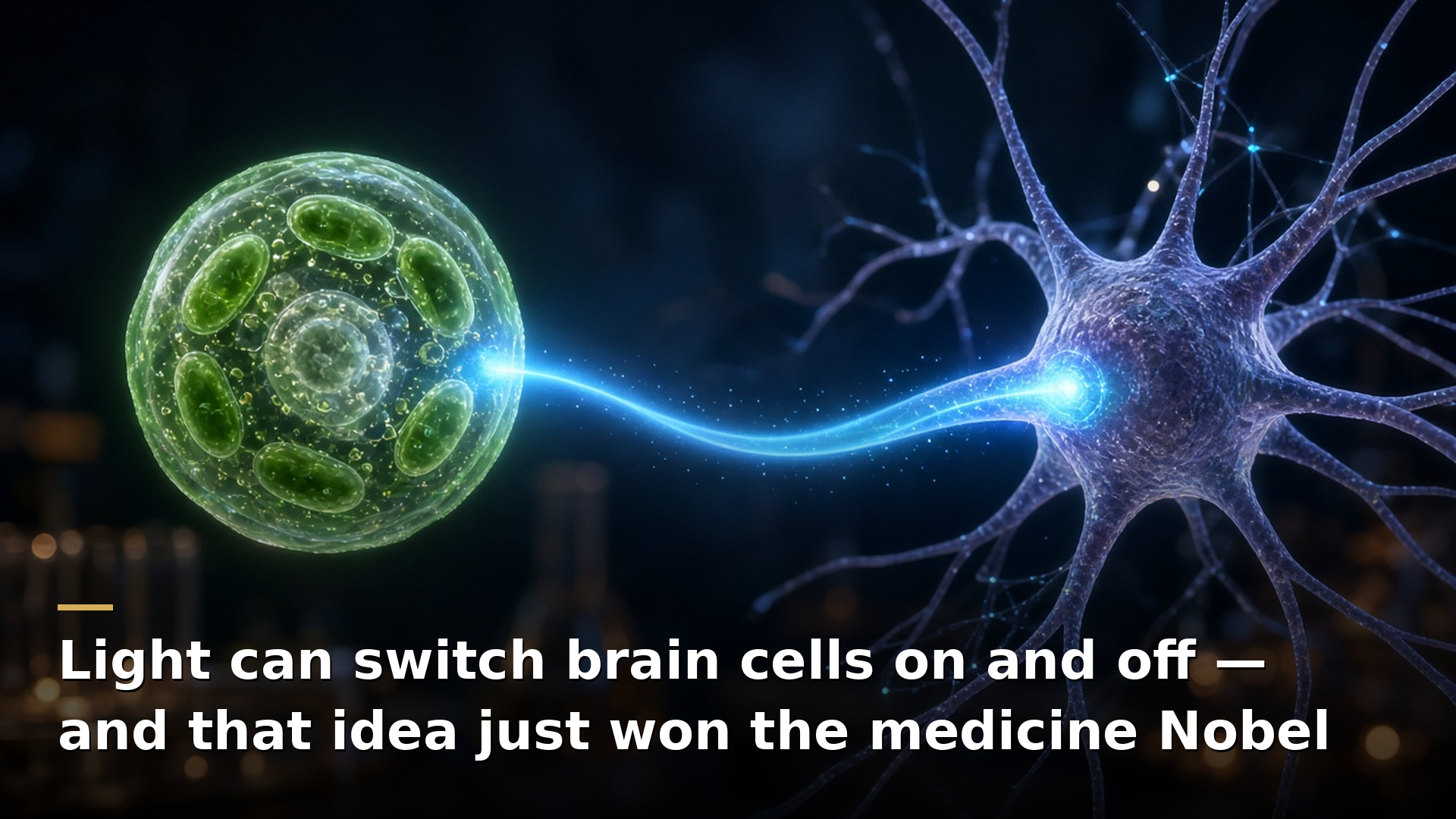
Curiosity first, then a tool. Peter Hegemann wondered how the single-celled alga Chlamydomonas swims toward light. In the early 2000s, he and Georg Nagel found a surface protein — channelrhodopsin — that opens a channel when blue light hits it. Charged ions rush in and create an electrical impulse. Put that protein in other cells, and those cells become light-sensitive too.
The brain switch. Karl Deisseroth put the channelrhodopsin gene into rat nerve cells and triggered signals with blue light, publishing in 2005. Two years later, the same light switch worked in living mice. That method — controlling nerve signals with light — is what the field now calls optogenetics.
What it unlocked. Researchers can now prove which circuits drive specific memories, feelings, and behaviors, including ones tied to neurological and psychiatric disorders. Older brain maps were more like sketch maps; this approach asks cause-and-effect questions with a flashlight instead of a blunt electrode. Per Svenningsson, chair of the Nobel Committee for Physiology or Medicine, said optogenetics opens mapping “in a way that we could once only dream of.”
Sight on the clinical edge. The committee notes that researchers are already using the method in attempts to restore sight in people with visual impairment. That is a research and clinical-attempt story — not a new drug approval or a finished therapy for everyone who needs it.
Who they are. Deisseroth (born 1971) is at HHMI and Stanford. Hegemann (born 1954) is Hertie Senior Professor of Neuroscience at Humboldt University of Berlin; the prize work was done at the Max Planck Institute for Biochemistry in Martinsried. Nagel (born 1953) is professor of molecular plant physiology at the University of Würzburg; that prize work was done at the Max Planck Institute for Biophysics in Frankfurt. The 12 million Swedish kronor prize is shared equally.
Ink, not pencil: the Nobel honors foundational discovery and a research method. Clinical sight-restoration work is noted by the committee as attempts underway — not as a guarantee of approved, everyday treatment.
Why regular people should care
The Monday stake is human and simple: if light can turn the right brain cells on or off, scientists can finally test which wires make a memory hold, a fear flare, or a habit stick — and, in some clinics, try to give vision a second chance. Understanding the brain used to be mostly correlation. This tool pushes toward cause.
What's next
Expect a wave of explainers and lab follow-ons as Physics (October 6) and Chemistry (October 7) prizes land this week. For patients and families, the honest watch is whether light-based sight-restoration attempts keep moving from research into durable clinical results — still a path, not a finished product.