
By Lena Hart
Walk into any pharmacy and the longevity aisle looks like a promise shelf. This week brings two peer-reviewed human studies that help cut through the noise: one hopeful signal on blood vessels, and one honest "no clear benefit" result.
What the Surrey trial found
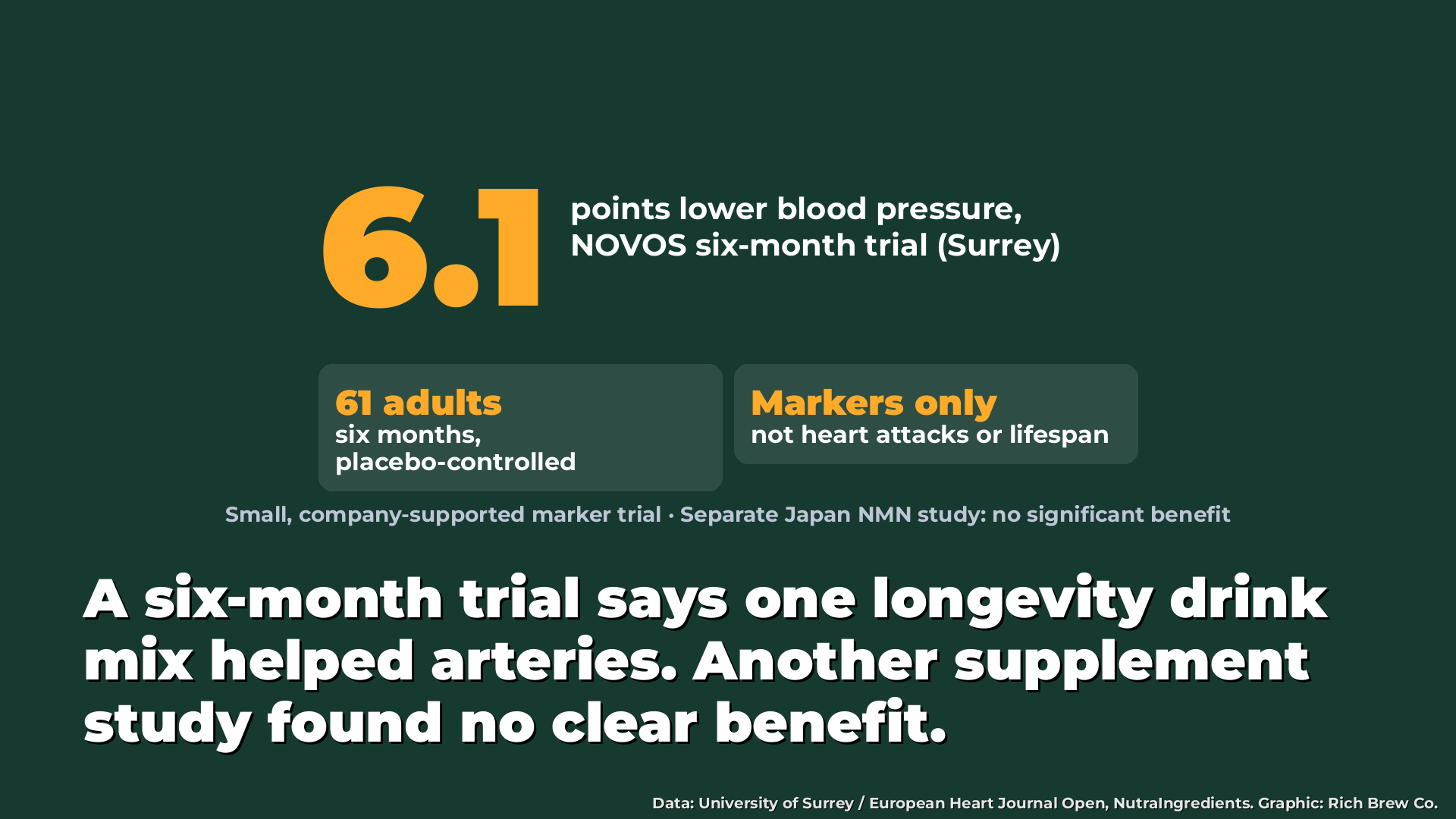
Researchers led by Professor Christian Heiss at the University of Surrey ran a randomised, double-blind, placebo-controlled trial, called STAMINA, published in the European Heart Journal Open. Sixty-one healthy adults aged 40 and older took part: 33 took a daily multi-ingredient drink mix called NOVOS Core, and 28 took a matched placebo, for six months.
NOVOS Core is a 15-gram daily serving of 12 ingredients, including vitamins, minerals, amino acids and plant-derived compounds, according to NOVOS and Surrey. It is a commercial NOVOS Labs product, not a single-vitamin pill.
Compared with placebo, the supplement group showed:
- better flow-mediated dilation (how well an artery widens), an adjusted between-group gain of 2.9 percentage points, per NOVOS's release
- lower pulse wave velocity (a stiffness measure), by 1.18 metres per second
- lower systolic blood pressure, by 6.1 mmHg
Surrey says blood vessel function also improved within an hour of the first dose. Cholesterol and other blood lipids did not change significantly. The study was not designed to count heart attacks, strokes or extra years of life. Think of it like checking tyre grip after a tune-up: useful, but not proof you will never crash.
Who paid, and what to notice
Funding and conflicts matter. NOVOS says this was an investigator-initiated study run by Surrey and supported by NOVOS Labs, which provided the product and placebo plus an unrestricted contribution toward research costs. NOVOS says it had no role in study design, data collection, primary interpretation or the decision to publish. Diogo Barardo, quoted in Surrey's release, is NOVOS's director of research and development, so he is a company employee. That does not make the results fake. It means readers should treat one small, company-supported trial as early evidence, not a final verdict.
The Japan NMN contrast
Separately, the trade publication NutraIngredients reports a 42-day open-label Japan study of nicotinamide mononucleotide (NMN) formulas in 42 healthy adults aged 45 to 65, published in Nutrients. According to NutraIngredients, authors from the Abe Yoan Aging Research Institute and Nippon Medical School Hospital found no statistically significant improvements in heart-lung fitness or thinking, the study's main goals. It was funded by Abe Yoando Pharma, and the authors warned that drops in biological-age scores do not prove better healthspan. We have this study only through NutraIngredients' report.
Ink, not pencil: one small Surrey trial improved vessel markers with NOVOS Core; a separate short Japan NMN study did not show clear cardio or cognition benefits. Neither proves a longer life.
How to read supplement science in 30 seconds
Ask five questions: Was there a placebo? How many people? How long? Markers or real outcomes? Who paid? Those checks beat any marketing page.
Why regular people should care
Adults over 40 are a big market for "healthy ageing" products. A real placebo-controlled trial that moved blood pressure and artery stiffness is genuinely encouraging, and arteries are a sensible place to look. The honest caveat: this was one small, company-supported trial that measured markers, not heart attacks or lifespan. It is not medical advice, and nothing here says you should buy or take any product.
What's next
Surrey researchers say larger studies are needed to see whether marker changes become lasting health gains. NOVOS says it is evaluating follow-up studies on muscle, brain and skin. Until then, treat both papers as a reading lesson: hopeful where earned, sceptical where the sample is small or the funder is close.