
By Lena Hart
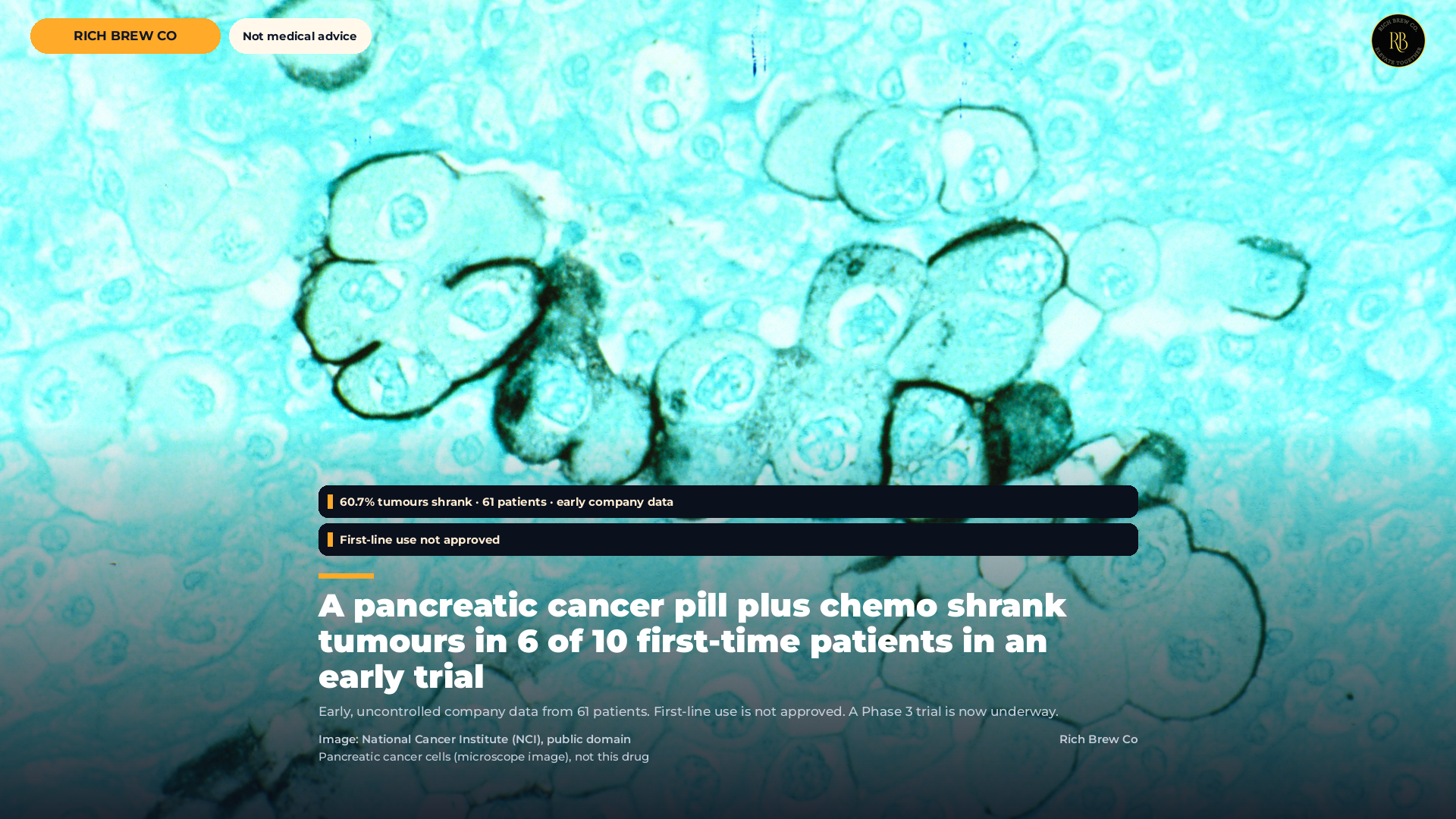
Image: National Cancer Institute (NCI), public domain. Human pancreatic tumour cells under a microscope; not an image of this drug or of patients in this trial.
Pancreatic cancer is the diagnosis families dread. It often hides until it has already spread, and then the conversation turns quickly to time: how much there is, and how to spend it well. So when an early trial suggests a new pill could help people get more of that time from their very first treatment, it is worth pulling up a chair.
Revolution Medicines says its pill RASONQUE (daraxonrasib), taken together with standard chemotherapy, shrank tumours in 60.7 percent of 61 people with newly diagnosed metastatic pancreatic cancer. About three in four (76.6 percent) were estimated to be alive one year after starting treatment.
These are early results from a small study with no comparison group. They do not prove the combination works better than chemotherapy alone. A large Phase 3 trial is now running to answer exactly that.
Who was in the trial
The study is called RMC-GI-102. It is an open-label Phase 1/2 trial, which means everyone knew what they were getting, and it is sponsored by the company.
The group in this update had metastatic pancreatic ductal adenocarcinoma (PDAC), the most common form of pancreatic cancer, and it had already spread to other parts of the body. None of them had yet been treated for the cancer after it had spread. Doctors call this the "first-line" setting: the first treatment after that diagnosis.
All 61 people took daraxonrasib, 200 milligrams once a day by mouth, alongside two standard chemotherapy drugs given by drip, gemcitabine and nab-paclitaxel. People could join whether or not their tumour carried a change in its RAS gene (more on RAS below).
The headline numbers
The data was collected up to Sept. 28, 2026. By then, half the patients had been followed for more than 18.3 months.
- Tumours shrank in 60.7 percent of patients. This is the confirmed response rate: tumours shrank by a clear, measured amount, and a later scan backed it up.
- In 8.2 percent, the tumours being tracked disappeared from scans. Doctors call this a complete response. It is very good news, and it is not the same as being free of cancer for good.
- The disease was held in check in 90.2 percent. Their tumours either shrank or stopped growing for a time.
- Responses lasted a median of 11.1 months. That means half lasted longer.
- The cancer did not grow for a median of 12.8 months. This is called progression-free survival (PFS): how long people lived without the disease getting worse.
- An estimated 76.6 percent were alive at one year.
The company has not yet reported median overall survival, the point at which half the patients have died. That figure needs more time. On safety, Revolution Medicines says side effects matched what was already known for the pill and for the chemotherapy, and OncLive reports that no new safety concerns appeared with longer follow-up. On its own, the pill's label lists rash, diarrhea and mouth sores among its most common side effects.
The numbers held up as the study grew. OncLive reports that an earlier look at 40 patients, presented at the American Association for Cancer Research (AACR) meeting in April 2026, showed tumours shrinking in 58 percent. The new update adds more people and more time.
How the pill works
Most pancreatic cancers are driven by a protein called RAS. Think of it as the accelerator pedal for cell growth. In pancreatic cancer, the pedal is stuck to the floor.
Chemotherapy works broadly, by hitting cells that divide quickly. Daraxonrasib is more targeted. It is designed to latch onto RAS while it is switched "on", the state that pushes cancer to grow, and to block several forms of it at once. The idea is simple: ease the foot off the accelerator while the chemotherapy does its work.
Where the drug already stands
This part matters, so here it is plainly.
- First-line use is not approved. Using daraxonrasib with chemotherapy as a first treatment is investigational.
- The pill is already approved for a different group. On Aug. 26, 2026, the United States (US) Food and Drug Administration (FDA) approved RASONQUE on its own for adults with metastatic pancreatic cancer who have already had at least one earlier treatment, or who cannot take combination chemotherapy. That approval was based on a separate, randomized Phase 3 trial called RASolute 302. The company says the European Commission has also approved it for adults who have had at least one earlier treatment.
- The company says the first-line combination has a US breakthrough designation. According to Revolution Medicines, the FDA gave the pill-plus-chemotherapy combination Breakthrough Therapy Designation for first-line use. The company says this status can help speed up development and review. It is not an approval.
Ink, not pencil: In 61 people with newly diagnosed metastatic pancreatic cancer, daraxonrasib plus chemotherapy shrank tumours in 60.7 percent, with an estimated 76.6 percent alive at one year. But this is early, uncontrolled company data, and first-line use is not approved.
Who presented it
The results were presented on Nov. 20 as a late-breaking talk at the EORTC-NCI-AACR (ENA) Symposium in Barcelona, Spain. The meeting is run by the European Organisation for Research and Treatment of Cancer (EORTC), the US National Cancer Institute (NCI) and the AACR.
The presenter was Wungki Park, a medical oncologist at Memorial Sloan Kettering Cancer Center in New York who works on both this study and the Phase 3 trial. "The emerging survival signal is meaningful," Park said in the company's release, adding that the findings "provide a compelling rationale to further evaluate daraxonrasib as a potential first-line treatment option."
The caveats, in proportion
This is hopeful news, and it comes with honest limits:
- There was no comparison group. Everyone got the same treatment, so we cannot tell how much of the benefit came from the pill and how much from the chemotherapy.
- It is small and early. Sixty-one people is a promising start, not a verdict. Comparing these numbers with older chemotherapy studies is tempting, but different trials enrol different people, so it can mislead.
- It is company data. Revolution Medicines sponsors the study, and the full details have not yet been checked by outside experts in a peer-reviewed journal.
- It is not medical advice. Anyone facing this diagnosis should talk with their own care team, including about whether a clinical trial could be an option.
Why regular people should care
The company says about 500,000 people worldwide are diagnosed with PDAC each year, and roughly 80 percent of pancreatic cancer patients learn they have it only after it has spread. For those families, a little more time is not a statistic. It is another holiday, another walk, another ordinary Tuesday together.
A once-a-day pill that could make the first treatment work harder would be a real step forward, if the Phase 3 trial confirms it. And the bigger story is the target. A pill aimed at RAS, the main driver of this cancer, was approved for later treatment just three months ago, and it is now being tested from the very first treatment. That is a sign of how fast this field is moving.
What's next
- Phase 3 RASolute 303: this randomized trial is recruiting about 900 people with newly diagnosed metastatic pancreatic cancer. It has three groups: the pill alone, the pill plus chemotherapy, and chemotherapy alone.
- What it will measure: how long people live without the cancer growing, judged by reviewers who do not know who got what, and how long people live overall.
- Timing: the trial registry estimates the main analysis around April 2028.
- Full data: a peer-reviewed paper and, later, regulators' view on first-line use.
Sources
- Revolution Medicines (GlobeNewswire), "Revolution Medicines Presents Updated Phase 1/2 Data for RASONQUE® (daraxonrasib) Plus Chemotherapy in First-Line Metastatic Pancreatic Cancer at ENA 2026," Nov. 19, 2026: https://ir.revmed.com/news-releases/news-release-details/revolution-medicines-presents-updated-phase-12-data-rasonquer/
- OncLive, "Daraxonrasib Plus Gemcitabine/Nab-Paclitaxel Generates Durable Responses in First-Line Metastatic PDAC," Nov. 20, 2026: https://www.onclive.com/view/daraxonrasib-plus-gemcitabine-nab-paclitaxel-generates-durable-responses-in-first-line-metastatic-pdac
- US Food and Drug Administration, "FDA Approves First in Class Targeted Therapy for Metastatic Pancreatic Cancer," Aug. 26, 2026: https://www.fda.gov/news-events/press-announcements/fda-approves-first-class-targeted-therapy-metastatic-pancreatic-cancer
- ClinicalTrials.gov, RASolute 303 (NCT07491445): https://clinicaltrials.gov/study/NCT07491445
- ClinicalTrials.gov, RMC-GI-102 (NCT06445062): https://clinicaltrials.gov/study/NCT06445062
Like, follow and subscribe for more podcasts from Richbrewco.com