
By Lena Hart
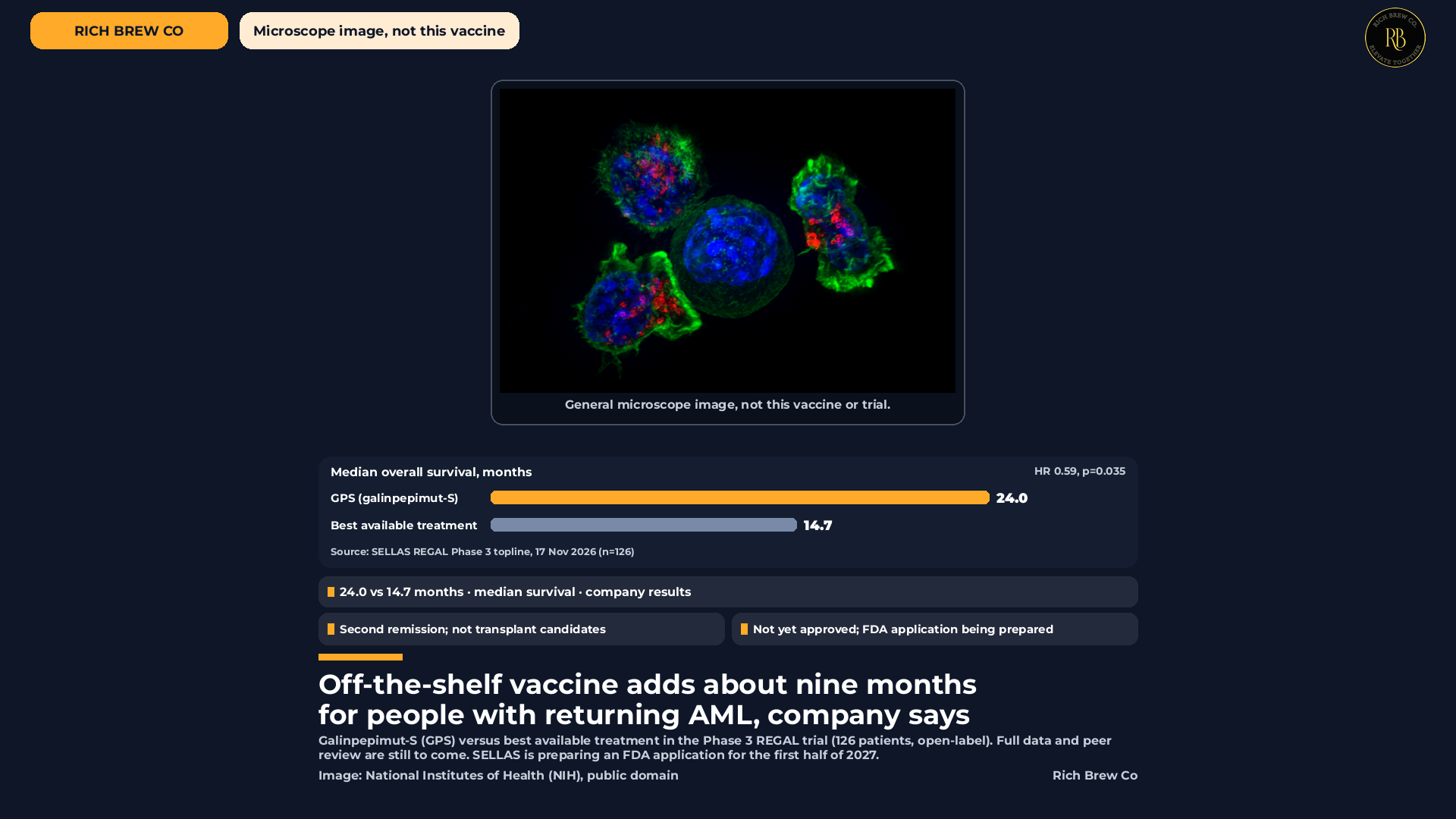
Image: National Institutes of Health (NIH), public domain. General microscope image, not this vaccine or trial.
For people whose leukemia has come back, every extra month matters: more birthdays, more ordinary evenings with family. A new trial result suggests one vaccine could add some of that time.
SELLAS Life Sciences says its cancer vaccine, galinpepimut-S (GPS), met its main goal in a late-stage Phase 3 trial called REGAL. In adults with acute myeloid leukemia (AML) whose cancer had come back and then gone into remission again, median overall survival was 24.0 months for patients who got GPS, versus 14.7 months for patients who got the best available treatment. Median means the midpoint: about half the patients lived longer than that, and half did not. The gap is about nine months.
The company announced the top-line result on Nov. 17. Memorial Sloan Kettering Cancer Center (MSK), where the vaccine was invented, announced it the same day.
Who was in the trial
REGAL focused on a hard-to-treat group. According to SELLAS, the patients:
- were adults with AML
- were in their second or later remission after their cancer came back and was treated again
- could not have a donor stem cell transplant, either because they were not eligible or were unable to undergo one
SELLAS describes REGAL as a global trial, and ClinicalTrials.gov lists sites in the United States, Europe, India and Taiwan. SELLAS sponsored it. It randomized 126 patients one-to-one: half got GPS, and half got their doctor's choice of best available treatment. That could be observation, a hypomethylating agent, venetoclax and/or low-dose cytarabine, SELLAS says.
GPS was tested as maintenance therapy after remission. The registry lists injections that start every two weeks and space out over time, continuing until the disease returns.
The headline numbers
The trial's main goal, or primary endpoint, was overall survival: how long patients lived.
- Median survival: 24.0 months with GPS versus 14.7 months with best available treatment.
- Risk of death: 41 percent lower with GPS, according to SELLAS. Statisticians express this as a hazard ratio of 0.59.
- Statistical result: a two-sided p-value of 0.035, just under the usual 0.05 cutoff. SELLAS calls the result statistically significant and clinically meaningful.
The analysis was triggered once 80 deaths had occurred, a number the trial set in advance, SELLAS says.
On safety, SELLAS says GPS was generally well tolerated. Treatment-related side effects were mostly mild to moderate (grade 1 or 2), most often reactions where the shot was given. The company reported no new safety signals.
How an off-the-shelf vaccine works
GPS is a treatment vaccine, meant to help the immune system go after leukemia cells that are left behind after treatment.
It targets a marker called WT1. MSK says WT1 is found in the cancer cells of more than 95 percent of people with AML. GPS is made of four short protein fragments, called peptides, taken from WT1. According to SELLAS, they are designed to rally two kinds of T cells, white blood cells that help the immune system find and attack threats, against cells carrying the marker, and to work across many different patient tissue types.
Here is what "off-the-shelf" means. Think of a key cut to fit a lock that most AML patients share. Some other cancer vaccines are patient-specific, built for each person like a tailored suit. MSK says GPS is not: it is the same vaccine for everyone, like clothing ready to wear from the rack, and it might be used in many patients.
Where it came from
The vaccine started in an academic lab. GPS was invented by MSK researcher David Scheinberg and colleagues, and MSK licensed it to SELLAS in 2014, according to MSK. That is about 12 years between the licence and this late-stage readout.
The releases disclose financial ties. MSK has institutional financial interests, and Scheinberg has financial interests related to SELLAS. SELLAS's release adds that Javier Pinilla-Ibarz, a REGAL steering committee member, does too.
The caveats, in proportion
This is encouraging news, and it comes with honest limits:
- It is the company's top-line result. Secondary endpoints are still being analyzed. SELLAS says the full results will be presented at a major medical meeting and submitted to a peer-reviewed journal. Until then, outside experts cannot check the details.
- The trial was small and open-label. There were 126 patients, and patients and doctors knew who got the vaccine.
- It is not approved. SELLAS plans to meet the United States (US) Food and Drug Administration (FDA) and says it is advancing preparations for a Biologics License Application, the formal request for approval, in the first half of 2027. The company itself notes the FDA may not agree with its analysis.
- It applies to one group. The result covers adults with AML in second or later remission who could not have a transplant, not all leukemia.
Beyond leukemia, a possibility only
MSK notes that WT1 also appears in ovarian cancer, mesothelioma and other cancers, and that GPS might possibly be used in several cancers. That raises the possibility that a WT1-targeted approach could one day be studied more widely. REGAL tested GPS only in AML, so any wider use would need its own trials.
Why regular people should care
AML can return after treatment, and for people who cannot get a transplant, options are limited. A vaccine that is the same for every patient and, so far, mostly causes mild to moderate side effects could add months of life, if the full data and regulators back it up.
What's next
- Full data: watch for the complete REGAL results at a major medical meeting, and a peer-reviewed paper.
- Secondary endpoints: SELLAS says these are still being analyzed.
- The FDA: a meeting to discuss an accelerated filing strategy, and an approval request that SELLAS is preparing for the first half of 2027.
- Regulators' view: whether one positive open-label trial is enough for approval.
Sources
- SELLAS Life Sciences (GlobeNewswire), "SELLAS Life Sciences Announces Positive Pivotal Phase 3 REGAL Trial Data…," Nov. 17, 2026: https://ir.sellaslifesciences.com/news/News-Details/2026/SELLAS-Life-Sciences-Announces-Positive-Pivotal-Phase-3-REGAL-Trial-Data-Showing-Immunotherapeutic-Cancer-Vaccine-Galinpepimut-S-GPS-Demonstrated-a-Statistically-Significant-and-Clinically-Meaningful-Improvement-in-Overall-Survival-in-Patients-with-A/default.aspx
- Memorial Sloan Kettering Cancer Center, "Investigational peptide vaccine demonstrates survival benefit in people with acute myeloid leukemia," Nov. 17, 2026: https://www.mskcc.org/news-releases/investigational-peptide-vaccine-demonstrates-survival-benefit-in-people-with-acute-myeloid-leukemia
- ClinicalTrials.gov, REGAL trial (NCT04229979), opened Nov. 18, 2026 (entry last updated Sept. 2025): https://clinicaltrials.gov/study/NCT04229979