
By Lena Hart
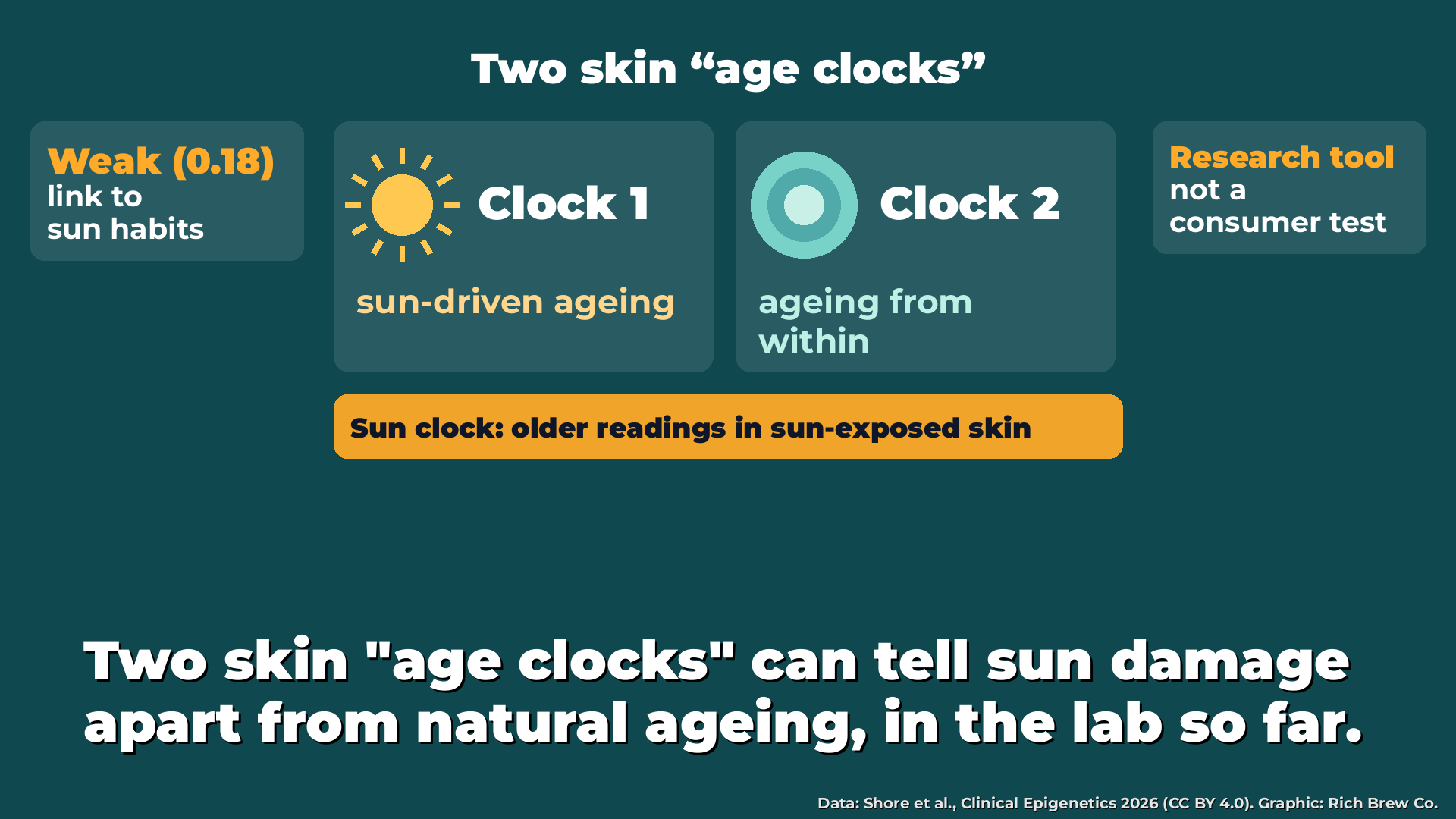
Most of us know someone whose face looks older than their years after decades of beach holidays, and someone else whose skin seems to ignore the calendar. Scientists have built two separate "age clocks" for skin: one tuned to sun damage, and one to the ageing that happens from inside the body. The paper came out in September and drew fresh attention in late October. It is early, careful lab work, not a test you can buy. But it could one day help researchers check which skin habits and treatments really make a difference.
What the researchers did
The study appears in the journal Clinical Epigenetics, published on September 11, 2026. The team came from King's College London (KCL), Erasmus MC (Erasmus University Medical Center) in Rotterdam, and the consumer goods company Unilever.
Their tools are epigenetic clocks. Our DNA carries tiny chemical tags, called methylation, that shift in a fairly steady way as we age. By reading those tags, a computer model can estimate how "old" a tissue looks.
The team trained two clocks on more than 400 skin samples:
- An "exogenous" clock, built from tags that change with age in sun-exposed skin, but not in protected skin.
- An "endogenous" clock, built from tags that change with age in skin that rarely sees the sun.
Think of a car with two meters. One counts the car's age. The other counts how long it has sat parked in the sun, fading.
What they found
- Sun-exposed skin read older. In 78 arm skin samples from an earlier public study, the sun clock gave sun-exposed skin older ages than protected skin, in both younger and older people. The inner-ageing clock and an older, widely used skin clock saw no difference.
- A weak link to sun habits. In 242 women from TwinsUK, a long-running study of twins at KCL, the sun clock ran slightly "fast" in people who reported spending more weeks in hot countries. The link was statistically real but weak: a correlation of 0.184, where 0 means no link and 1 means a perfect one.
- Face swabs. In 44 skin swabs from the crease beside the nose, taken in the Rotterdam Study, the sun clock's reading matched graded sun damage a bit more strongly (0.33).
- The inner clock was better at guessing actual age, but did not track sun exposure.
The human side
The twins in TwinsUK have given skin samples and answered health questions for years. The sun question was simple: "How many weeks have you spent in hot countries?" The answers were collected about 10 years before the skin samples, which the authors say may weaken the link.
Ink, not pencil: the sun clock's link to real sun habits was weak, and the authors say it needs more checking before wider use. Many samples came from women, and some groups were small. So be wary of any product, cream or test that claims to measure your "skin age" with clocks like these.
Who paid
Unilever funded much of the work. The paper says the two clocks are covered by a patent held by Unilever, and three authors are Unilever employees. TwinsUK itself has many public and charity funders. None of this means the science is wrong, but it is worth knowing.
Why regular people should care
Skin is the organ we all see age. Today, judging whether a skin habit works mostly means looking in the mirror. Tools like these could let researchers measure sun-related ageing separately from natural ageing, and test treatments more fairly. For now, the everyday advice does not change. This is not medical advice; for skin worries, talk with a doctor or dermatologist.
What's next
The authors say the sun clock needs more testing in other groups, body sites and lab methods. If it holds up, they see it helping researchers test anti-ageing skin treatments more fairly, and one day giving people more personal skin advice. The paper came out on September 11; science news site Bioengineer.org wrote it up on October 30.