
By Lena Hart
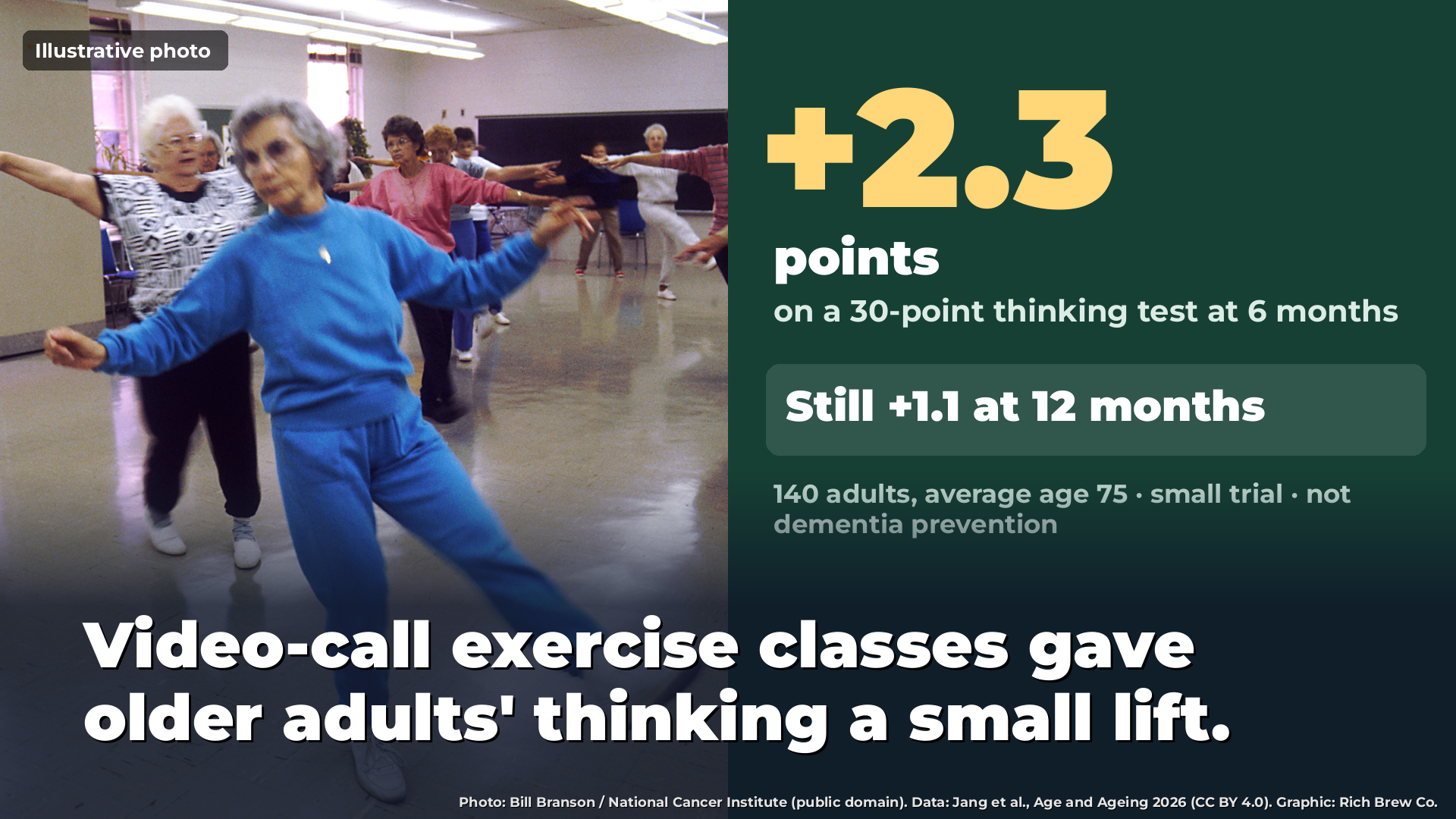
Maybe your mother has started forgetting names, and the nearest exercise class is a long drive away. A new study suggests that a phone, a video call and a stretchy exercise band may help a little. In a small trial in South Korea, older adults with memory and thinking problems who joined live online exercise classes, plus nutrition support, did better on a thinking test than those who didn't.
What the researchers did
The study, a randomised controlled trial (RCT), appears in the October 2026 issue of the journal Age and Ageing, from the British Geriatrics Society. In an RCT, people are assigned to groups by chance, which makes the comparison fairer.
The team enrolled 140 adults aged 60 to 80 (average age 75; 60% women) at two public health centres, one rural (PyeongChang) and one urban (Hanam). All had signs of memory and thinking problems on a screening test, but could still manage daily life on their own. People already diagnosed with dementia, or taking dementia drugs, were not included. Everyone also had to be able to use a smartphone.
Half joined a six-month programme, according to the full paper:
- Twice a week, 60 minutes, live on Zoom, led by certified trainers: 20 minutes of aerobic exercise, 20 minutes with elastic bands and 20 minutes of balance work.
- Nutrition support: advice from a dietitian, plus a protein drink twice a day at home (16 grams of protein a day).
The other half got the usual health services and leaflets from their health centre.
What they found
The main measure was the Montreal Cognitive Assessment (MoCA), a common 30-point test of memory and thinking. People started at about 19.5 points on average.
- At six months, the video group had improved 2.3 points more than the comparison group.
- At 12 months, six months after the classes ended, the gap was smaller, 1.1 points, but still there.
- The video group also did better on daily functioning and frailty, a measure of how worn-down and vulnerable the body is.
- No harms from the programme were reported.
- The authors say the six-month gain was bigger than about 0.7 points, the smallest change that earlier research counts as meaningful for people with mild memory problems.
To picture it: on a 30-question quiz, that is like getting about two more answers right, and then holding on to about one of them.
The human side
Not everyone in their late 70s is at ease with video apps. At the first in-person visit, staff helped each person install Zoom on their own smartphone and showed them how to join a class, with extra help in the first sessions. Trainers watched everyone live and gave feedback to keep them safe.
Ink, not pencil: what not to trust yet is any claim that this prevents dementia. The study did not test that. It is one small trial in one country, compared with usual care rather than a "pretend" programme, so it needs repeating before anyone calls it proven.
Who ran it, and who paid
Because exercise and protein came together, no one can say which part helped. The smartphone rule ruled out nearly a third of the people screened. People enrolled between December 2019 and April 2022, partly during the pandemic. The study was funded by a South Korean government research grant. A dairy company, Maeil Dairies, provided the protein drinks free; the authors say it had no role in the study. One author has consulted part-time for that company since May 2025 and co-founded a digital health company in June 2026; the paper discloses both and says the consulting role is unrelated to the study.
Why regular people should care
Many older adults cannot easily get to a clinic or a gym. This trial suggests a cheap, at-home routine, built from things health centres already have, might help people stay a bit sharper and stronger. That is a hopeful, practical idea. This is not medical advice: anyone with memory worries should talk with a doctor before starting a new exercise plan or supplement.
What's next
The authors say the results support offering such programmes through community and primary care, especially where in-person care is hard to reach. Bigger trials in more places would show whether the benefit holds, and how long it lasts.