
By Lena Hart
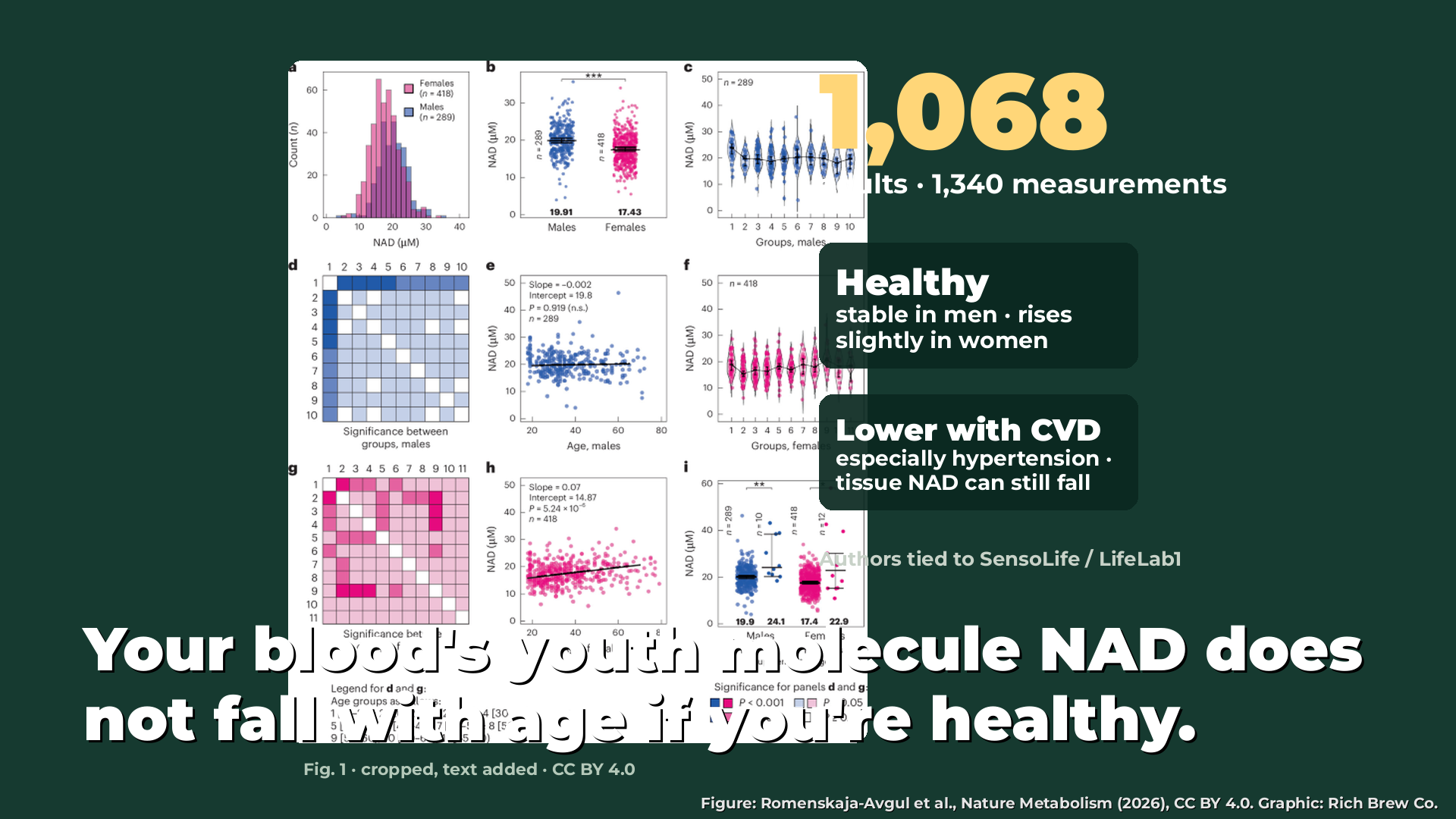
If you have browsed longevity supplements, you have probably been told that NAD — nicotinamide adenine dinucleotide, a molecule cells use for energy — falls as you age, so you should "boost" it. A large new blood study says that popular pitch does not match what happens in healthy adults' blood.
What the Vilnius team measured
On November 4, researchers linked to Vilnius University published an open-access brief communication in Nature Metabolism. They made one thousand three hundred forty measurements in one thousand sixty-eight adults (six hundred thirty-six women, four hundred thirty-two men), mostly from dried finger-prick blood spots that capture total whole-blood NAD.
In healthy people, whole-blood NAD did not decline with age. It stayed stable in men and rose slightly in women. Levels were lower in people with cardiovascular disease, especially hypertension (high blood pressure).
Lead researcher Dalius Ratautas told Vilnius University the women's upward trend was so unexpected the team checked it again and again. Think of blood NAD less like a candle that always burns down with birthdays, and more like a dashboard light that may dim when the heart and vessels are under strain.
What this does not prove
The paper is careful. It was not designed to prove cause and effect, and the authors write that the data do not provide direct evidence that NAD supplements treat cardiovascular disease or hypertension. Some real-world supplement users in the study hit unusually high blood levels (about thirty-eight to fifty-eight micromolar), roughly two to three times the unsupplemented range; the long-term safety of staying that high is not well studied.
The honest caveat: blood is not muscle
Here is the optimistic-plus-honest pair readers need. Tissue NAD can still fall with age even if blood does not. The paper says its blood findings do not contradict earlier reports of NAD decline in skeletal muscle, brain and skin. Blood and tissue can tell different stories — like checking the oil level in a car's dipstick versus wear inside the engine.
Who has ties to the test kits
Competing interests matter. The paper discloses that several authors are or were employees of SensoLife, and others are or were employees of LifeLab1, during the work. Those companies make related dried-blood NAD test kits used in the study. That does not erase the peer-reviewed result. It means treat one team's blood map as strong evidence about blood, not as a sales pitch for kits or pills.
Ink, not pencil: in one thousand sixty-eight adults, whole-blood NAD did not fall with age in healthy people; it tracked heart disease, especially hypertension — and the authors say this does not prove supplements treat those conditions.
Why regular people should care
Adults are sold "youth molecule" products on the idea that NAD always runs out with age. This study says that story does not hold for whole blood in healthy adults, and it points attention toward heart health instead. This is not medical advice, and nothing here says you should buy, skip or take any supplement. Talk with a clinician about blood pressure and heart risk the usual way.
What's next
Watch for larger studies that separate medication effects from disease, and for trials that test whether raising NAD helps people with hypertension — with safety follow-up measured in years, not weeks.