
By Casey Forge
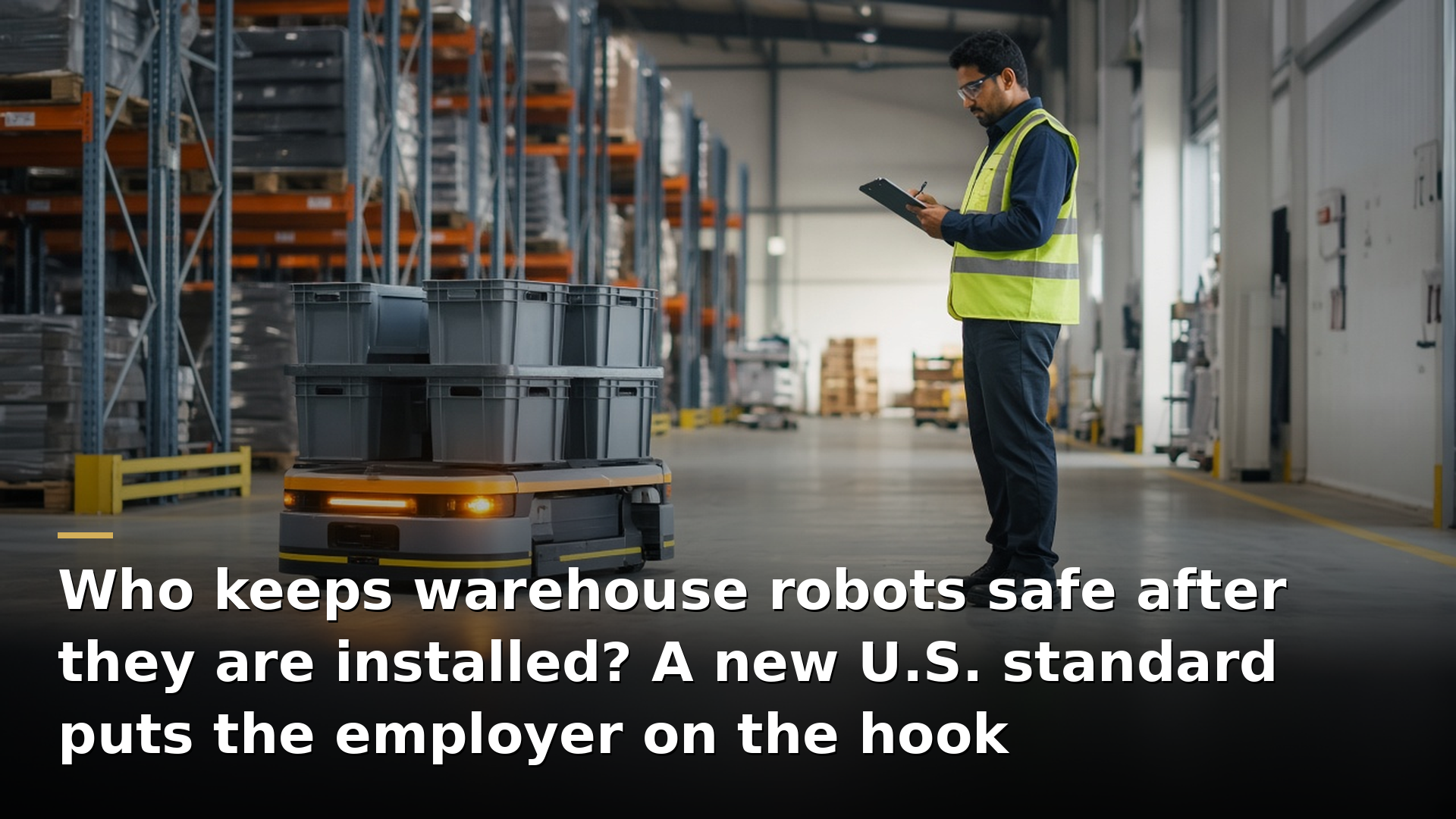
A self-driving cart that shares an aisle with people is not “done” the day it rolls off the truck. Someone still has to own the boring, ongoing work: training, inspections, and what happens when the floor layout changes next month.
The missing chapter. The Association for Advancing Automation (A3) says it has completed the three-part R15.08 series for industrial mobile robots — the carts and mobile machines that move through factories and warehouses. Part 3, published as ANSI/A3 R15.08-3-2026 (American National Standards Institute), is now available. Its full title is Industrial Mobile Robots – Safety Requirements – Part 3: Use of IMR Applications.
What Parts 1 and 2 already covered. Part 1 sets safety requirements for the industrial mobile robot itself. Part 2 covers the system and how that robot is applied on site. Together they were mostly about building and installing something that can share space with people without a fence.
What Part 3 adds. According to A3’s public summary (via Robotics 24/7), Part 3 focuses on the user — the employer running the robots day to day. It offers requirements and guidance for keeping risk acceptable across everyday operations and the full machinery lifecycle. That includes risk assessment, management of change, employee training, and periodic reviews and inspections. The ANSI webstore preview puts it in similar words: safe use, risk assessment, managing change to both the robot application and the current operating environment, and personnel safety over the whole life of the equipment.
Why “management of change” matters on a real floor. Warehouse aisles get rearranged. A new rack goes in. A route that was quiet at 2 a.m. is busy at shift change. Part 3 is aimed at that after-install reality: safety is not a one-time checkbox at commissioning. A3 also says Part 3 was developed alongside Part 3 of the older ANSI/A3 R15.06 standard for fixed industrial robots, so employers get more consistent guidance whether the machine sits still or rolls.
The machines-beside-you thread. This sits next to last week’s Safeworld seed story — crash-testing generative AI robots in digital copies of workplaces — and the Agility Robotics / FORT Robotics safety-kit deal for the Digit 5 humanoid. Different tools, same bet: robots that share floors with people need trust layers that outlast the demo video.
Ink, not pencil: the standard text is sold and paywalled (ANSI lists a PDF price), so this draft sticks to A3’s and ANSI’s public summaries — not a line-by-line reading. U.S. national standards of this kind are voluntary unless a regulator, contract, or insurer adopts them. The Robotics 24/7 write-up is dated October 4, 2026 — about three days old as of this Oct. 7 desk date — so treat freshness as a caveat, not a breaking siren.
Why regular people should care
Someone has to own the Tuesday after install. If mobile robots keep filling warehouses and factories, the person walking past them is not a robotics engineer. Part 3’s everyday stake is accountability: who reassesses risk when the layout changes, who trains the new hire, who checks that last month’s safe path is still safe. Machines beside you only stay boring if that homework is someone’s named job.
What's next
What to watch. Whether regulators, big buyers, or insurers start pointing to R15.08 Part 3 in requirements; whether robot makers market “Part 3–ready” playbooks for their customers; and whether the Safeworld-style testing layer and this employer-duty chapter start to reinforce each other. For now the U.S. mobile-robot safety series is complete on paper — and the ongoing safety duty sits with the companies that run the robots, not only the ones that built them.