
By Casey Forge
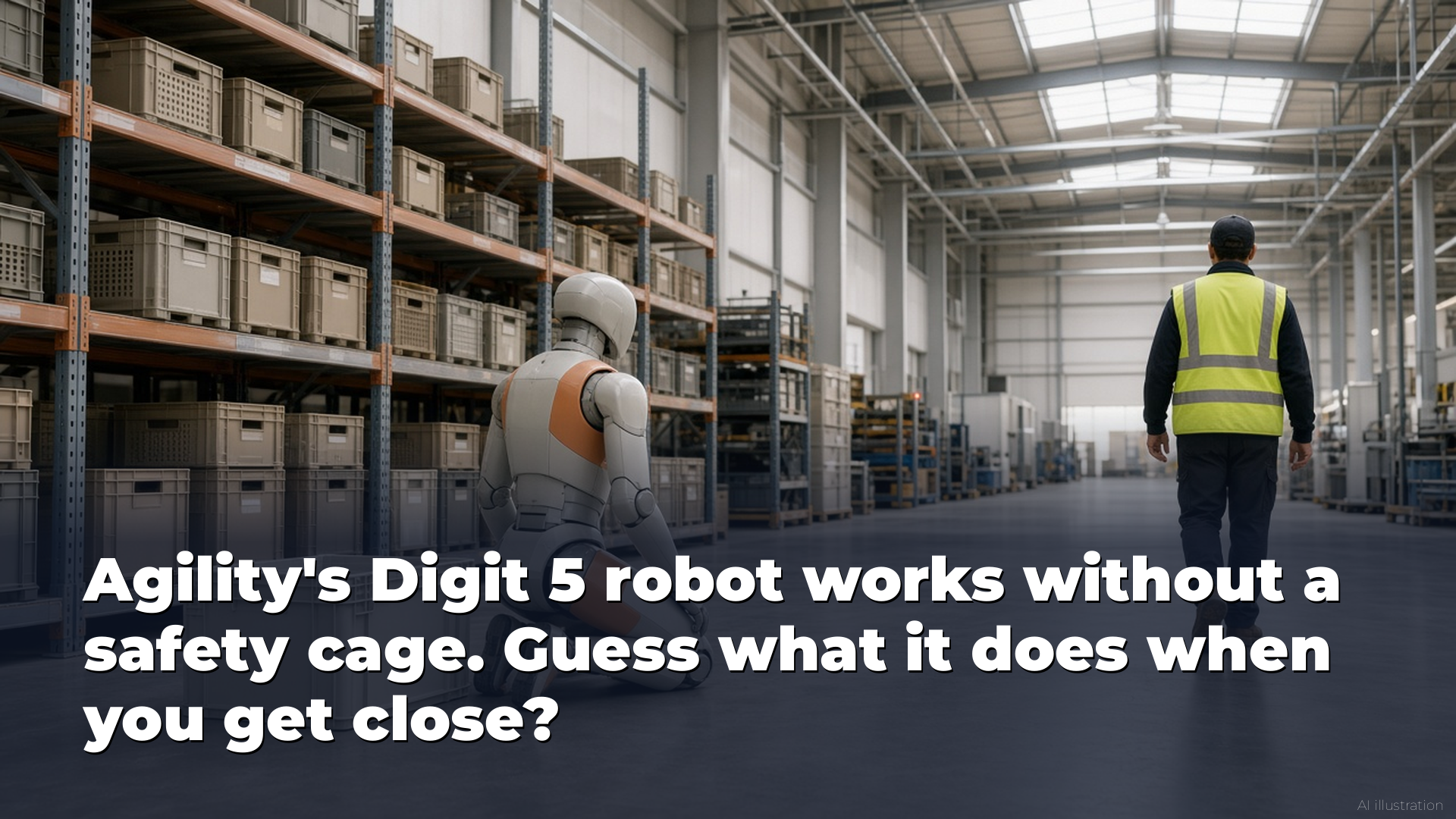
Picture a warehouse worker walking down an aisle with a clipboard. Ahead, a robot the size of a person is lifting a heavy plastic bin onto a high shelf.
The worker gets closer. The robot stops, puts the bin down, sits on the floor and switches off its motors.
That is the plan for Digit 5, the newest humanoid robot from Agility Robotics.
The news. In an essay for IEEE Spectrum published October 19, Agility co-founder Jonathan Hurst explained how the company redesigned its robot so it can work next to people without a safety fence. A day later, on October 20, farm-equipment maker AGCO and Agility announced a plan to try Agility's Digit robot at AGCO's factory in Hesston, Kansas.
How it works
No more cage. When the earlier Digit 4 was put to work for customers, it had to stay behind physical barriers, kept apart from people at all times, to meet insurance and regulatory demands. Hurst writes that this "severely limited their usefulness." So working safely around people became a main goal for Digit 5. The team spent two years on it.
Sit and switch off. Digit 5 uses a set of sensors to find nearby people. "As a person approaches, Digit 5 is programmed to stop what it's doing, set down its payload, sit on the floor, and cut power to its motors before the person gets close enough to touch the robot," Hurst writes. Separate computers inside the robot are dedicated to safety.
Built for heavy work. Agility says Digit 5 is designed to lift 23-kilogram (about 50-pound) bins onto shelves up to 1.75 meters high. Its battery is meant to run for 90 minutes and fully recharge during a 9-minute break, and Agility says it is designed to work 20 hours a day.
Think of it like a forklift that politely parks itself whenever someone walks by. Hurst even makes that comparison himself.
Why regular people should care
Hurst has spent years trying to build robots that move as gracefully as animals. Digit 5 is not that robot. "In some ways, Digit 5 feels more like a forklift than the graceful humanoid I set out to build," he writes. Safety features made it bigger and heavier, and it can no longer run or jump like older models.
He accepts the trade. In his view, a robot that can safely work next to people and last a whole shift has to come first. Making it graceful comes later.
For workers, the hope is simple: robots take on the heavy, repetitive lifting that strains backs and shoulders. AGCO says Digit will start with sorting and stacking parts and placing storage bins. "This strategic relationship views humanoid robotics and AI [artificial intelligence] as essential 'teammates' in building flexible, intelligent factories," said Thomas Enghof, AGCO's director of manufacturing technology.
Ink, not pencil: These are company claims and plans. Digit 5's safety design has not yet been proven on a busy factory floor, and the AGCO pilot has not started. The release does not say which Digit model AGCO will use. The companies have not said how many robots it will use or how long it will last.
What's next
A Kansas pilot in 2027. AGCO says the pilot at Hesston is expected to begin in 2027. The companies say Toyota, GXO and Schaeffler also use Agility's humanoid robots.
The big question. A robot that sits down every time someone walks past is safe, but it may also stop a lot. Real-world use will show whether Digit 5 can stay both safe and busy on a shared floor.