
By Casey Forge
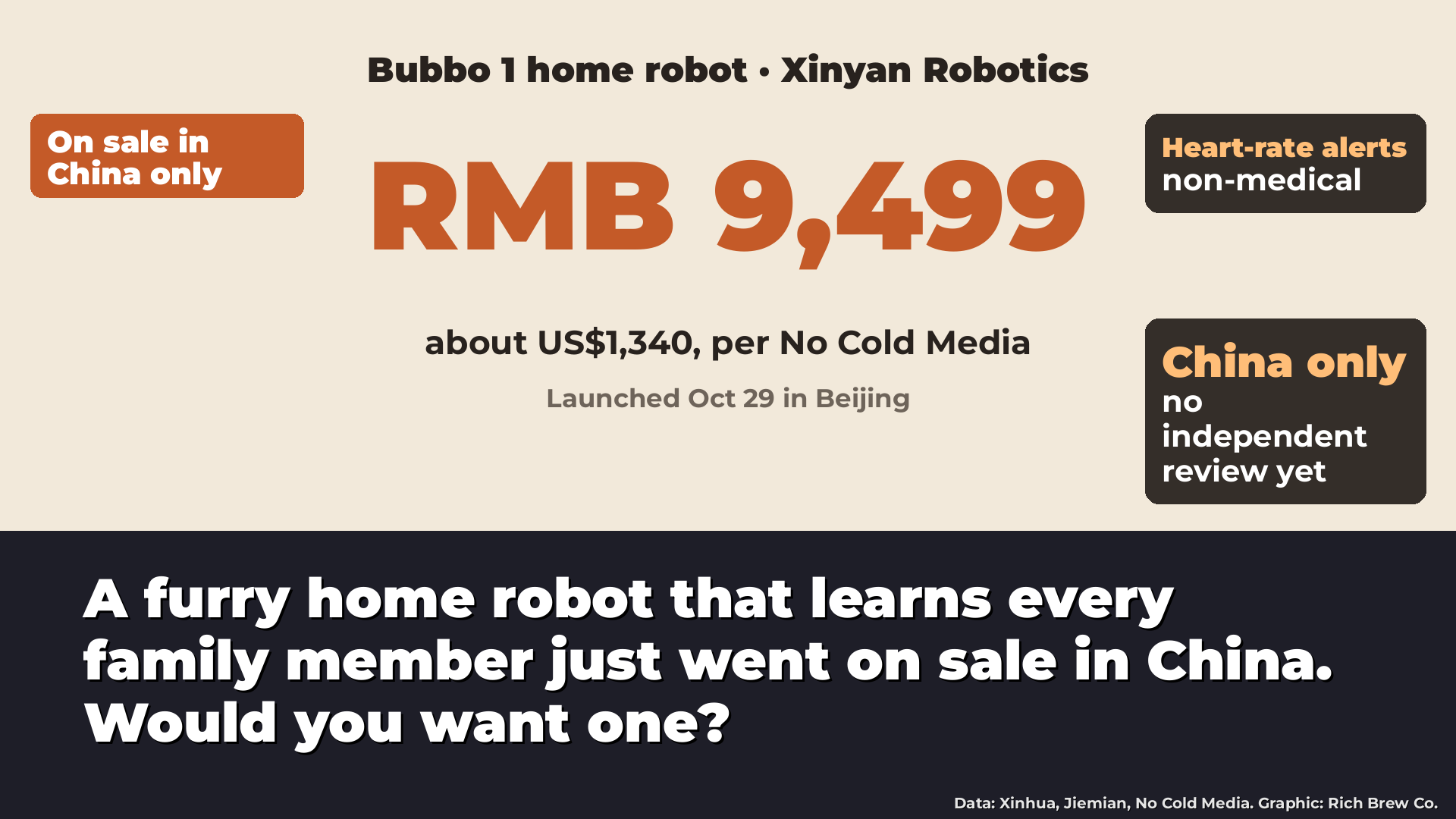
Picture a soft, furry robot about as tall as a toddler, moving over to Grandma to ask about her younger days, then turning to answer a grandchild's question about space. That is the pitch for Bubbo 1, a home companion robot that went on sale in China on Thursday. It is a clear look at where "gift robots" are heading, and at the questions families should ask before one moves in.
What happened
On Thursday, October 29, Chinese start-up Xinyan Robotics, founded in 2025, launched Bubbo 1, its first product, at an event in Beijing. According to Chinese media reports from Xinhua, China's state news agency, and business site Jiemian, it went on sale the same day through JD.com, a large Chinese online store, and other official channels.
- Price: RMB 9,499 (renminbi, China's currency). The first 1,000 buyers pay RMB 7,999. No Cold Media, an English-language site covering China tech, converts that to about US$1,340, or about $1,130 for early buyers.
- Size: about 65 centimetres (about 26 inches) tall, according to a launch feature on Phoenix's ifeng.com.
- Senses: the company says it has 26 sensors of 13 types, two "expression" screens for a face, and six degrees of freedom, meaning six ways it can move, Xinhua reports.
What it is meant to do
Xinyan says Bubbo runs its own Bubbo OS (operating system) and is built as a "family agent." Instead of serving one owner, it watches the household, learns who each person is, and keeps track of how they relate to each other.
The company describes features for each generation:
- For older people: company and conversation, plus fall detection that sends an alert to a phone app, so adult children can steer the robot over to check, according to the ifeng.com feature.
- For children: answers to questions and conversation in two languages, pitched to each child's level.
- For everyone: a family photographer mode, so the person who always takes the picture can finally be in it.
It also offers camera-based heart-rate alerts, which Xinyan describes as "non-medical." It is not a medical device. It can also share data with a Cece smart ring, made by a sister company Ren also founded, Jiemian reports.
The human side
Founder Ren Yongliang told a story about his own daughter at the launch, as the ifeng.com feature recounts. She asked him what a black hole was. He answered with the real science, and she ended up scared to fall asleep. That, he said, convinced him that answering children's questions needs carefully tuned answers, not just a parent's instinct.
He also explained the 65-centimetre height: it is about the height of a two- to three-year-old child, a good level for taking family photos.
On price, Ren compared the robot to hiring a bilingual home companion. Spread out, he said, it works out to less than RMB 1,000 a month, Jiemian reports.
Ink, not pencil: this story rests on the company's launch claims as reported by Chinese media (Xinhua, Jiemian and ifeng.com) and No Cold Media. We could not open the JD.com listing or a Xinyan press release ourselves, and no independent tester has reviewed Bubbo 1 yet. We found no sign it is sold in North America.
Why regular people should care
A robot that learns every face in your home is a bit like a new babysitter who never goes home. Before welcoming one, it is fair to ask: where does the video and heart-rate data go? What still works without an internet connection or a subscription? The ifeng.com feature says the company processes camera images on the robot until they cannot be rebuilt, before anything goes to the cloud. Outside experts have not checked that.
What's next
The company plans software updates at least once or twice a month, according to the ifeng.com feature. For North American families, Bubbo 1 is a preview, not a purchase. Expect more companion robots like it, and keep those privacy questions handy for the holiday season.