
By Casey Forge
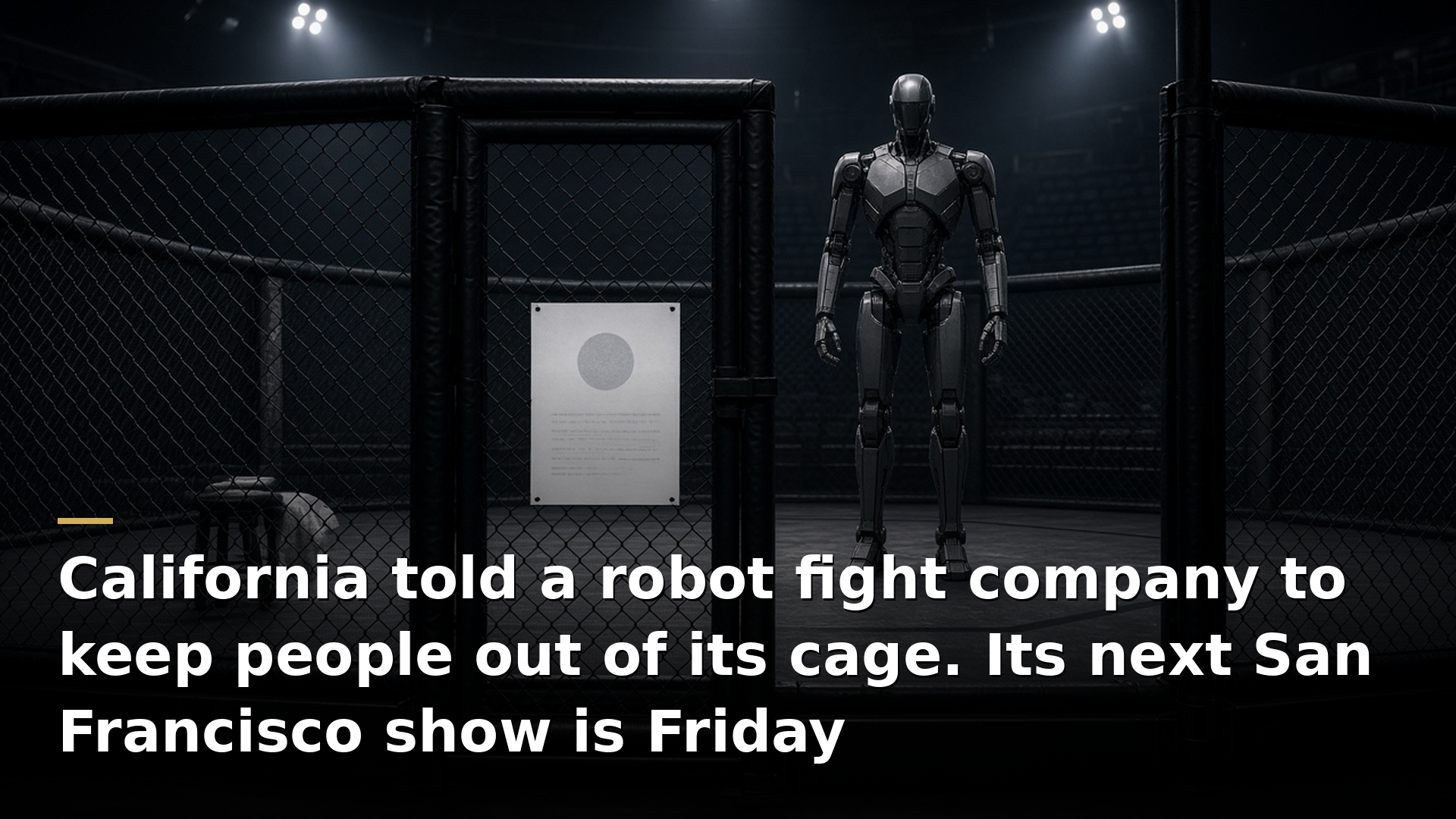
California has ordered a San Francisco company to stop putting people in a cage with its fighting robots unless the state approves and licenses the bout. No California or federal law explicitly covers people fighting robots, so the state is applying its boxing and mixed martial arts rules, and the company's next show is Friday, Oct. 9.
The order. Robot Entertainment Kombat (REK), a San Francisco company that stages robot fights, received a cease-and-desist letter from the California State Athletic Commission, the state body that licenses boxing and mixed martial arts. The commission is part of the California Department of Consumer Affairs, and the letter carries both names at the top. It is dated Sept. 23 and signed by the commission's executive officer, Andy Foster, according to a photo of the letter that REK's CEO, Cix Liv, posted on X.
What it demands. The letter orders REK to stop "holding, promoting or advertising any boxing or mixed martial arts contest match, or exhibition, involving any human in the State of California without the prior approval of the California State Athletic Commission," and to stop promoting or taking part in such events "involving any human without a license." It also warns that running these events without a license is a misdemeanor, a minor crime, under state law.
What the state says. "The California State Athletic Commission is committed to protecting the safety of the public and integrity of combat sports," Department of Consumer Affairs spokesperson Monica Vargas told SFGATE. "Unsanctioned activity puts the physical and financial well-being of all those involved at risk and such activity will not be tolerated."
What happened in the cage. On Sept. 18, influencer Frankie LaPenna fought three robots, according to USA Today's account of his video. He knocked over a smaller robot in seconds. Against the 6-foot "Terminator," he took a kick that sent him across the cage despite his protective gear, then pushed the robot to the ground to win. He lost his last bout, against a faster robot called the "Predator." Afterward he said it kept getting back up and, unlike a human opponent, never seemed to tire. One machine on the card, a 200-pound humanoid, was advertised as able to kick with up to 850 pounds of force.
A rulebook written for two people. Think about what makes a boxing match fair: opponents matched by weight, a referee who can stop it, two bodies that both get tired. California and federal law do not explicitly ban human-versus-robot fights, USA Today notes. The dispute is over whether these bouts fall under existing combat-sports rules that require state approval and licenses. Liv says he contacted regulators before the events and was told they were illegal. "They said what we are doing is illegal, yet there is no law for it," he wrote. "The law clearly states that a boxing match is between 'two persons' as defined by law."
The timing, honestly. The order is not brand new. Liv posted it on Sept. 30 with the line: "We made it boys. California sent us a Cease and Desist for 'UNSANCTIONED HUMAN VERSUS HUMANOID ROBOT CAGE FIGHT'." SFGATE and tech sites covered it in early October, and USA Today brought it to a national audience on Oct. 7. REK's website still lists a "REK Deathmatch" in San Francisco on Friday, Oct. 9. The three announced bouts are robot against robot, some with arm-mounted blades, according to Humanoids Daily's account of the event page. Nothing announced so far puts a human in the cage.
Ink, not pencil: the letter's date, signer and wording come from the photo Liv posted, and SFGATE, which says it obtained the letter, also dates it Sept. 23. We did not find the order on a state website. USA Today dated the order Sept. 30, the day Liv posted it, and named the second agency as the "California Department of Public Affairs"; the letter shows the Department of Consumer Affairs. The 850-pound kick is REK's own advertising claim, not a measured result. The Sept. 18 bout appears to be REK's first involving a human; its events are usually robot against robot. REK did not respond to USA Today or SFGATE.
Why regular people should care
Machines beside you need a referee, too. This week's cage is extreme, but the question is the same one we keep asking about warehouses and sidewalks: when a strong machine shares space with a person, who checks that it's safe? Our recent robot-safety coverage has followed answers built for work: Safeworld's effort to crash-test AI-driven robots in digital copies of workplaces, and the Association for Advancing Automation's (A3) completed mobile-robot safety standard, which puts ongoing safety duties on employers. Those were written for factories and warehouses, not for a paying crowd watching a volunteer trade kicks with a humanoid. Entertainment may be where the gap shows first.
What's next
Friday is the test. Watch whether the Oct. 9 San Francisco show goes ahead as a robots-only card, whether any human steps into the cage and whether the state responds. Oct. 9 is the only upcoming event on REK's website, which lists 14 past fights, most of them in California. The bigger question will outlast this one company: whether lawmakers write rules for people and robots sharing a ring, or leave regulators stretching rules written for "two persons."