
By Casey Forge
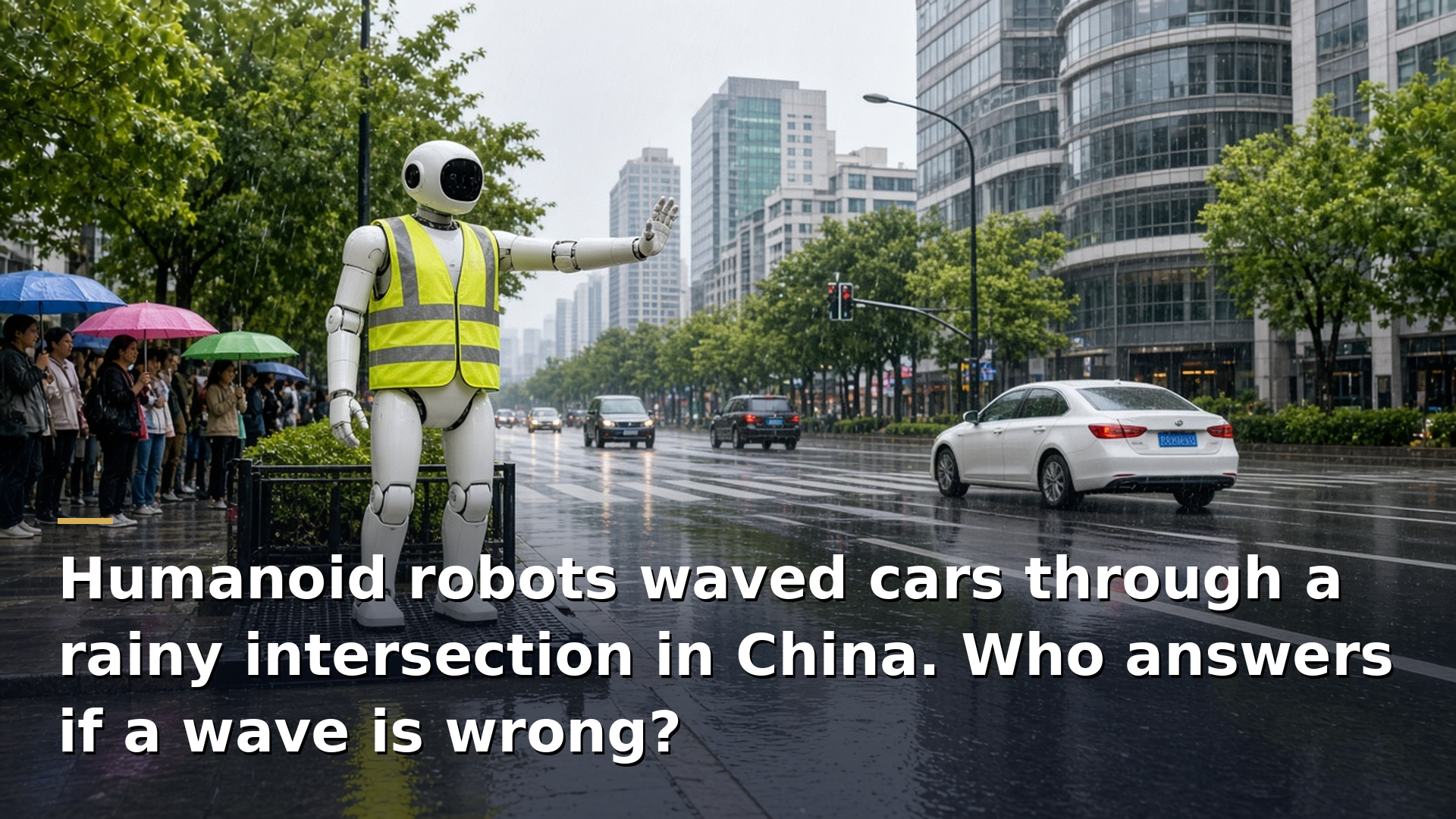
When a person in a reflective vest waves you through a red light, you go. You don't ask for their training records. You trust the vest.
In Hangzhou, China, during a rainy start to October that included the National Day holiday, some of those waves came from humanoid robots.
What happened. DEEP Robotics, a Hangzhou robot maker, put a batch of its DR02 humanoids at busy intersections in the city's Xihu District, including Zheda Road and West Wenyi Road, according to its Oct. 8 press release. The robots gave traffic hand signals during steady rain. Others answered visitors' questions in several languages at Xixi National Wetland Park and near the West Lake scenic area.
How it is supposed to work. The company says the robot is sealed against rain and dust. It uses sensors and cameras to move around the intersection, steer clear of pedestrians and vehicles, and adjust "its position and hand signals for directing traffic according to on-site conditions." It was also tested on spotting e-bike riders without helmets, overloaded bikes, and people or cars stopping over the line, then giving spoken safety reminders.
Who is telling the story. Two of the three main accounts use almost the same words. The company wrote the release. China's state news agency, Xinhua, ran a Chinese-language story on Oct. 9 that closely follows it. Xinhua frames the holiday crowds as "a rare real-world testing window" (our translation) and calls the trial a test of the robots' "adaptability and stability in real traffic flow." The only quote from someone on site, an unnamed staff member, appears in both: "With many repetitive advisory tasks handed to the robot, we can devote more energy to accident handling and enforcement of key violations."
No scorecard. TechRepublic points out what is missing: "DEEP Robotics did not provide trial results quantifying accuracy, uptime, cost savings or improvements in traffic flow." We found no independent safety data. We don't know how many robots were used, for how many hours, how many signals they gave, or whether any went wrong.
Not replacing officers, for now. TechRepublic says the trials "were presented as product testing rather than evidence of a completed commercial deployment or a replacement for human traffic officers." The company's English release is a little bolder. It says the test showed "the feasibility of the product replacing manual labor for repetitive duties under harsh weather conditions," while people focus on "tasks requiring human judgment." Xinhua's Chinese version speaks more softly, of the robots taking on repetitive duties rather than replacing workers. Neither account says the robots worked without people nearby.
What's solid, and what isn't. The company's photos and both written accounts show robots standing at real, busy intersections in the rain, and that is new. Everything else here is the company's description of its own test. "Works in the rain" is a claim until someone outside the company measures it.
The wave question. Here is the part that matters to anyone who drives, rides or walks. Picture a driver who rolls forward because a robot waved, and a cyclist the robot didn't see. Who is responsible? The driver, the robot maker, the city that allowed the test, or the officer standing nearby? None of the published accounts say what rules covered the test, or who would answer for a wrong signal. That doesn't mean there were no rules. It means nobody has told the public.
This week we wrote about a dancing humanoid that knocked a streamer to the floor. That robot was doing exactly what it was programmed to do. An intersection asks much more of a machine. It has to read a scene that never repeats, in weather that blurs cameras, while people decide in a second whether to trust it.
Why regular people should care
Machines are moving from the factory floor to the curb. In a warehouse, a robot can be fenced off. At a crosswalk, it stands beside a child holding a parent's hand. TechRepublic notes that fixed cameras and ordinary traffic equipment can already do some of these jobs. So the real test of a humanoid traffic helper isn't whether it can wave. It's whether it beats the simpler options, and whether someone clearly answers for it when it doesn't.
If you meet a robot directing traffic, treat it the way you'd treat a temporary sign: follow it, but keep your own eyes on the road.
What's next
Data, then rules. TechRepublic says any wider rollout will depend on "demonstrating dependable performance, clear coordination with human officers and measurable benefits." Watch for published results from DEEP Robotics, any comment from Hangzhou traffic authorities, and the first city to write down who is responsible when a robot's wave goes wrong. Until then, the vest still matters more than the hand inside it.