
By Casey Forge
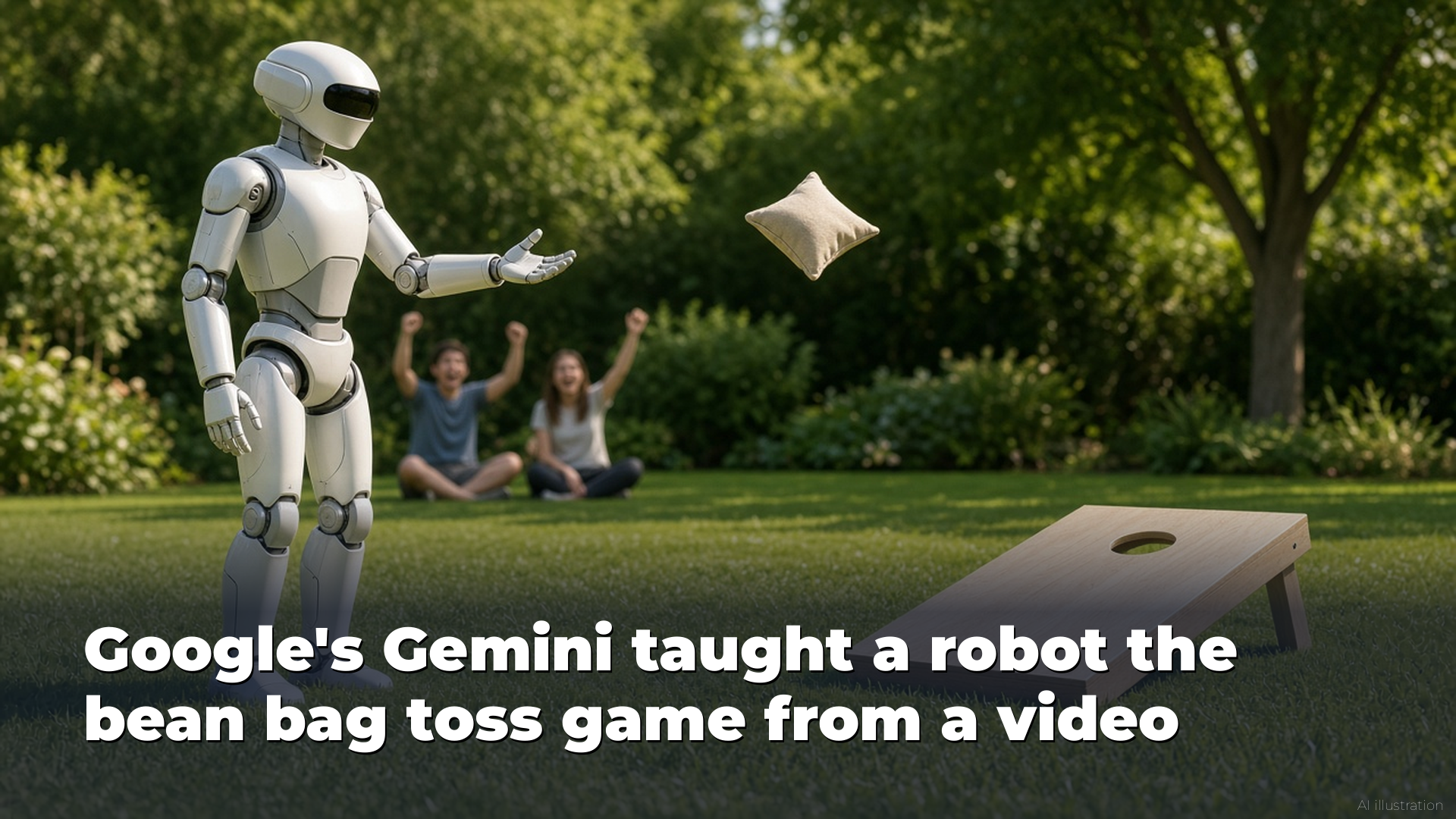
Most of us learned to throw a ball the same way. Someone showed us, we tried, we missed, and we adjusted.
Robots have usually learned differently. Engineers spend weeks building a careful computer model of the robot and the task before it can practise anything.
Google DeepMind says it has found a shortcut. Its newest AI (artificial intelligence) model watched a plain video of a person playing the bean bag toss game, then helped a humanoid robot learn the same throw. If the idea holds up, robots could pick up new jobs far faster than they do today.
What happened
The bean bag toss is the backyard game where you toss small bean bags at a slanted board with a hole in it.
Google showed the demo on October 13, when it launched Gemini 4 Argon, its latest AI model. Trade sites were still writing about it this week.
According to Google, in an internal test Argon:
- watched a raw video of a person playing the bean bag toss game,
- worked out where the board was and how the person's body moved,
- wrote its own computer simulation, a kind of video-game practice field, and
- passed what it learned to Apollo, a humanoid robot made by Apptronik, a company based in Austin, Texas.
In the real world, Apollo then sank seven shots in a row.
In Google DeepMind's video, the robot's own explanation says it watched each bag land and adjusted its release "by a few centimeters" until the throws went in. You can hear the team cheering. "It was learning from its own experience, which was extremely thrilling to see," one researcher says.
Google calls this "Video-to-Sim-to-Real": from video, to simulation, to the real world. The company says it "compresses weeks of manual simulation modeling into a few hours."
Why it is a big deal, if it scales
Think of how you might learn to make bread from a cooking video. You watch, you practise in your own kitchen, and you adjust until it comes out right. You don't need a baker standing beside you for weeks.
Until now, robots have mostly needed that baker. Every new task meant hand-built models and lots of engineering time. If an AI can turn ordinary videos into practice sessions, there are millions of how-to videos already out there.
What we don't know
This was one task, in one internal test, run by Google. No outside group has checked it.
Google's post does not say how many throws Apollo tried in total, so seven in a row does not tell us its overall success rate. A bean bag toss is also forgiving. A miss is just a miss. Folding laundry or helping an older person stand up is much harder, and mistakes matter more.
Ink, not pencil: Google did run this demo, and its video shows Apollo sinking the throws. Whether the method works for many different everyday tasks, and how often it fails, is still unknown.
Why regular people should care
Today's robots are slow to teach, which is one reason they are still rare in homes, shops and care settings. A faster way to teach them could bring helpful robots closer, for heavy, dull or risky work.
It also raises a fair question for all of us: if a robot learns a skill from a video, who checks that the skill is safe around people before it is used for real? That is a question worth asking robot makers early.
What's next
Argon is available now to developers and to paying Gemini subscribers. Google's launch post does not say when, or whether, robots in homes or workplaces will use this method. The next thing to watch is whether Google or Apptronik show the same trick on everyday tasks, with full results.