
By Casey Forge
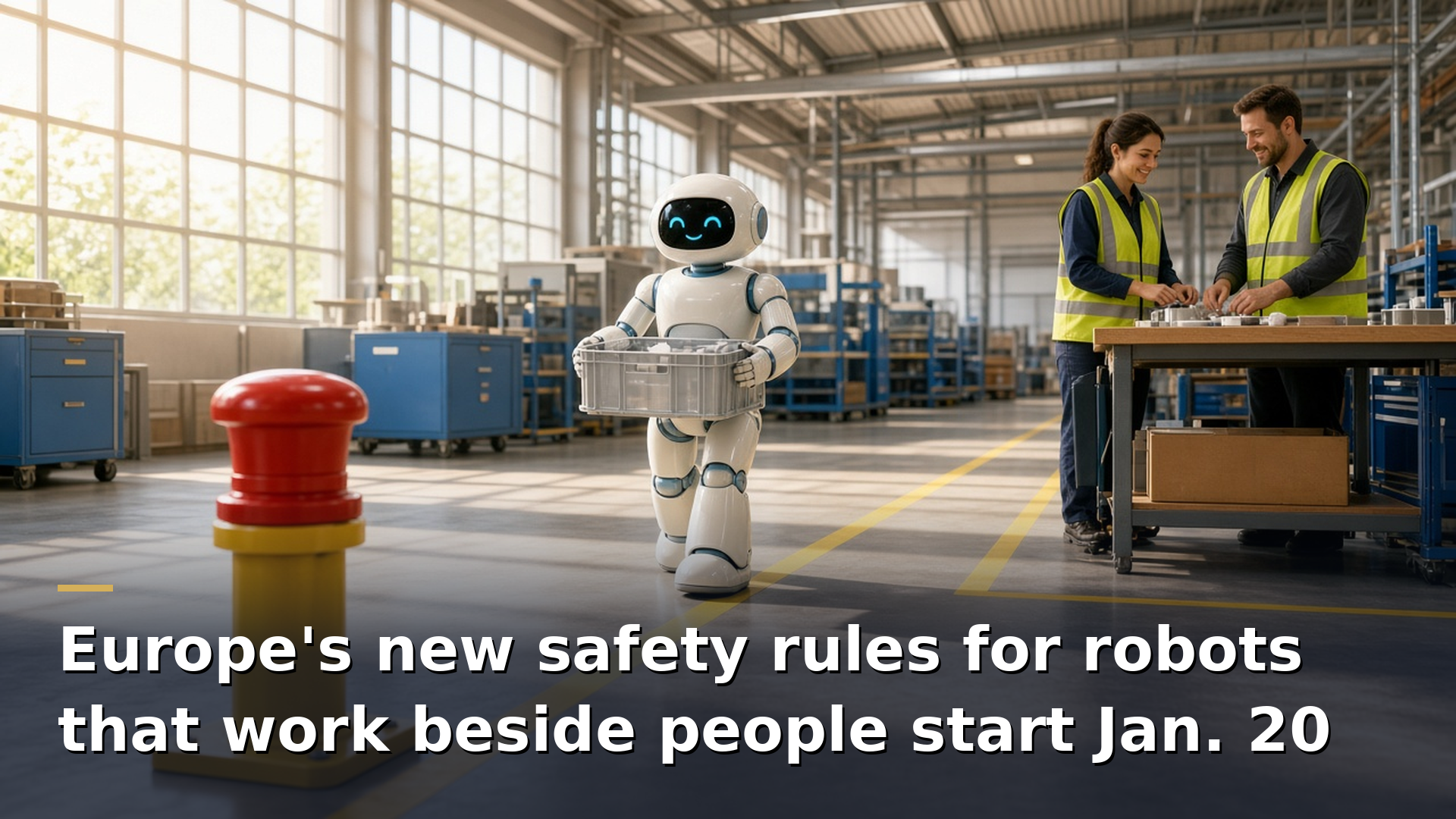
A robot that learns on the job sounds like progress. In Europe, from January, a robot whose safety features rely on that kind of learning will also need an outside inspector.
On Oct. 8 in Milan, the Italian technology group Lutech unveiled L.u.c.a., short for "Lutech hUmanoid Collaborative Assistant." It is a human-shaped robot meant to work next to factory staff and take on the most dangerous jobs, Italy's national news agency, ANSA, reported.
What Lutech showed. According to ANSA, the robot has a separate operating system just for safety, and in an emergency that system takes priority over normal work. "The robot's reaction must be immediate," Lutech's head of manufacturing, Manfredo D'Alessandro Caprice, said (translated from Italian), with obstacles handled "in milliseconds." Cameras and sensors feed a central platform that trains the robots, gives them tasks and changes their behaviour across the whole fleet. Lutech also says, according to other Italian coverage of the launch, that L.u.c.a. has already moved materials and run safety checks on factory floors.
What Lutech didn't say. No price. No technical specifications such as height, weight or battery life. No named customers, and no word on who builds the robot's body. As a review of the coverage points out, safety certifications were not mentioned either. For now, this is a presentation, not a product you can order.
The rules it will have to meet. The European Union (EU) Machinery Regulation, officially Regulation (EU) 2023/1230, replaces a 2006 directive and applies from Jan. 20, 2027 (Article 54). The date was first printed as Jan. 14, then fixed by an official correction in July 2023. Because it is a regulation, the same text applies directly in every EU country.
Machines that keep learning get an outside check. Most machines can be self-certified by their makers. Annex I, Part A, points 5 and 6 list a special group: safety parts, and machines with built-in systems, that have "fully or partially self-evolving behaviour using machine learning approaches ensuring safety functions." Under Article 6(1) and Article 25(2), these need one of the procedures that bring in an independent testing body, known as a notified body. The regulation's explanatory notes (recitals 54 and 55) say why: learning systems can be hard to see inside, depend on data and act on their own. They also say the outside check does not apply to software "incapable of learning or evolving."
So for L.u.c.a., one question matters: does its safety system learn, or does it follow fixed, programmed rules? Lutech hasn't said.
Think of an elevator. You step in without a second thought because someone independent inspected it. The new rules apply that idea to a machine whose safety features can change as it learns.
Rules for sharing space. Annex III sets the safety requirements every machine must meet. Section 1.2.1 says a machine that learns and acts with some independence must not move beyond its "defined task and movement space," must keep records of its safety decisions for one year, and must be correctable "at all times." Once a stop command is given, nothing may prevent the machine from stopping. Section 1.3.7 asks makers to reduce both the risk of contact and the "psychological stress" of working near a machine, whether people simply share a space with it or work directly with it. Section 1.1.6 adds that such machines should, where relevant, tell operators "what it is going to do and why."
Hackers count as a safety risk. Section 1.1.9 says software and data critical to safety must be protected against "accidental or intentional corruption," and that the machine must keep evidence of any tampering. Section 1.2.1 also asks control systems to withstand "reasonably foreseeable malicious attempts from third parties." For a robot fleet steered from one central platform, that matters.
Ink, not pencil: how notified bodies will test learning safety systems in practice is still being worked out, and Lutech has not said whether L.u.c.a. needs that test.
Why regular people should care
Robots are leaving their cages. For decades, factory robots worked behind fences. Humanoids are designed to walk the same aisles as people. We have covered what can go wrong when a humanoid and a person share space without clear limits. These rules try to answer, in writing, what a robot must do before it works next to you: stay in its lane, stop when told, explain itself and resist tampering.
What's next
Just over three months to go. Any company selling machinery in the EU, including humanoid makers, must meet these rules from Jan. 20, 2027. A 2026 amendment also lets the European Commission add extra requirements for high-risk artificial intelligence (AI) systems, which must apply by Aug. 2, 2028. Watch for the first humanoids to name a certification. That will say more than any launch event.