
By Casey Forge
Retirement, for this robot, was a running start. Figure says it trained its F.02 humanoids to jump on their own into molten steel at a foundry in Imatra, Finland — a real leap, the company insists, not footage drawn after the fact.
The reason is more shop-floor than science fiction. Figure says it loves F.02. The robot collected a lot of firsts: the company's first deployment at BMW, the birth of Helix, the first Figure robot doing household chores, and the first logistics deployment. Then the newer F.03 fleet grew, and "maintaining the F.02 fleet no longer makes sense." The machines are full of custom actuators and other hardware the company did not want left intact on a scrap bench. Taking each one apart, Figure says, would eat so much technician time that the next robot, F.04, would slip. So the old fleet had to go in a way that destroyed the proprietary parts without stealing the people building the new one.
Figure says it asked the internet. The answer that stuck came from Arnold Schwarzenegger: melt them. He wanted in, and the company took the suggestion literally. Foundries in the United States and Mexico would not let a robot carrying lithium-ion batteries jump into their equipment. Figure even asked former MythBusters cast members to help hunt for a site. The place that said yes was the foundry in Imatra.
Training started at Figure's campus in San Jose, with large airbags and jumps off the second floor of one of its buildings. Stunt artists supplied the movement reference. Engineers trained a new AI model in simulation so a robot could aim itself into a bucket of molten steel at a foundry none of the robots had visited. That is the whole trick in one sentence: practice in a simulator, then do it once, for real, somewhere new.
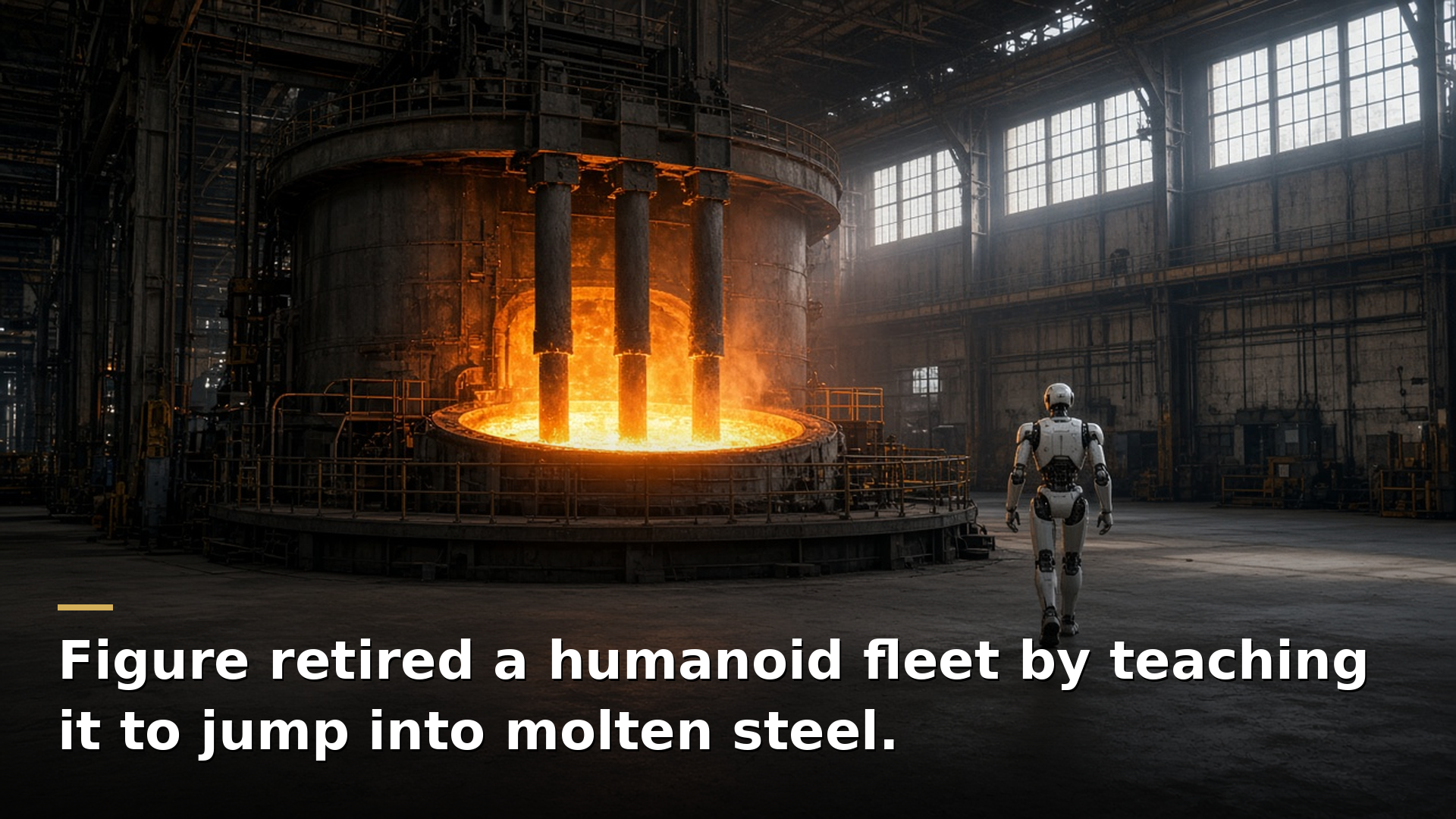
The furnace is a 75-ton electric arc furnace. Three large graphite electrodes melt solid steel scrap. Figure had 24 hours and six melts. Each melt gave about a 20-minute window before the steel cooled and grew a hard crust. Heat and electromagnetic fields knocked out cameras and other electronics around the furnace. Figure says the robots kept running the policies they had trained anyway.
Afterward the metal bars came back to the United States to be machined into a small run of objects commemorating F.02 — "a piece of Figure's history in a compact package," in the company's words. Most of the fleet is gone. A few robots remain in storage at headquarters. Figure's own sign-off is worth keeping: in a season of synthetic video, they say they really trained the robots to jump autonomously, shipped them to Finland, and had them leap into a vat of molten steel.
Ink, not pencil: this is Figure's account, echoed by Interesting Engineering, not an independent safety audit. The company does not say how many robots jumped, only that most of the fleet is gone and a few are still stored. "No longer makes sense" is their phrase for retiring F.02 — they did not publish a cost spreadsheet. And a jump into a furnace is a disposal method, not a product feature anyone should copy in a garage. The batteries are why other foundries refused.
Monday-morning stake: factories and homes are about to meet robots that go out of date faster than a pickup truck. Figure's bind is the ordinary one, turned up: keeping yesterday's fleet was getting in the way of tomorrow's, and careful disassembly was too slow. The leap matters less as spectacle than as proof that a robot can leave simulation and hit a tight target in a place it has never been — while the metal, at least, gets a second life as a keepsake instead of an anonymous scrap pile.
Why regular people should care
Humanoid robots only become normal if someone can build them, deploy them, and then retire them without a year of teardown. F.02's résumé — a car plant, a logistics floor, household chores — is the mundane half of that story. The Finland jump is the strange half, and it is also a data point: the same machines could be taught a new whole-body skill in simulation and execute it while nearby electronics failed. If that kind of learning keeps working on duller jobs than a furnace, the robots that show up in warehouses and, later, homes get useful faster. Abundance here looks like shorter generations of hardware, not a single perfect robot frozen in 2024.
What's next
Figure says a few F.02 units are still at headquarters, the recovered metal is being machined into a limited series of artifacts, and F.03 is the fleet they intend to keep. The next signal is not another melt. It is whether F.04 actually arrives on the schedule this disposal was meant to protect, and whether skills practiced only in simulation keep surviving first contact with a real room. Watch the commemorative pieces, too. They are the rare robot retirement you can hold.