
By Casey Forge
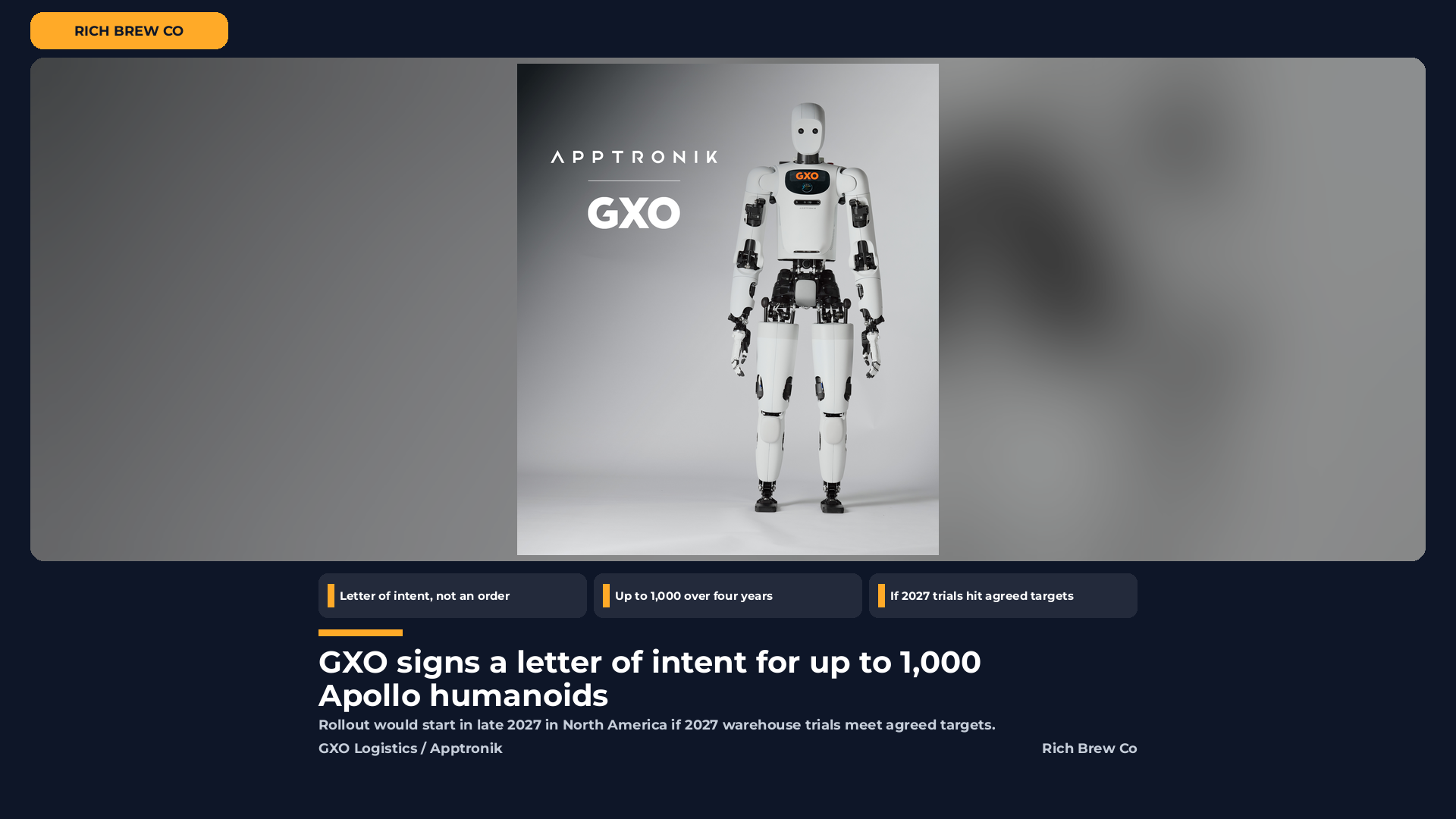
Image: GXO Logistics / Apptronik, press image issued with the Nov. 12, 2026 announcement
Picture a warehouse shift built around lifting, carrying and sorting the same kinds of boxes, hour after hour. That kind of repetitive, physically demanding work is exactly what one of the world's largest contract logistics companies wants humanoid robots to take on.
GXO Logistics has signed a letter of intent with robot maker Apptronik to expand live warehouse trials of Apptronik's Apollo humanoid robot in 2027. If those trials meet agreed productivity, safety and operational targets, the two companies say they intend to move toward a global rollout of up to 1,000 Apollo robots over the next four years, with the first deployments in North America in late 2027.
The announcement came on Nov. 12. Here is what it does and does not commit to.
A letter of intent, not an order
A letter of intent is a statement of plans, not a firm purchase order or a binding contract. GXO's release says the wider rollout is "subject to the success of the deployments and the ability to meet agreed performance, safety and operational KPIs." KPIs are key performance indicators, the measurable targets a project has to hit.
The 1,000 figure is a ceiling, not a booked fleet. The specific targets the robots must meet were not disclosed. No price, contract value or per-robot cost was given, and no warehouses or customers were named.
GXO says the commercial framework "is expected to follow a RaaS structure." RaaS stands for robotics-as-a-service: instead of buying a large fleet outright, GXO would pay for robots as a service, in a flexible arrangement it could scale as needs grow. The word "expected" matters. It is the plan, not a signed service deal.
What the robots would actually do
The 2027 trials focus on the heavy, repetitive parts of warehouse work. According to GXO, the planned tasks include:
- Picking: both bringing goods to a person and sending a robot to the goods
- Moving cases and totes, the plastic bins that carry items through a warehouse
- Packing
- Sortation, getting items to the right place for shipping
GXO says each use case will be "assessed and sequenced against jointly agreed productivity, safety and operational KPIs." The trials, which begin in 2027, are also meant to "validate the safety, security and technical requirements for scaled deployment" and to "demonstrate how humanoids can work alongside existing automation and GXO team members." In plain terms, each job has to prove itself next to people and the machines already on the floor before it scales.
What it could mean for workers
The companies frame this as help for people, not a replacement for them. GXO says Apollo "is designed to perform repetitive, physically demanding tasks in warehouse environments," and that the technology "is expected to help address labor availability, improve throughput and uptime, and enable employees to focus on higher-value activities."
The leaders behind the deal put people at the centre. GXO Chief Executive Officer (CEO) Patrick Kelleher said the expanded work is about identifying and scaling "the applications where humanoids can deliver the greatest impact for our customers and team members." Apptronik CEO and co-founder Jeff Cardenas said the robots are "designed from the start for thoughtful collaboration with people."
Those are company statements. Warehouse hiring is also shaped by the wider economy, not by robots alone.
Scale helps keep this in perspective. GXO says it has "over 150,000 team members across more than 1,000 facilities, totaling more than 200 million square feet." Even a full fleet of 1,000 robots would be a modest presence across that network — a meaningful early step, not a wave of replacements.
Ink, not pencil: GXO and Apptronik have signed a letter of intent for up to 1,000 Apollo robots over four years, but the rollout happens only if 2027 live trials meet agreed productivity, safety and operational targets.
How the partnership got here
This did not start last week. GXO first announced work with Apptronik in June 2024, as an early-stage proof of concept "to develop practical applications for the Apollo humanoid in a warehouse environment." The plan then was to evaluate Apollo in a lab first, then move to a U.S. distribution center once ready.
According to GXO's Nov. 12 release, "earlier this year, Apollo wrapped a successful pilot deployment with GXO in the U.S. focused on autonomous picking for small consumer goods." The companies also say they have "conducted data collection and live autonomous evaluations on more than 50 different logistics tasks" at Apptronik's Robot Park humanoid training facility.
GXO calls that pilot successful but has not published results. The release gives no pilot site, number of robots, or speed or success-rate figures.
The robot version is not named yet
The Nov. 12 release simply says "Apollo." It does not say which version of the robot GXO would use. Apptronik unveiled Apollo 2 in June 2026, in walking and wheeled-base versions, and said lessons from it are feeding into a next-generation commercial model, Apollo 3. Because the deal does not name a version, we are not attaching any one model's height, payload or battery figures to it.
On safety, Apptronik's Apollo 2 product page describes "hardware-level safety zones," including an "impact zone" designed to immediately pause movement when an object is detected within a set radius, and a configurable perimeter zone that teams can adjust. Those are design claims from the company, not test results from GXO warehouses. Validating safety is exactly what the 2027 trials are for.
Who is behind Apollo
GXO's release says Apptronik has nearly 500 employees. The company started out of the Human Centered Robotics Lab at the University of Texas at Austin, and Apollo draws on work on 15 earlier robots, including NASA's Valkyrie.
Separately, as company background rather than the value of this deal: in February 2026, Apptronik announced a $520 million Series A extension that brought its total Series A to more than $935 million, and its total capital raised to nearly $1 billion. The company said the money would help it "ramp up production" of Apollo. Manufacturing company Jabil has been Apptronik's worldwide manufacturing partner for Apollo since February 2025. Neither company has published an annual production figure.
Not GXO's first humanoid
GXO is working with more than one humanoid maker. In October 2026, it announced an expansion with Agility Robotics, saying Agility's Digit robot had already moved more than 100,000 totes at one GXO site, with more deployments expected in early 2027. GXO also announced a humanoid pilot with Reflex Robotics in 2024.
Compared with the Agility deal, the Apptronik plan has the bigger headline number but sits at an earlier, conditional stage.
Why regular people should care
Think of it like a new hire's probation period. Apollo gets the job on a wider scale only if it shows it can do the work safely and well beside the team.
If the trials succeed, some of the most tiring warehouse tasks could shift to robots, the lifting, carrying and sorting that wears on bodies over a long shift. GXO says it wants people moving to higher-value work. The packages that reach your door pass through warehouses like these, so steadier, more reliable operations could matter well beyond the warehouse floor.
The careful, step-by-step approach is also good news. Each task has to prove itself before it scales. That is a sensible way to bring new machines into workplaces full of people.
What's next
- 2027 live trials: watch for the tasks that clear GXO's productivity, safety and operational targets.
- A firm deal: look for a binding robotics-as-a-service agreement with terms.
- Which robot: watch for word on whether GXO deploys Apollo 2, Apollo 3 or another version.
- Late 2027: the first North American deployments are targeted for then, if the trials succeed.
- Results: watch for published numbers from the 2026 pilot or the 2027 trials.
Sources
- GXO, "GXO and Apptronik Expand Partnership to Scale Humanoid Deployment," Nov. 12, 2026: https://investors.gxo.com/news-releases/news-release-details/gxo-and-apptronik-expand-partnership-scale-humanoid-deployment
- GlobeNewswire copy of the same release: https://www.globenewswire.com/news-release/2026/11/12/3401413/0/en/gxo-and-apptronik-expand-partnership-to-scale-humanoid-deployment.html
- GXO, "GXO advances humanoid strategy, announces multi-phase R&D initiative with Apptronik," June 20, 2024: https://investors.gxo.com/news-releases/news-release-details/gxo-advances-humanoid-strategy-announces-multi-phase-rd
- Apptronik, "Welcome to Robot Park" (Apollo 2 unveil), June 30, 2026: https://apptronik.com/news-collection/welcome-to-robot-park-where-apptroniks-apollo-goes-to-work
- Apptronik, Apollo 2 product page: https://apptronik.com/apollo/apollo-2
- Apptronik, Series A funding release, Feb. 11, 2026: https://apptronik.com/news-collection/apptronik-closes-over-935-million-series-a
- Jabil, Apptronik manufacturing collaboration, Feb. 25, 2025: https://investors.jabil.com/news/news-details/2025/Apptronik-and-Jabil-Collaborate-to-Scale-Production-of-Apollo-Humanoid-Robots-and-Deploy-in-Manufacturing-Operations/default.aspx
- GXO, Agility Robotics expansion, Oct. 26, 2026: https://investors.gxo.com/news-releases/news-release-details/gxo-and-agility-robotics-expand-partnership-accelerate/
- GXO, Reflex Robotics partnership, Sept. 18, 2024: https://investors.gxo.com/news-releases/news-release-details/gxo-partners-reflex-robotics-deploy-new-warehouse-automation