
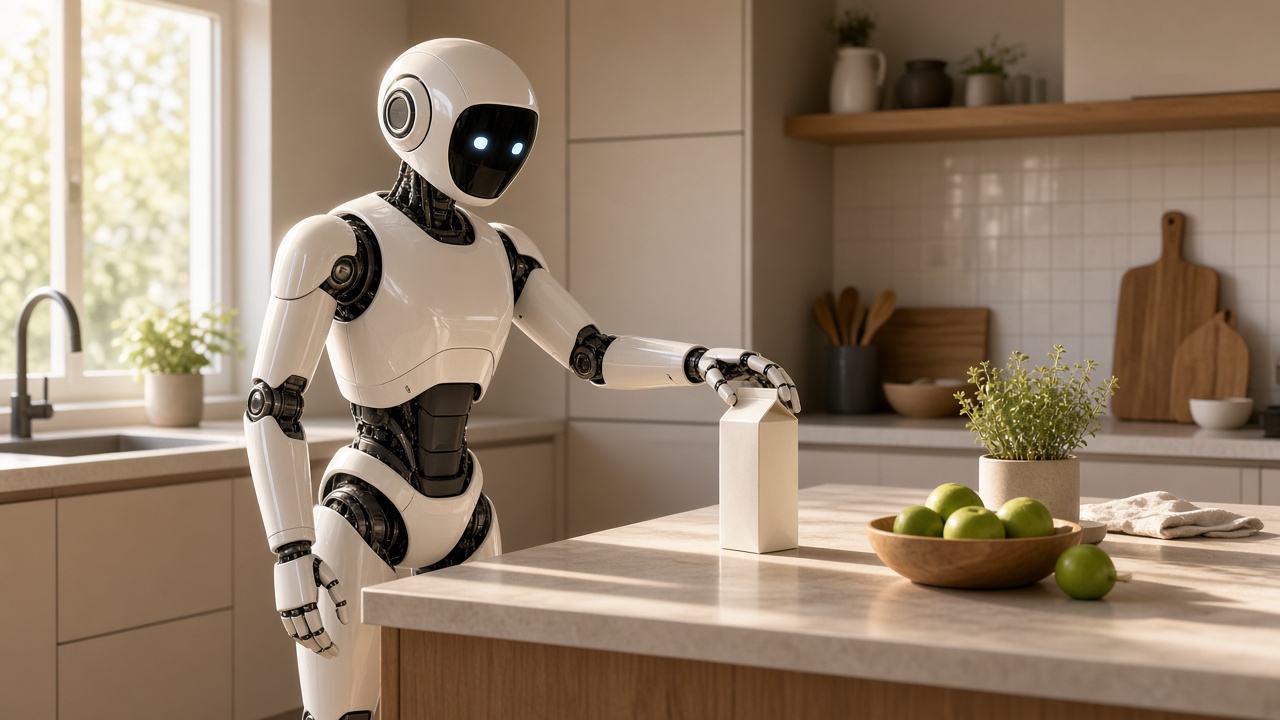
What if the robot’s “brain” didn’t need a whole new policy for every kitchen — just a good map and a skill drawer?
Researchers from Stanford and Caltech have introduced HomeBody, a system that plugs a frontier vision-language model — here GPT Astra — straight into a composable skill library on a Unitree G1 humanoid. Instead of the usual VLM → learned VLA → controller chain, System 2 calls skills (navigate, pick, place, open drawer) after the robot explores an unfamiliar kitchen, builds a Real2Sim digital twin in NVIDIA Isaac Sim, and keeps persistent spatial memory so objects still count when they leave the ego view.
Demos include multi-object cleanup — coffee bags to the island, spoiled milk and juice cartons in the trash — and fetching medicine from a remembered drawer on an underspecified request, then discarding a bad carton on the way. No environment-specific training data or extra policy learning for those tasks. Honest limits from the team: Astra latency between skills, finger-servo heat on long runs, API cost, and Real2Sim setup time. Local skills run on an RTX 4090 laptop while Astra sits remote. Code is on GitHub; the project page is video-friendly by design.
Why regular people should care
Homes are messy, kitchens are unique, and nobody wants a robot that only works in the lab that trained it. A humanoid that explores, remembers, and sequences chores from plain language is the difference between a demo reel and something that might one day fetch your meds when your hands are full. Limits are real — and naming them is part of trusting the progress.
What’s next
Watch more skills land in the library, whether latency drops enough for fluid home use, and how other labs reuse the “VLM + skills + memory” pattern. The future of chores just got a little more curious.
Image suggestions for Pic’s
1. Unitree-style humanoid mid-kitchen, reaching toward a carton on a counter (no logo wall). 2. Split: robot ego-cam view vs soft Isaac Sim twin of the same island. 3. Drawer-open moment: articulated hands hooking a handle, warm residential lighting.
Sources: Stanford TML — HomeBody, THE DECODER.