
By Casey Forge
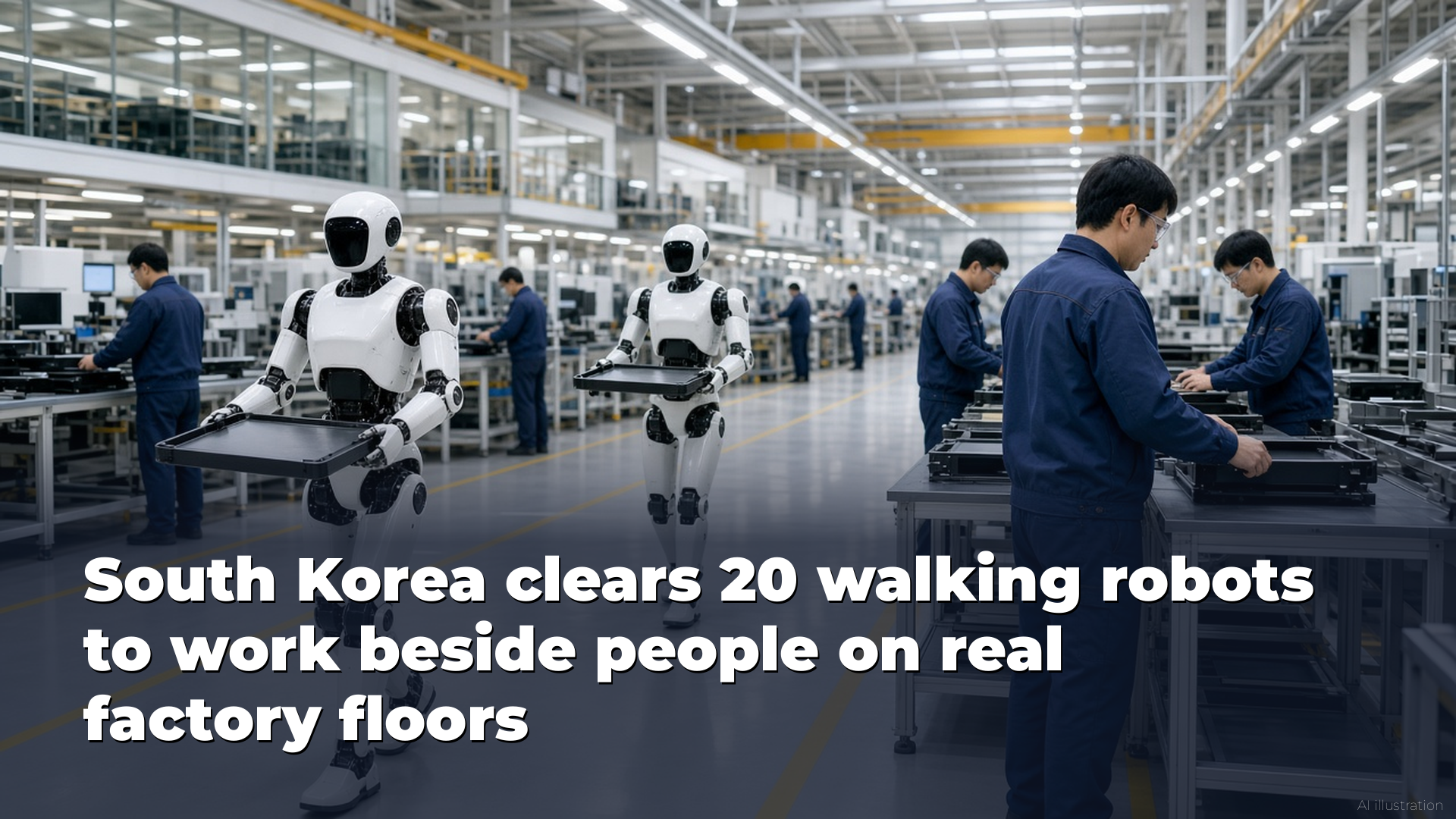
For decades, the rule in factories was simple: robots stay behind the fence, people stay in front of it. South Korea just agreed to test what happens when the fence comes down.
Picture a worker on a car-parts line. On her left is a colleague she has known for years. On her right, soon, may be a robot that walks on two legs, picks up a part and sets it in place. Not in a lab. On a normal shift.
The decision. On October 13, South Korea's industry ministry said its regulatory sandbox committee approved a live field test of 20 AI-powered humanoid robots, according to Seoul Economic Daily and Yonhap News Agency. A regulatory sandbox is a way for a government to let a new technology be tested under special permission, even when old rules don't fit it yet.
Four very different jobs
The robots. The two-legged humanoids come from Robros, a Korean robotics company. They will work at four sites, each with a different kind of task:
- Nepes (chips): cleaning contaminants off round parts used in semiconductor packaging.
- Sungwoo Hitech (cars): placing car body parts in their set positions.
- HD Hyundai Samho (ships): stacking scaffolding brackets, the pieces that hold work platforms to a ship's hull.
- Delivery Lab (logistics): moving refrigerated packaging.
The robots will move in spaces shared with, or next to, human workers. They will recognise what is around them, then pick up, carry and stack objects.
Why four places. Each site has different conditions and needs different precision, Seoul Economic Daily reported. Testing all four shows how well one kind of robot adapts.
Why the old rules didn't fit
Fences for fixed arms. Korea's current safety rules for industrial robots assume the robot stays in one place, and they require safety fences to separate it from people, Yonhap reported. That works for a welding arm bolted to the floor. It does not work for a robot that walks across the room.
Think of it like road rules written only for trains. Trains stay on tracks, so the rules are about crossings and barriers. A bicycle needs a different set of rules entirely. Humanoids are the bicycle.
Safety comes first. The test is allowed only on the condition that the Ministry of Employment and Labor's risk assessments and safety measures are carried out, according to Yonhap. The government plans to use the data to rewrite safety standards and open the technology to more factories.
The minister's view. "AI technology is advancing so fast that regulation struggles to keep up," Trade Minister Kim Jung-kwan said, as translated by Seoul Economic Daily.
Ink, not pencil: this is a test permit, not a full rollout. Twenty robots across four sites is a careful start, and we don't yet know how long the test runs or how results will be shared.
A small neighbour story, too
At the same meeting, the committee also approved a first test of four-legged patrol robots from Maum AI on riverside paths and in parks around Cheonan, Yonhap reported. The robots are meant to spot dangers, broadcast warnings and send live video to a control room.
Why regular people should care
This is about rules, not just robots. Most robot news is a flashy demo. This is quieter and more useful: a government asking how people and walking machines can share the same floor safely, and testing it before writing the rules. Korea is short of workers in some industries, and the government hopes humanoids can help with that, Seoul Economic Daily reported.
The best part may be who teaches the robots. A Hanyang University robotics professor told the paper that what matters is learning from how skilled workers move. In other words, human skill stays at the centre.
What's next
Watch the safety data. The results should shape new standards for humanoids at work. If the tests go well, expect more factories, and more countries, to follow with their own rules for robots without fences.