
By Casey Forge
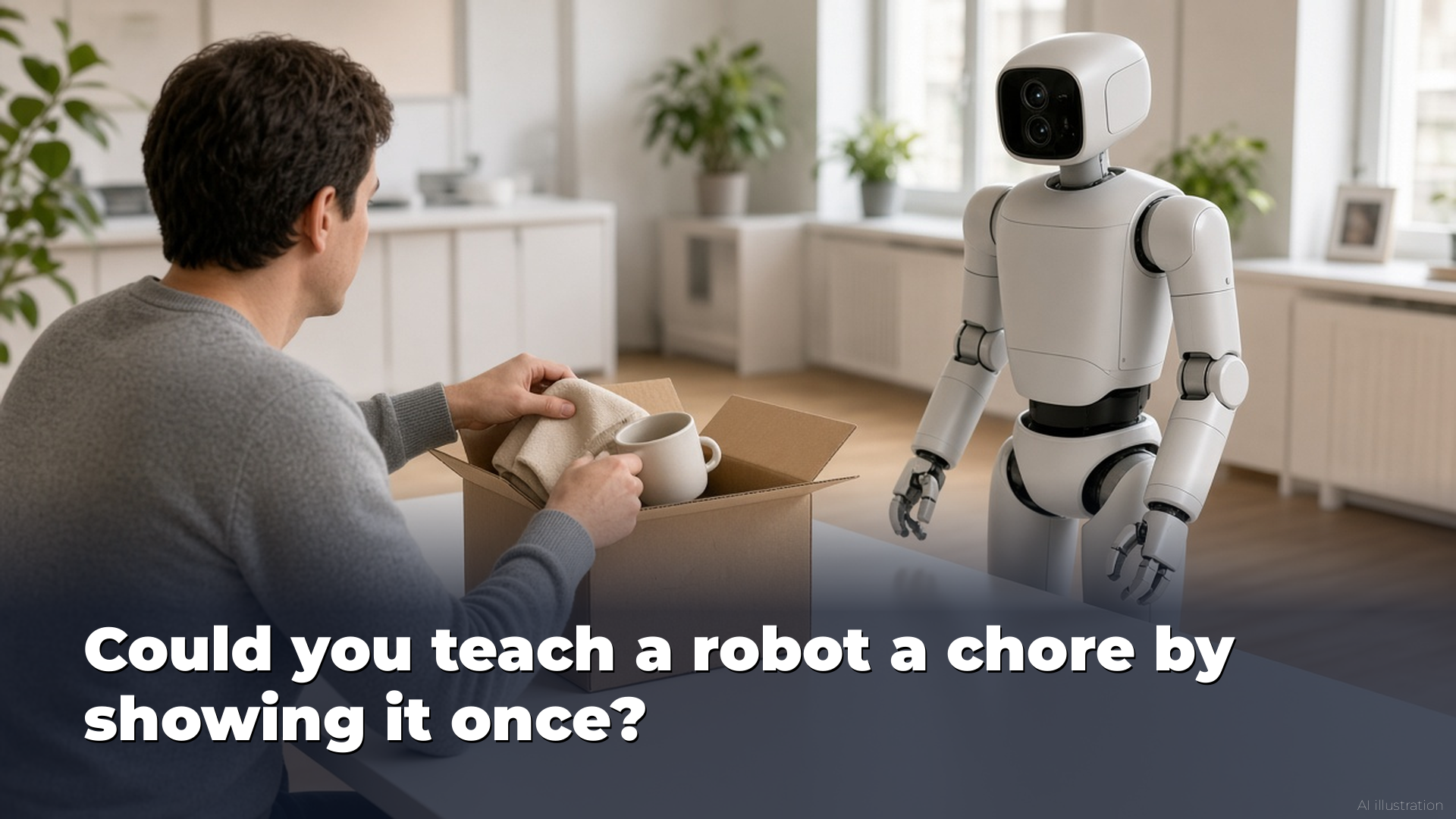
Think about your first day at a new job. A colleague shows you how to fold the boxes, once, and you get on with it. Most robots can't learn like that. They need to see the same task again and again, often for days. A young London company says it has found a way for robots to learn a new chore from a single demonstration.
What was announced
On Tuesday, October 27, Machenta came out of "stealth", startup talk for working in secret. According to Imperial College London, where the idea began, the company raised $40 million in a first, or "seed", funding round led by the investment firms Creandum and Union Square Ventures. Imperial calls it the largest seed round ever raised by a UK robotics startup.
Machenta was founded by Edward Johns, a professor of robot learning at Imperial and now the company's chief executive, and his PhD student Vitalis Vosylius, with colleagues from their lab. The team is around a dozen people, according to Tech.eu, and has a new office and lab in King's Cross, London.
How "learn it once" is supposed to work
Here is the problem. Today's AI-powered robots are usually trained by people showing them a task many times. After that, they are mostly stuck with the skills they have. Adding a new one can mean a slow update by engineers.
Machenta calls its approach "instant robot learning." It has two parts:
- Practice in a computer-made world. The company trained its robot brain entirely in simulation, without real-world data, according to Imperial and Tech.eu. Imperial says that could spare future developers the practical and privacy problems of collecting lots of video of people.
- One look, then go. Once trained, the company says, a robot can do a new task after seeing it just once. Its examples include packing, assembling and tidying, on different kinds of robots, including humanoids.
Ink, not pencil: these are the company's own demonstrations. We found no independent tests of the claims so far.
The human side
The work started six years ago in Johns's Robot Learning Lab at Imperial, with one question: could a robot learn a new skill as fast as a person?
"Humans don't need to see the same thing over and over before they can do it," Johns said in Imperial's announcement. "If you take some objects, and show somebody what to do with them, they'll probably then be able to do the same task immediately."
His own summary is simple: "Intelligence is not so much about what you can already do, it's about how quickly you can learn to do something new."
Kathi Wilhelm, a partner at Creandum, said the team had "spent years breaking through this extremely hard problem, long before there was a company around it."
Why regular people should care
Most of us will never program a robot. But most of us can show someone how to do something. Imperial says the goal is robots that learn new tasks "with guidance only from their end users." If that works, the person who knows the job best could teach the machine directly, not only engineers. It is an early, hopeful step, and a reason to watch for proof outside the lab.
What's next
Machenta says it will use the money to grow its learning system and its team. Watch for independent tests, first customers and real-world trials. They will show how well "learn it once" works beyond company demos.