
By Casey Forge
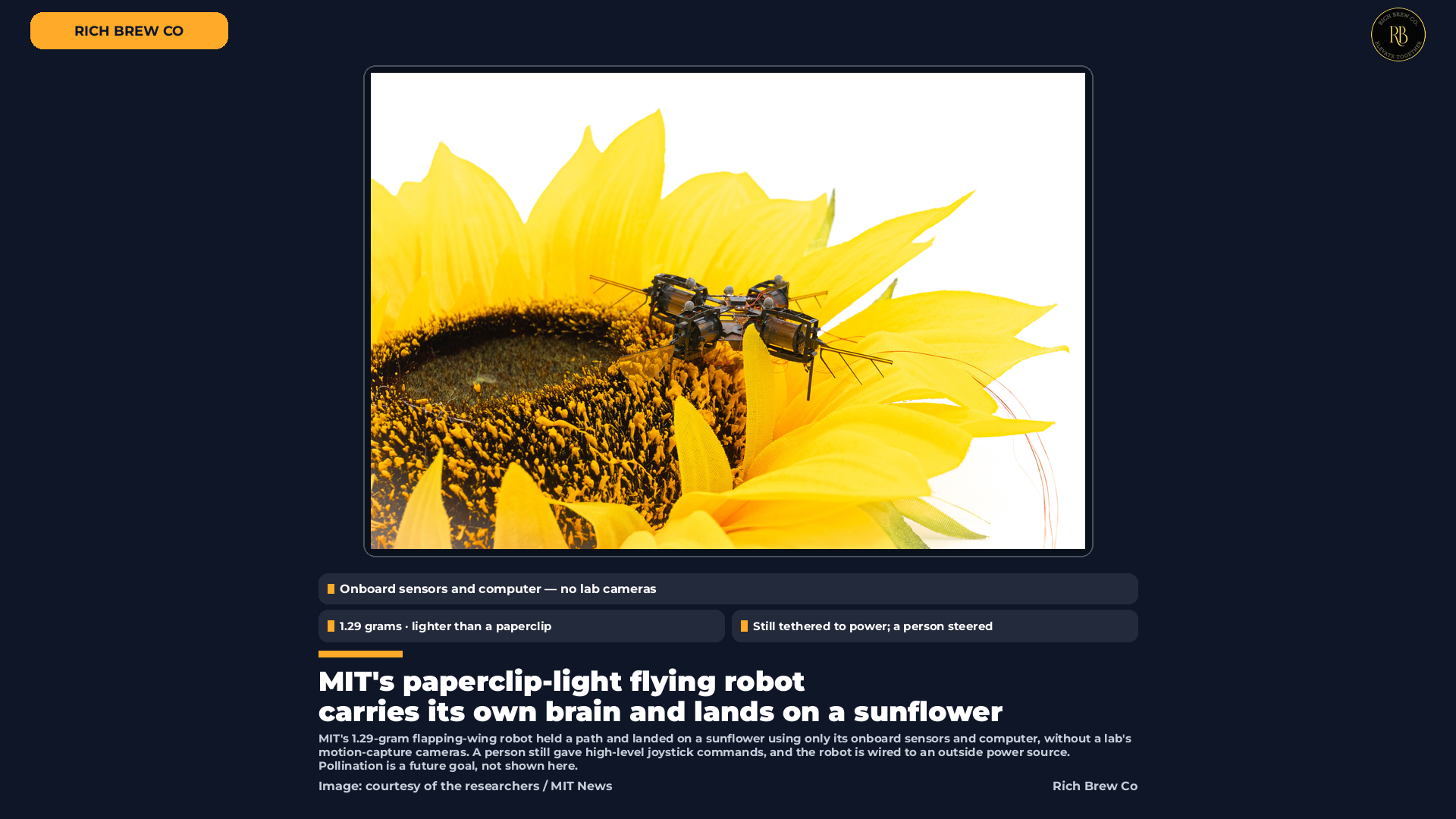
Image: courtesy of the researchers / MIT News
A robot lighter than a paperclip avoided obstacles in a lab and touched down on a sunflower. What made the moment special is that it kept its own balance and position, using only the sensors and a computer it carried itself.
Engineers at the Massachusetts Institute of Technology (MIT) have built a 1.29-gram flapping-wing robot that flies using only onboard sensing and computation. The work was published on Nov. 18 in the peer-reviewed journal Science Robotics and described the same day by MIT News.
"This is the first demonstration of an aerial microrobot that is sensory and compute autonomous," said Kevin Chen, an MIT associate professor who leads the Soft and Micro Robotics Lab, according to MIT News.
Why this is a first
Until now, insect-sized flying robots typically had to fly inside labs ringed with motion-capture cameras. Those cameras watched the robot and told it where it was. Without them, the robots could not navigate or stay on course on their own.
This robot carries its own senses and its own "brain." That means it can hover and follow a path without the camera setup, a big step toward tiny robots that could one day work outside the lab.
What the robot is like
MIT describes the robot as roughly the size and shape of a microcassette and lighter than a paperclip. It has four flapping wings driven by soft artificial muscles.
Its onboard electronics weigh just 244 milligrams and include:
- an inertial measurement unit (IMU), a motion sensor that tracks which way the robot is tilted
- an optical-flow sensor that estimates sideways speed and position
- a time-of-flight sensor that measures height
- a microcontroller, the tiny computer that ties it all together
To carry that load, the engineers made the artificial muscles 50 percent larger and raised the robot's net lift by 46 percent, giving it a lift-to-weight ratio of 1.9, MIT News reports. The electronics use only about 6 percent of the robot's power; the rest goes to the artificial muscles and wings.
Flight accuracy was within a few centimetres, MIT News reports. The paper describes "centimeter-scale positional flight accuracy," which the team says is comparable to flying with outside cameras.
One lesson stood out. The team found that estimating the robot's position more often, with simpler maths, worked better than slower, more precise calculations. It is a bit like a tightrope walker making lots of small, quick corrections instead of stopping to think through each step.
The sunflower flight
In a 30-second flight outside the motion-capture setup, a person gave the robot high-level commands with a joystick. The robot handled its own balance and position, avoided obstacles and landed on a sunflower.
The person chose where the robot went. The robot did the hard part of staying stable and on course as it got there.
Ink, not pencil: MIT's 1.29-gram robot flew and landed on a sunflower using its own onboard sensors and computer, but it is still tethered to outside power, was steered by a person's joystick commands in a 30-second demo, and pollination has not been shown.
What it could make possible
The researchers and MIT point to several possible future uses. They are possibilities, not products:
- Pollination help where bee and other pollinator populations have dropped, for example on blueberry bushes and almond trees. This would add help where pollinators are scarce. It has not been demonstrated yet.
- Crop checks, such as spotting pests up close without damaging plants.
- Inspection in tight spaces where larger drones cannot go.
For farms, orchards and greenhouses, close-up help from robots this small is a real research path, but it is not in the field yet.
The honest limits
- Still plugged in. The robot is connected to an outside power source and cannot yet fly free outdoors.
- A human picks the route. A person gave high-level joystick commands during the sunflower flight.
- One short demo. The sunflower landing was a single 30-second flight outside the motion-capture system. The team also reported other flight tests, including hovering and following paths.
- No product, no timeline. This is lab research.
- Pollination is a goal, not a result. The team has not shown the robot pollinating anything.
Who did the work
The co-lead authors are MIT graduate students Yi-Hsuan (Nemo) Hsiao, Quang Phuc Kieu and Zhongtao Guan, according to MIT News. Kevin Chen of MIT, Jonathan P. How of MIT and Elizabeth Farrell Helbling of Cornell University are co-corresponding authors.
The research was funded by the US National Science Foundation, the Office of Naval Research, the Air Force Office of Scientific Research, MathWorks and a Zakhartchenko Fellowship.
Why regular people should care
In places where bee and other pollinator populations have dropped, crops such as blueberry bushes and almond trees are the kind researchers have in mind. Tiny, gentle robots that fly on their own brains could one day give farmers extra help, alongside natural pollinators, and catch pests early without harming plants.
The same small-and-careful design could also help inspect places too cramped for today's drones. None of that is here yet. But showing that a robot this small can fly without a room full of cameras is one of two big steps. The other is carrying its own power.
What's next
- Onboard batteries: the team is now working to integrate power electronics and batteries the robot can carry, which would enable untethered flight outdoors.
- An onboard camera: MIT News says the team plans to add one for recognizing objects and avoiding obstacles.
Sources
- MIT News, "This featherweight, flying robot carries its own sensors and computers," Nov. 18, 2026: https://news.mit.edu/2026/featherweight-flying-robot-carries-its-own-sensors-and-computers-1118
- Science Robotics, "Controlled flight of an insect-scale flapping-wing robot via integrated onboard sensing and computation," Nov. 18, 2026: https://www.science.org/doi/10.1126/scirobotics.aeg6618
- arXiv preprint 2602.08328 (abstract): https://arxiv.org/abs/2602.08328
Like, follow and subscribe for more podcasts from Richbrewco.com