
By Casey Forge
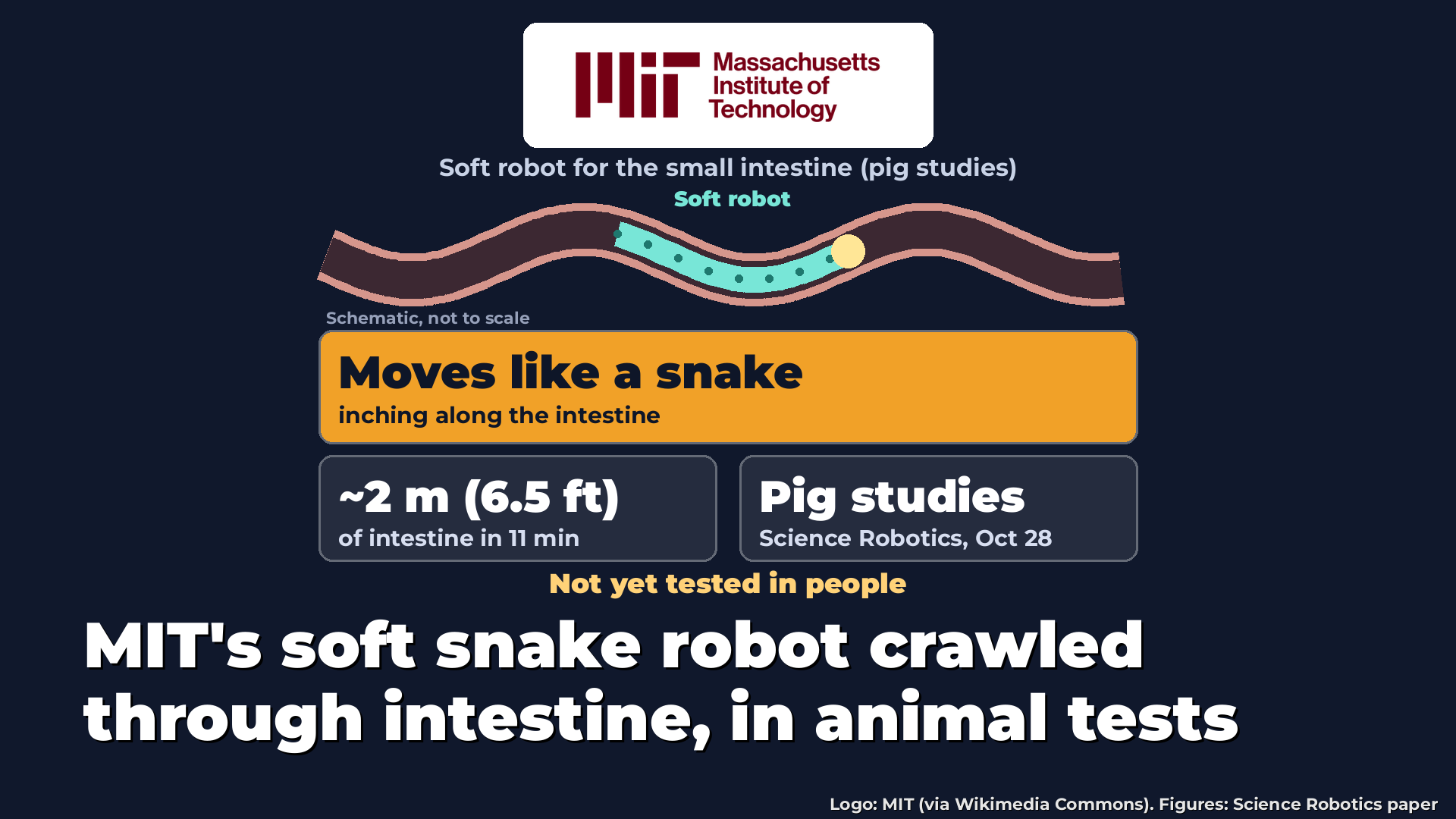
Data card: Rich Brew Co. Logo: MIT (via Wikimedia Commons).
Your small intestine is about 20 feet long, about an inch wide, and folded up deep inside your belly. That makes it one of the hardest places in the body for doctors to look at. A team of engineers has now built a soft robot that inches through it the way a snake moves along the ground. It is early, but for people living with hard-to-find gut problems, it is a hopeful idea.
What they built
In a study published on October 28 in the journal Science Robotics, researchers at the Massachusetts Institute of Technology (MIT) and UT Southwestern Medical Center in Dallas describe a robot they call BIOSENTER (short for bioinspired soft enteroscopic robot).
It is a soft, hollow tube a little over 3.5 inches long, according to UT Southwestern. Here is how it moves, in plain words:
- Air does the work. Small chambers inside the robot fill with air in different combinations, so the tube stretches forward or bends left, right, up or down.
- Grippy "scales" hold it in place. The front and back have small balloons wrapped in sleeves inspired by kirigami, the Japanese art of cutting and folding paper. When a balloon inflates, tiny points pop out, like a snake's scales, to grip the slippery lining.
- A person steers. An operator guides it with a joystick-style controller, connected by a cable.
A channel through the middle carries tools: a camera, a sprayer to deliver medicine, and clips to take small tissue samples (biopsies) or remove small growths called polyps.
How it did
In studies in pigs, the robot travelled through about 2 metres (about 6.5 feet) of small intestine in 11 minutes, the paper says. The team also used its camera, took tissue samples and sprayed liquid as a stand-in for medicine, without visible tissue damage under the tested conditions. MIT News and UT Southwestern describe the same results.
Ink, not pencil: this robot has not been tested in people. "Further engineering development and validation will be needed before human testing," said Binbin Ying, a lead author now at UT Southwestern.
Why doctors want something better
Today, the main way to examine deep inside the small intestine is a procedure called double-balloon enteroscopy, a scope exam. Two balloons are inflated and deflated in turns to pull the scope along. MIT calls it "slow and laborious", and Ying says few doctors are trained to do it.
Imagine trying to push a wet noodle through a long, twisting garden hose. That is roughly the challenge. A robot that crawls forward under its own power could, the team hopes, make the job easier and faster.
The human side
The senior author, Giovanni Traverso, is an MIT engineer and also a gastroenterologist who treats patients at Brigham and Women's Hospital. He explains the goal simply: "When we evaluate the small intestine, we do it for either diagnosis or treatment. If we find a little polyp that needs to be removed, this robot allows us to take a biopsy or remove it."
Why regular people should care
Problems such as bleeding, Crohn's disease and other forms of inflammatory bowel disease (IBD), and tumours can sit in the small intestine, where they are hard to reach. Today's exam takes special training, and only a few patients can be seen each day, Ying says. A tool that is easier to use could, one day, mean more people examined, sooner, by more doctors. That is the hope, not yet the reality.
What's next
The team says it is improving the robot's navigation and testing it for more uses. Ying's lab is also using AI to fine-tune the grippy sleeves. Before any human trial, the team says it must test longer distances, safety and ease of use, and compare the robot directly with today's double-balloon scopes. No timeline has been given.