
By Casey Forge
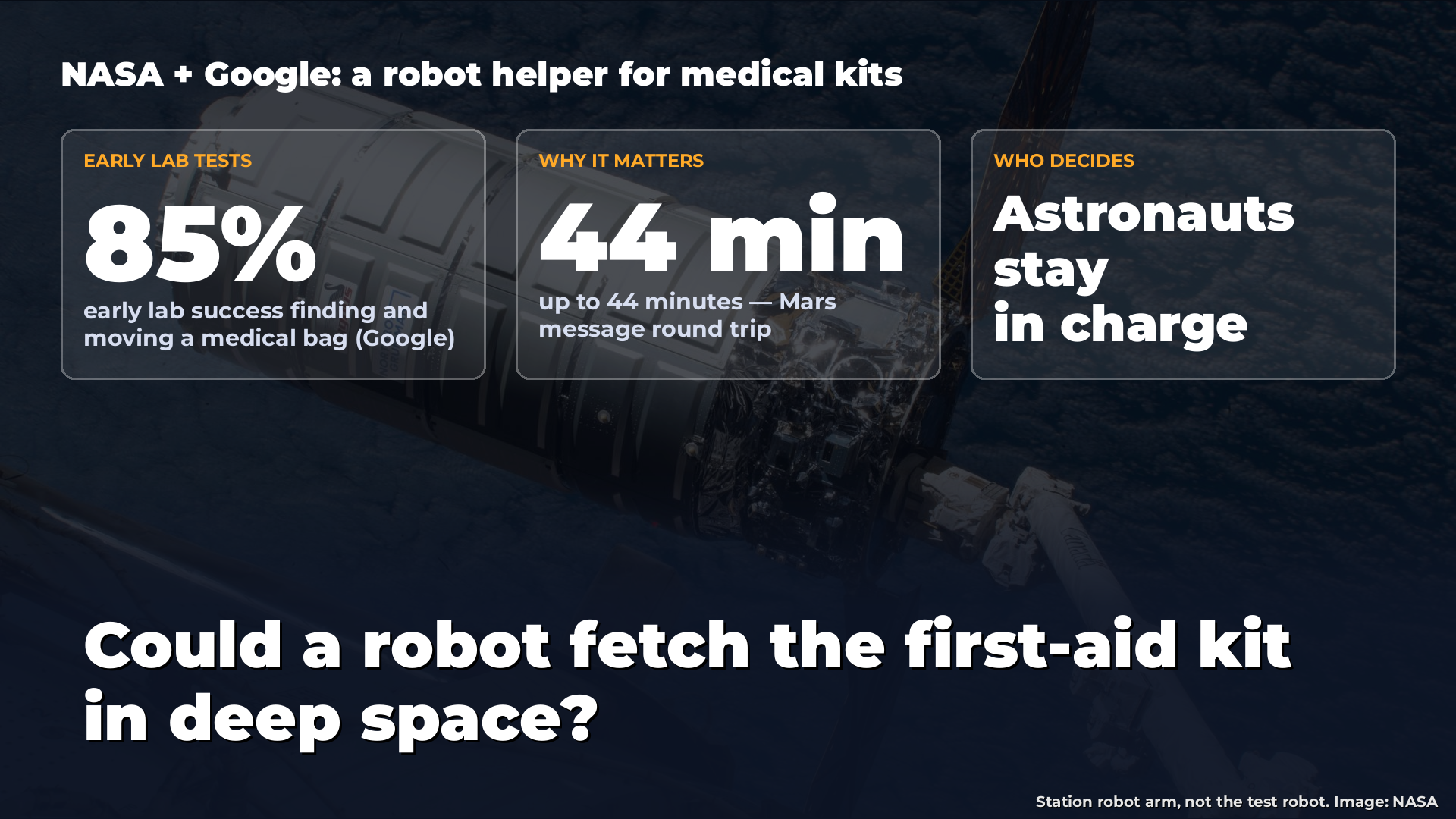
Image: NASA. Background shows the station robot arm Canadarm2, not the test robot.
When someone gets hurt at home, one person usually stays with them while another runs to get the first-aid kit. Now imagine there is no one to run, and the nearest doctor is millions of kilometres away. NASA and Google are testing a robot that could be the one who runs and fetches, while the astronauts stay in charge of the care.
What was announced
On Tuesday, October 27, Google described the project in a Google Cloud blog post by Jim Kelly, a vice president at Google Public Sector. Nextgov/FCW reported on it on October 28.
The robot was developed by three NASA teams, its Human Research Program, the Johnson Space Center robotics team and the JPL (Jet Propulsion Laboratory), working with Google Public Sector.
Google calls it a "proof-of-concept": an early test version to see if the idea works, not a finished machine.
A cargo mover that can switch to medic's helper
Google says that most of the time, the robot would do ordinary jobs: moving cargo, organising tools and securing storage spaces. When a medical need comes up, it can switch roles.
Google gives one example. If an astronaut has severe back pain, a possible sign of kidney stones, the robot could fetch and prepare an ultrasound machine. That would let the crew's medical officer focus on reading the scan and treating the patient.
Ink, not pencil: the robot does not diagnose or treat anyone. Google says the goal is help "under the astronauts' direct supervision and command."
How well it works so far
In an early lab test, the robot had to find a medical bag and move it to a new spot. According to Google, it succeeded about 85% of the time, which Google calls "an initial 85% baseline success rate" and "a strong foundation for the next phase of rigorous training and safety refinement."
In plain terms: promising, but not yet good enough for an emergency. A helper who brings the right bag 17 times out of 20 is useful; one you can rely on every time is the goal.
The robot's "brain" is an open-source model called Pi0, made by the robotics company Physical Intelligence. Before touching real hardware, it practised in a computer simulation called MuJoCo, from Google DeepMind. Google says astronauts could direct it with plain English instructions.
Why space needs this
On a trip to Mars, Google notes, a message to Earth and back could take up to 44 minutes. That is far too slow for a doctor on the ground to guide every move in a medical emergency. A small crew would need help that is already on board.
The human side
Google is careful about where the line sits. "This ensures astronauts receive the physical assistance they might not be able to perform by themselves, without ever replacing human decision-making," Kelly wrote.
That is a picture many of us know from hospitals: the nurse or assistant who fetches, prepares and steadies things, so the doctor can think.
Why regular people should care
The same idea, a robot that fetches and sets up while a person decides, is where helper robots for homes, care homes and remote clinics are heading. Work done for astronauts often finds its way back to Earth. It is an early, hopeful step, and a sensible model for robots in care: hands to help, people in charge.
What's next
Google says the next phase is more training and safety work. There is no date for a space test, and Google has not said when a space-ready robot might exist. Watch for results on more medical tasks and for tests beyond the lab.