
By Casey Forge
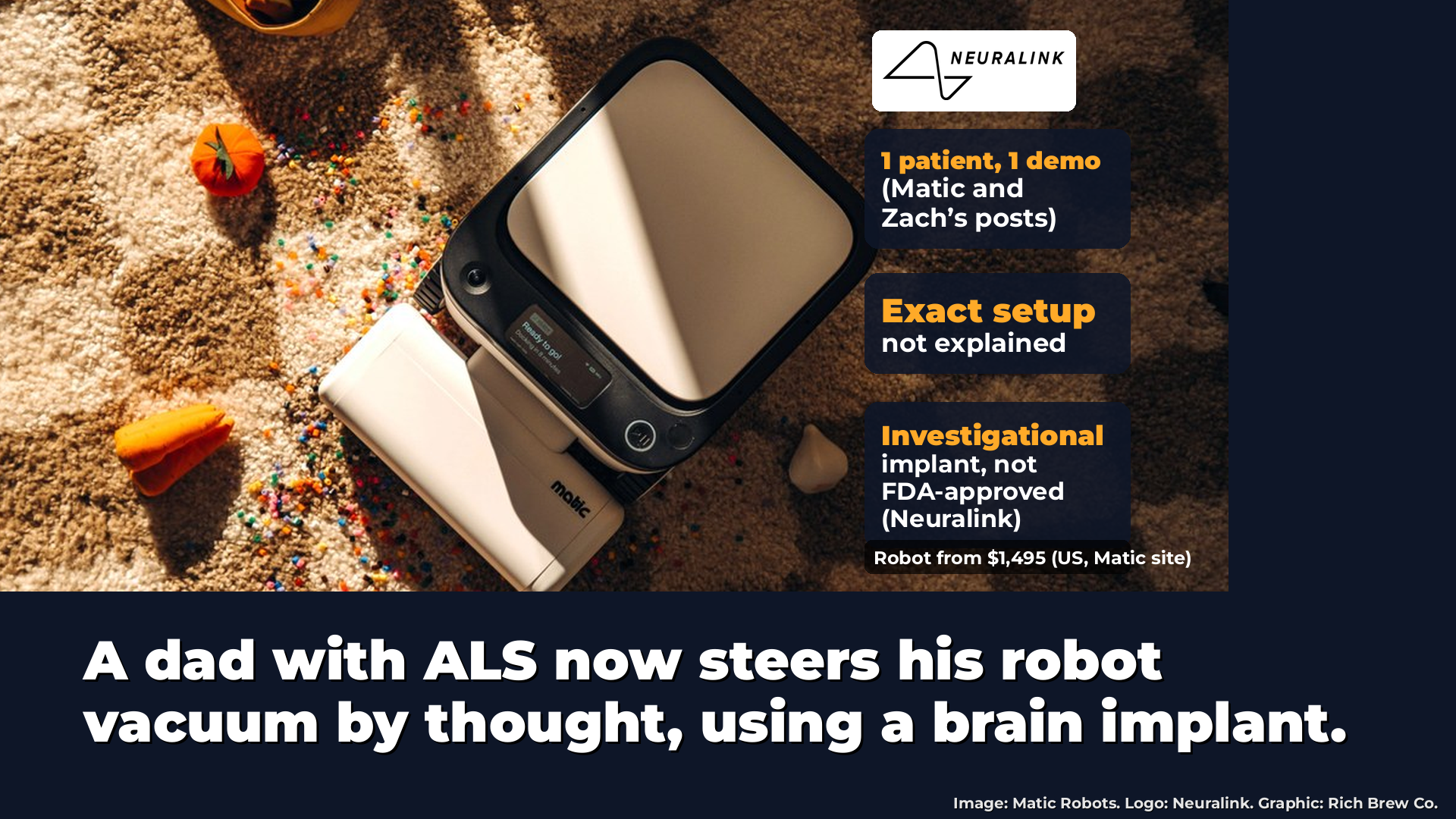
Vacuuming the living room is a chore most of us put off. For Zach McManus, it is something new to be proud of. Zach has ALS (amyotrophic lateral sclerosis), a disease that slowly takes away control of the body's muscles. In videos he and the robot maker have shared, he steers a robot vacuum around his home with his thoughts, using a Neuralink brain implant. "Just got done vacuuming the living room!!" he posted on X in October.
What happened
On Monday, November 2, robot maker Matic Robots shared a short video on X of Zach moving its vacuum-and-mop robot. "Zach is controlling Matic with his mind," the company wrote. "Neuralink patient #22 is using his thoughts to move Matic around his home." The clip had more than 57,000 views by Monday night.
The demo itself is a few weeks old. Zach first posted his own video on October 20, calling Matic "the first robot vacuum in the world to be controlled, purely with thoughts." He added: "My wife and I first video edit ever lol." That "first" is Zach's and Matic's claim; we have not seen it independently checked.
How it works, as far as we know
On his X profile, Zach says he is Neuralink's 22nd recipient. He calls his implant Telepathy, Neuralink's name for it, and explained it simply in a post: "I think about moving my hand and it causes the cursor to move on my screen." He says his surgery was "a little over six months ago."
Neither Matic nor Neuralink has explained the exact setup that links the implant to the robot. The fan site Neura Pod, which tracks Neuralink patients, suggests the implant's cursor may drive the robot's app, but says the details are still for Zach and Matic to share. As of Monday night, Neuralink had not posted about the demo on X.
Think of the implant like a mouse you move with your mind. Anything you can click on a screen, you may be able to control, and now that includes a robot that rolls around the house.
Matic says its robot uses "smart vision" and on-device processing to map a home and steer around toys, cables and pets. Its website lists the robot from $1,495 (US).
The human side
Zach's posts are full of joy. He says he can now control "my laptop, phone, TV, Xbox controller, @maticrobots vacuum, and soon to be driving my wheelchair." He has two boys, eight and five, he says, and his kids "literally won't stop saying 'hey Matic, trick or treat'."
For people who have lost the use of their hands, every machine they can run alone is one less job waiting on a caregiver. That is a big deal, even when the job is just crumbs on the floor.
Ink, not pencil: this is one person and one demo, shared by the robot maker and the patient. It is not a product you can buy for this today. Neuralink says its devices are investigational and not approved by the FDA. We are not making any claims about the implant's safety.
Why regular people should care
Most smart-home gadgets assume you can tap a phone or speak a command. ALS can take away both. Stories like Zach's show how brain-computer interfaces, or BCIs, could one day let people with paralysis run everyday machines on their own, from a vacuum to a wheelchair. If someone you love lives with ALS or paralysis, it is a hopeful sign of where assistive tech may be heading.
What's next
Watch for Matic or Neuralink to explain how the link works, and whether Matic plans to offer brain-computer interface support to other users. Zach says wheelchair control is coming for him next. Bigger questions, like who qualifies for implants and when they might be approved for wider use, are still being answered in trials.