
By Casey Forge
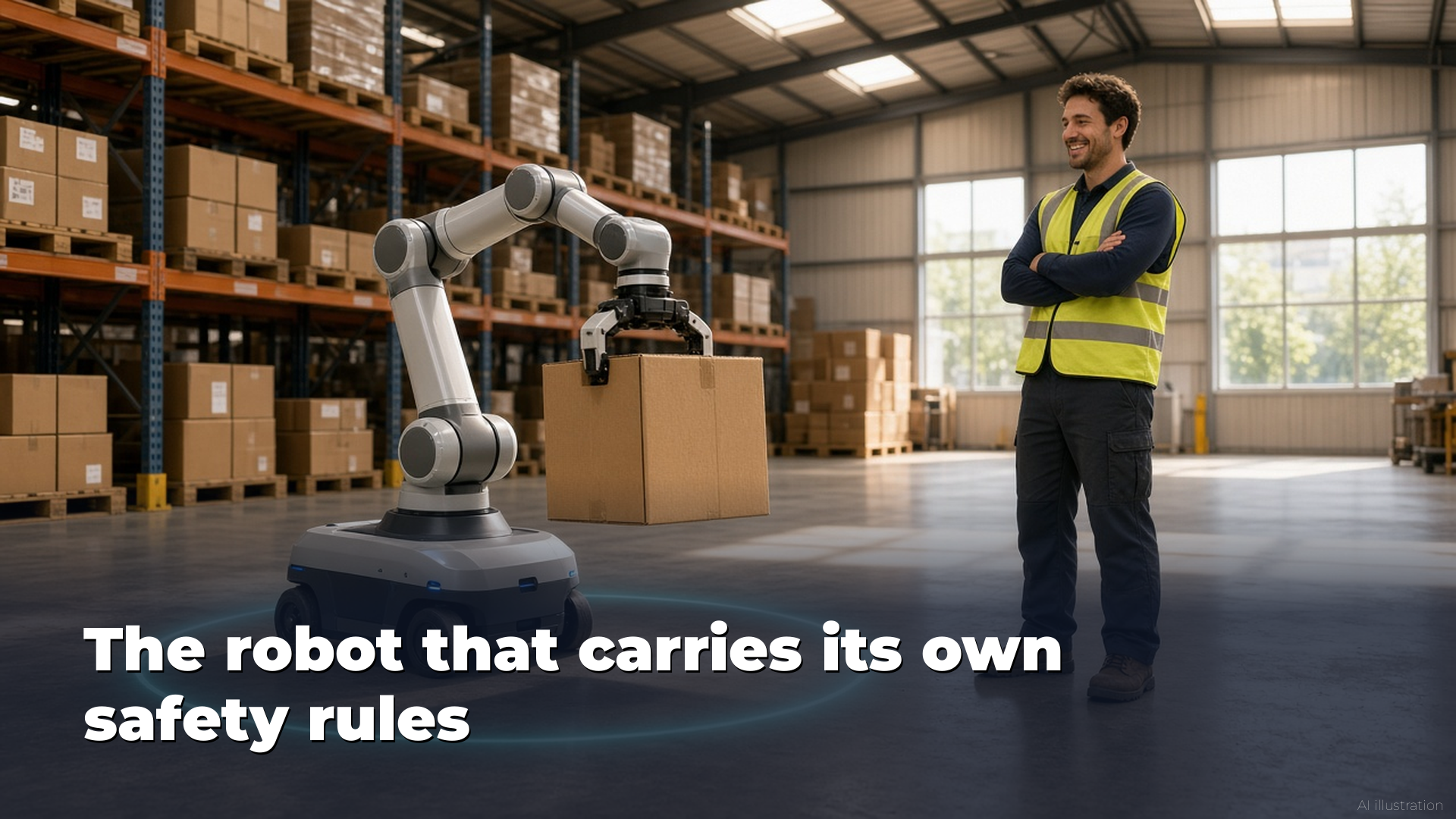
For most of history, the safest factory robot was one you could not reach. It lived in a cage, and if you opened the gate, it stopped. Nvidia wants the next generation to bring its own safety with it, so the cage can go.
Imagine a warehouse worker pushing a cart around a corner. Today, the robots nearby often work behind fences or inside zones marked with outside sensors. Tomorrow, the robot walking next to that worker might carry everything it needs to notice them and slow down.
What it is. Nvidia announced Halos for Robotics on June 22, 2026. The company calls it a "full-stack" safety system, meaning it covers the chips, the software and the testing. It grew out of Nvidia's earlier safety work for self-driving cars.
Why now. In an October 8 Ars Technica explainer, Nvidia's Amit Goel said robot brains and bodies are getting capable fast, "and a thing we thought is going to be the next bottleneck is safety."
Safety that travels with the robot
A guardian chip inside. The system starts with a computer module called IGX Thor, which has a separate processor dedicated to safety work, Ars reports. The Halos software watches "every hardware block" and "every software library" to spot failures quickly, Goel said, and keeps safety tasks walled off from everything else.
It is a bit like a car's airbag. You do not think about it on the drive to work. It sits quietly, separate from the radio and the satnav, waiting for the one moment it matters.
The first robot to use it. Agility Robotics, a US company, was first to build parts of Halos into its Digit humanoid robot, which works in warehouses and factories. Ars says the latest version, Digit 5, brings its safety sensors on board, where earlier Digit setups also relied on sensors placed around the work area.
"Now the robot is literally unchained," Goel told Ars. "The safety goes with the robot wherever it goes."
Careful around corners
One small, human detail. Robots, like people, cannot see around corners. Nvidia's team described robots moving down an aisle at about six miles per hour that almost stop before a turn, because in warehouses and hospitals "things can come from anywhere." That is the kind of caution you want from a machine beside you.
Every robot is different. A robot vacuum and a robot forklift need very different rules. So Halos lets companies write their own safety functions, Goel said, without breaking the base system.
Checked by outsiders. Nvidia runs an inspection lab that helps companies prepare for independent safety certification. Nvidia says the lab is accredited by the ANSI National Accreditation Board (ANAB), and that groups such as TÜV Rheinland and UL Solutions take part. Agility says it will use the lab to test Digit against established safety standards before final certification.
Ink, not pencil: Nvidia's safety stack is a toolkit, not a guarantee. Final third-party certification for Digit was still ahead when Nvidia announced the partnership, and parts of Halos are in "early access." Whether general-purpose humanoid robots will work well in everyday jobs is still an open question, Ars notes.
Why regular people should care
Machines are leaving the cage. If you work in a warehouse, a factory or a hospital, robots may soon share your aisle rather than stay behind a fence. That can take heavy, repetitive lifting off human backs. But it only works if the robot reliably notices you first. Building that safety into the machine, and having outsiders check it, is the right order of things.
Other names are lining up, Ars reports, including Boston Dynamics, forklift maker KION Group and LG.
What's next
Watch for certification. The real milestone is when a robot built on Halos passes an independent safety check and works beside people every day, not just in a demo. Watch Agility's Digit first, and watch Boston Dynamics, whose Atlas humanoids could start working in Hyundai car factories by 2028, Ars reports. Until then, the safest robot is still the one that knows when to stop.