
By Casey Forge
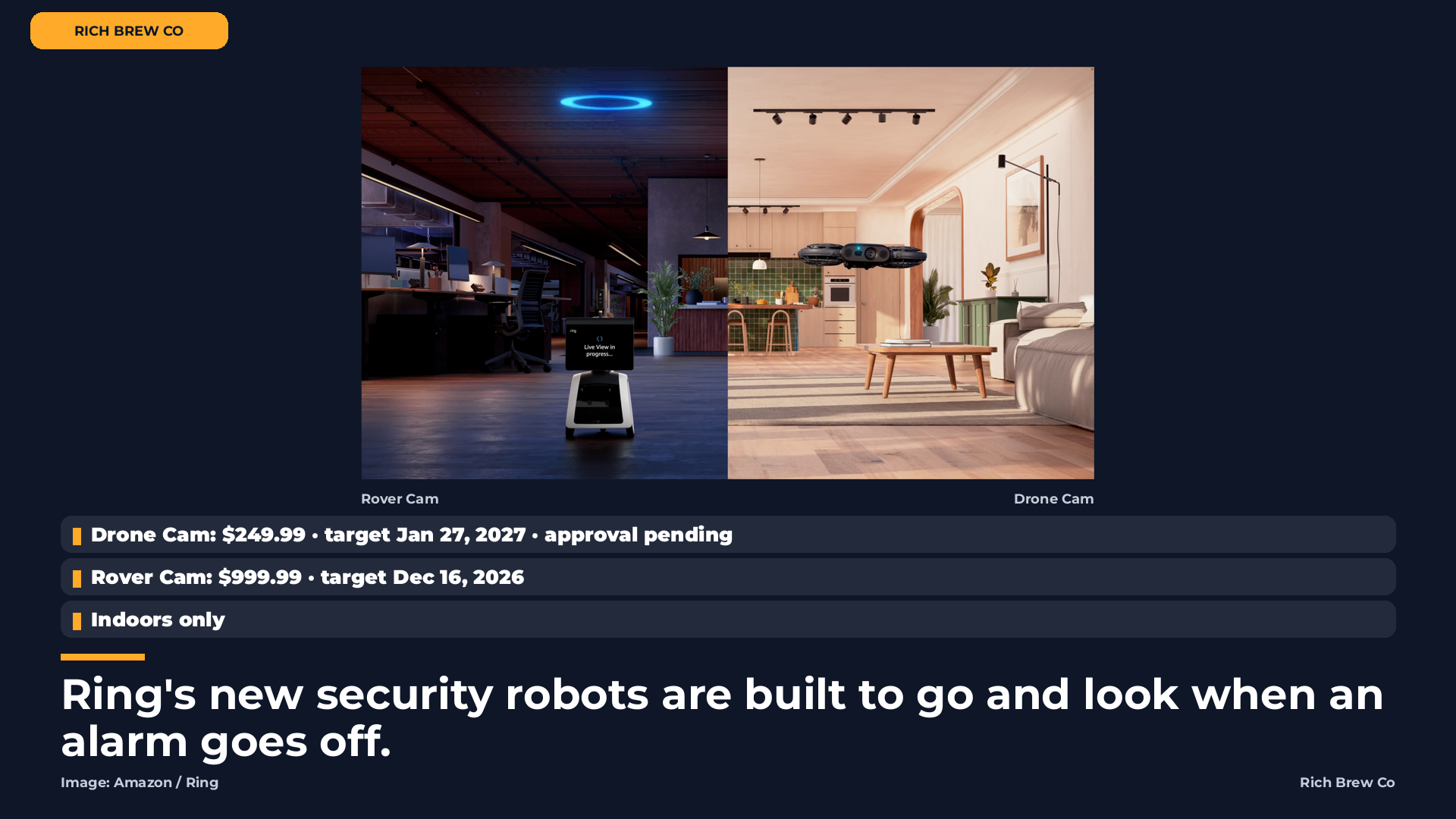
Image: Amazon / Ring. Graphic: Rich Brew Co.
Picture this. You are at work and your phone buzzes: a sensor on an upstairs window at home has gone off. You want to know what happened without making an unnecessary trip home. Ring wants to offer another option: a small camera that flies itself to that window and shows you.
That is the idea behind Ring Robotics, which Amazon's home security company Ring announced on November 10. It has two products. The Ring Drone Cam is a flying indoor camera for homes. The Ring Rover Cam is a camera on wheels for shops, offices and warehouses. Neither has shipped yet. Both are built around one simple, useful job: go and look.
The problem these robots try to solve
A fixed camera sees one spot. To see the whole house, you would need a camera in nearly every room, and many people do not want that.
"People like indoor cameras, but they don't necessarily want them everywhere around their home," Ring founder Jamie Siminoff told CNBC.
Ring's answer is one camera that moves between saved viewpoints. It cannot watch every room at once, but it can check different places without a fixed camera at each viewpoint.
How the home drone is designed to work
It waits in its dock until it is needed. According to Ring, the drone sits in a charging dock with its camera off. Ring's product page says it records only while flying.
It can respond to an alert on its own. When a connected Ring camera, sensor or alarm is triggered, Ring says the drone automatically flies to patrol points you set earlier. You can also send it out yourself from the Ring app: to a room, to a saved viewpoint or to a spot you tap on a map of your home.
It learns your home first. To set it up, you carry the drone through your space. Ring's system, which it calls AI (artificial intelligence) Pilot, turns what the camera sees into a floor plan and suggests places worth checking, such as a side door or windows. Ring says it then plans its route and steers around furniture and other obstacles.
It is built to see in the dark. Ring lists 2K video (a sharp, high-definition picture), a 148-degree view and the ability to turn all the way around. Two built-in LED (light-emitting diode) spotlights switch on in low light. Ring says the drone does not use infrared night vision.
It is small. WIRED and The Verge both report it weighs 165 grams, about the weight of a small apple. Ring's product page lists the drone's size, but not its weight.
Ring's own example captures the hopeful side well: before leaving for the weekend, you could send the drone on a final sweep to check that the windows are shut.
How the business rover is designed to work
The Rover Cam is aimed at a different person: someone who locks up a shop or small warehouse at night and wonders what is happening inside.
It patrols on the ground. Ring says the rover maps a space by exploring it on its own, then drives to rooms or saved points. When it arrives, it does a full 360-degree scan. Ring's product page says it can cover up to 5,000 square feet on a single floor.
It can see over the counter. A periscope camera on a mast rises to look over counters and shelves. Ring says it streams and records in up to 4K video (an even sharper picture than 2K) while it moves, not just when it stops.
It can speak up. Unlike the drone, the rover has two-way talk, so you can speak through it from your phone. It also has a siren and a bright light tower, and it uses infrared night vision for black-and-white video in the dark.
It watches while it rests. Ring says the rover can detect a person and start recording even while docked.
Ring describes the rover checking the premises after closing, or checking things out when a sensor trips at 2 a.m., and sending video to your phone. For a small business owner, that could mean a quick look before deciding whether to drive back in.
Privacy features, in Ring's words
Ring says privacy is the "default" for both robots. Here is what the company says it has built in:
- The drone's camera is off while docked, and it records only in flight.
- The rover has a Sleep Mode that pulls the periscope down and turns off the microphone.
- Both show when they are recording. Ring says both have indicator lights, and the rover also tells you on its screen.
- They are meant to be noticed. Ring's announcement says the drone's propellers "aren't quiet" and the rover's light tower is bright. Siminoff told WIRED the drone is loud by design, so nobody could use it to snoop quietly.
Videos from both will use Ring's newer encryption, called Throw Away the Key Encryption (TAKE). Encryption scrambles video so other people cannot easily watch it. Ring calls TAKE its "strongest default encryption yet," and the launch announcement presents it as the default protection for these robots.
TAKE is not the same as full end-to-end encryption. In Ring's own explainer, unique keys rotate, and a copy is "temporarily held" in a secure cloud enclave so Ring can run the intelligent features you have switched on. Ring says it then deletes its copy of the keys. After that, Ring says, only you and any shared users you have chosen keep the keys on your own devices. The Verge reports that the keys rotate every five minutes and that Ring's copies are deleted after 24 hours. Those two timings are not stated on Ring's explainer page.
Ring also offers a stricter end-to-end encryption option on its devices. In that mode, Ring says, only your enrolled devices hold the keys, and shared users and cloud features are turned off. The launch materials for these two robots do not say whether that stricter option will be available on them.
What to check before you buy
These robots are promising, and the limits are worth knowing up front.
Prices and target dates: Ring says the rover is targeted to begin shipping in the United States on December 16, 2026, for US$999.99, and the drone on January 27, 2027, for US$249.99, but the drone still needs Federal Communications Commission (FCC) approval before it can be sold.
- Dates are targets. The rover is open for preorder. The drone has only an email sign-up for now. Amazon's fine print says the drone has not yet been authorized under FCC rules and may not be sold until it is. The drone date falls after the holidays, so it is not a gift for this December.
- Indoors only. Both robots are for indoor use. The rover is for dry, single-floor spaces.
- Short flights. Ring says the drone can fly up to 8 minutes per flight, tested with a new, fully charged battery under controlled conditions. Real flight time will vary, and battery life drops over time. The Verge reports that Ring claims five to eight minutes, and about eight minutes of charging for each minute of flight. This is a tool for quick check-ins, not all-day watching.
- Wi-Fi is essential. Much of the drone's intelligence runs in Ring's cloud. WIRED and The Verge report that without an internet connection, it can only land. The rover's product page says it needs Wi-Fi to map and get around.
- Best when nobody is home. Ring's safety guide says to avoid flying the drone when people are present, not to use it near children, and to keep pets away from its flight paths. It also warns that its sound may startle pets. The rover is not suitable around children under 3 or small pets.
- The drone is silent in one way. It has no microphone, speaker or siren. For talking or sounding an alarm, you need the rover or other Ring devices.
Which features need a paid plan
Ring says a "compatible Ring Protect plan" is needed for some features. It has not said which plan, or what it will cost per month for these robots. So the plan and monthly price are unknown for now. Ring's general plans page lists home plans, but it does not name either robot.
Here is what Ring has clearly marked as needing a compatible subscription:
- On the drone: scheduled patrols, saved video history (up to 180 days) and video search.
- On the rover: scheduled patrols, saved video history, Professional Monitoring (staff who request emergency help) and, in the launch announcement, reviewing recorded video "anytime."
Ring has not said whether sending the drone out yourself, or sending it automatically when an alarm or sensor is triggered, also needs a paid plan. Those features should not be assumed to be included for free.
A note on support over time
The rover is built on the technology behind Amazon's earlier Astro robot. Amazon stopped supporting a business version, Astro for Business, in 2024, less than a year after it launched, and gave buyers full refunds plus a US$300 credit, The Verge reported at the time. Ring says it took what Astro customers liked most, roving security, and built a purpose-made security robot. Before spending US$999.99, it is fair for a business to ask how long Ring expects to support it.
Ring also offers a one-year limited warranty on each robot, according to its product pages.
Why regular people should care
For years, home security has meant cameras stuck in one place. These robots point to a more flexible idea: one camera that comes to the problem. For a parent at work, a traveller far from home or a shop owner at night, a fast look at what set off an alert could mean less worry and fewer unnecessary trips.
The practical details still matter. Short flights, Wi-Fi needs, unclear plan pricing and a drone still waiting on approval all shape how useful this will be. But the direction is encouraging: robots doing one clear, helpful job, with lights and sound that tell you when they are working.
What's next
- December 16, 2026: Ring's target to start shipping the Rover Cam in the United States.
- FCC approval: the drone needs it before it can go on sale. Watch for news on that.
- January 27, 2027: Ring's target to start shipping the Drone Cam in the United States, if approval comes through.
- Plan details: watch for Ring to name which Ring Protect plan the robots need and what it costs, and to say clearly which features are included without a plan.
- First real-world reviews: hands-on tests in ordinary homes and shops will show how well the flight time, navigation and privacy features hold up.