A useful robot is not the one that wins a dance contest. It is the one that finishes a shift.
That is the quieter story this week in robotics: machines leaving the highlight reel for real workflows — towels, factory lines, and the hard math of trust, uptime, and cost.
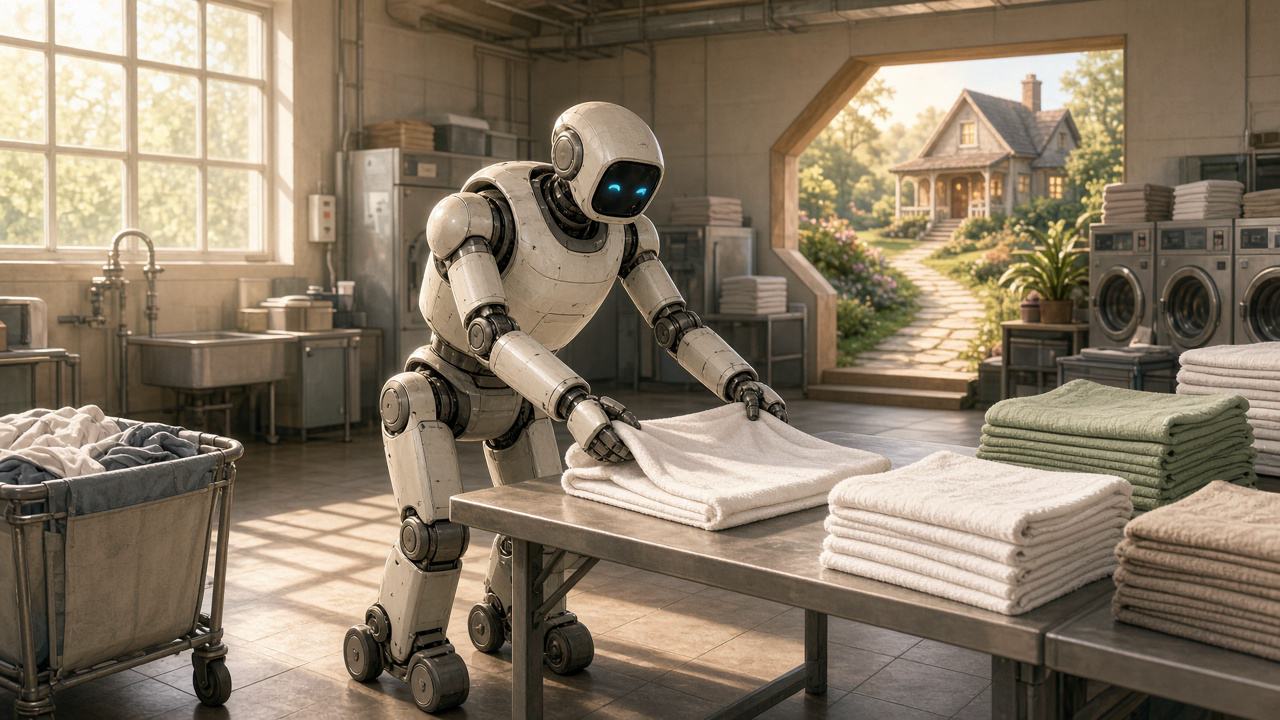
On Sept. 29, DYNA Robotics launched DYNA 2.1 with its wheeled semi-humanoid Taku — built to run full commercial workflows without a human babysitter. In laundry, that means load and unload washers and dryers, snap and fold towels, stack by size, reach high and low shelves, and recover drops or bad grasps on its own. The stack pairs a vision-language orchestrator (what next?) with whole-body control (drive, reach, bend, lift as one motion), on top of DYNA’s world-action model trained on a large corpus of human and robot data. DYNA scores progress with MTBI — mean time between interventions — arguing that minutes of real work per human assist beats one-off task success rates. Deployments are aimed at hotels, laundries, and restaurants; customer-site shifts are the next milestone after the demo.
A day later at the Samsung AI Forum, Samsung’s RX team sketched a longer arc: factories first, then home. With 100-plus Samsung plants and product lines as a proving ground, the pitch is industrial reliability before consumer helpers “by the millions.” The cost board is blunt: roughly $100k CapEx per humanoid, about $100k NRE to teach a job, and around $20k/year OpEx — still “the most expensive workers on Earth” next to ordinary labor and conventional industrial arms. Factory bar: success rates toward 99.99%, not the research-demo 99%. Tech spine: a 3-layer Robot Foundation Model (fast full-body control, mid-rate manipulation, slower high-level agent), plus customer-teachable skills from a single human video so training costs can fall.
Connect the threads. DYNA is commercial choreography — own a messy, multi-step hospitality workflow end to end. Samsung is industrial reliability as a bridge to consumer scale — prove uptime and cost in plants, then widen the job list. Different yards, same thesis: trust is measured in interventions avoided, dollars that pencil out, and shifts completed when nobody is filming.
Why it matters
Most people will meet robots first as quiet help in hotels, kitchens, and factories — not as sci-fi companions. When a machine can fold the laundry pile and keep the dryer cycle moving, or hit factory-grade reliability without a swarm of engineers, the promise stops being a demo and starts being a coworker. That is how millions of home helpers become plausible: not by skipping work, but by surviving it.
What’s next
For DYNA: how long Taku runs between interventions on real customer floors, and how much site-specific prep each laundry or kitchen needs. For Samsung: whether factory RFM reliability and video-taught skills actually drive CapEx/NRE down enough to open the home market. Watch the boring metrics — MTBI, 99.99%, cost per shift. That is where the future clocks in.
Sources: - DYNA Robotics launches DYNA 2.1 physical agent (PR Newswire) - Dyna reveals Taku and Dyna-2.1 autonomous laundry (Humanoids Daily) - Samsung robots from manufacturing sites to home (MoneyToday) - Samsung unveils robot commercialization roadmap (Edaily)