
By Casey Forge
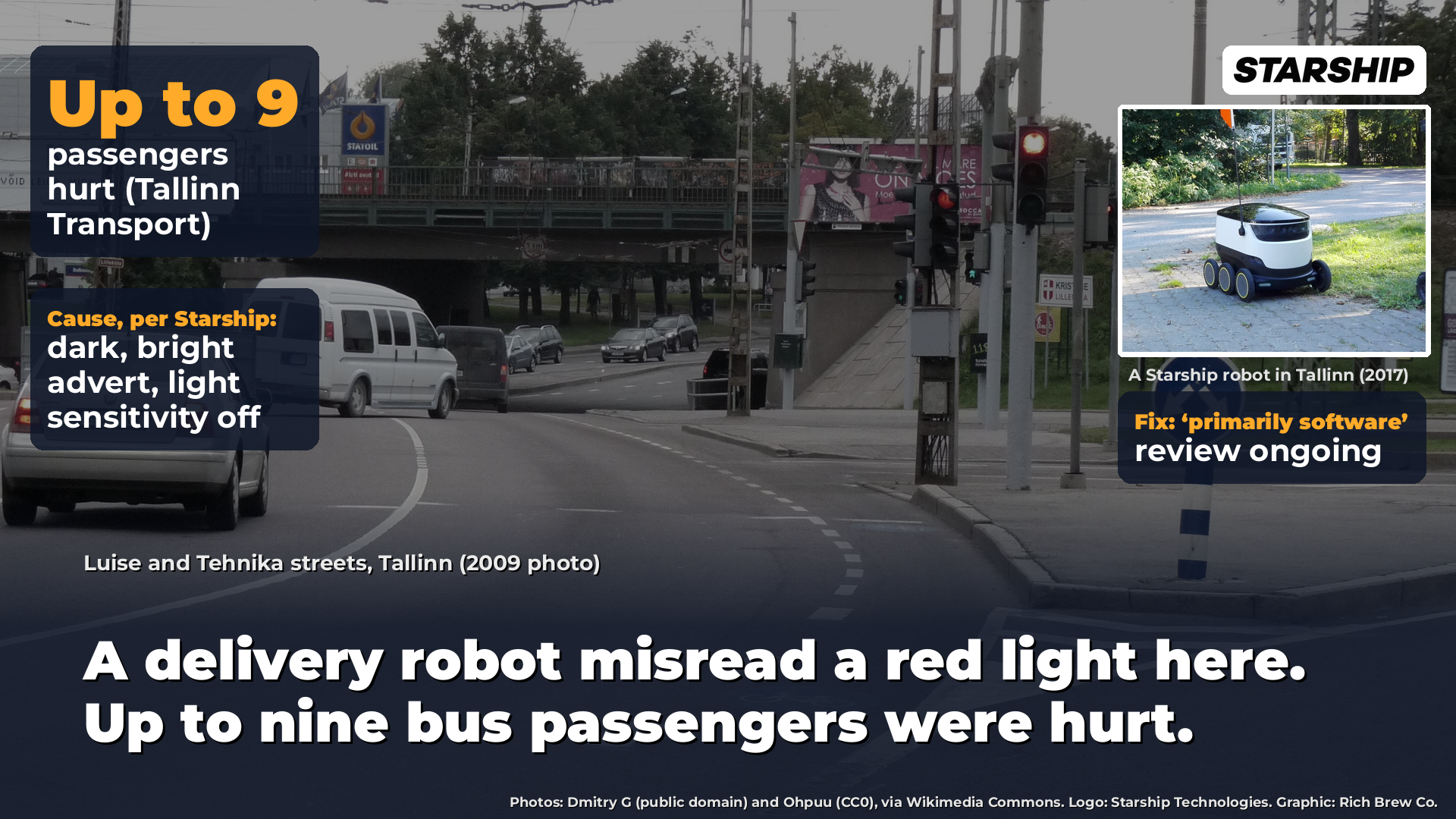
If you live in a city with small, six-wheeled delivery robots, you have probably seen one wait at a crosswalk. On Monday evening in Tallinn, Estonia, one of them did not wait. It rolled onto a crossing on a red light, a city bus braked hard, and standing passengers fell. Here is what we know, what the company now says went wrong, and what is still disputed.
What happened
At about 6 p.m. local time on Monday, October 26 (9 a.m. Pacific time), a delivery robot entered a pedestrian crossing at Luise and Tehnika streets in central Tallinn, the city bus company Tallinn Transport (TLT) told Estonia's public broadcaster, ERR. TLT said the robot went on a red light, and that the bus driver and other road users confirmed this.
The driver braked sharply. Up to nine passengers were injured, TLT said. The newspaper Postimees reported the company's figure as eight to nine. After the stop, the driver asked if anyone needed help or an ambulance, and no one did, TLT board member Andrei Novikov told ERR. TLT later received a complaint from one passenger about their health.
The bus's own camera shows the bus and the robot colliding, and the robot being pushed along the road, ERR reports.
The robot belongs to Starship Technologies, which designs and runs the machines. It carried Bolt branding, but Postimees reports that Bolt's link is limited to the sticker and some orders, and that Starship controls the robots in traffic.
Two sides on what happened next
TLT says the robot left the scene. "The robot fled, if you can put it that way. That means it drove away after the collision," Novikov told ERR's Russian-language service.
Starship disputes that. Pepe Aaviksoo, who runs operations at Starship, said the robot contacted the company's back-office team, which moved it out of the road to the curb. It stayed there for about 10 minutes, he told ERR. Starship told Estonian World that the robot's own logs show it stopped beside the scene and only moved on after the bus had left.
What the company says went wrong
Starship is still running its own investigation and says it will share the results with the public and the police. But on Estonian TV on Thursday, October 29, Aaviksoo gave a first explanation, ERR reports:
- It was dark, and a lit-up advertisement sat behind the traffic lights.
- The lights for walkers and for cars were in the same line of sight, and the robot misread the signal. No cars were coming toward it at that moment, so it decided to cross.
- The robot's light sensitivity "was not working as it should have" and had changed for some reason, he said. That will now be fixed.
Think of trying to read a small traffic light at dusk with a bright billboard glowing right behind it. Even people squint.
"There are many lessons to be learned, but exceptional situations do occur," Aaviksoo said. He said the fixes will be "primarily software-based." For now, Starship has rerouted its robots so they do not use that crossing.
Ink, not pencil: the cause above is Starship's own early account, not an official finding. TLT says the police must establish what happened, and Starship's review is not finished.
The human side
The bus driver was shaken. He did not want to keep working that day and was sent home, and a replacement driver took over, Novikov said. He said the driver was right to brake, and that, judging by the bus camera, a more sudden stop would have made things "much worse." TLT praised the driver for reacting to the danger, Estonian World reports.
Why regular people should care
Sidewalk robots are no longer a novelty. Starship says its robots work in seven countries, have made 11 million deliveries, and had crossed this junction more than 4,000 times. Rare is not the same as never.
Who pays when a robot causes a crash it barely touches? In Estonia, a bus passenger hurt by a sudden stop can claim from the bus's motor insurance, no matter who was at fault, Lauri Potsepp of the Estonian Motor Insurance Bureau told ERR. If the robot or its operator is later found responsible, the insurer may seek the money back from the robot's owner. Rules in other countries may differ.
What's next
Starship says it will publish its findings when its review is done. Estonia's Transport Administration told ERR it has so far registered no delivery-robot crashes that hurt people, though it notes some incidents may not be reported to police. Watch for the police findings, and for whether the software fix lets the robots return to the Luise and Tehnika crossing.