
By Casey Forge
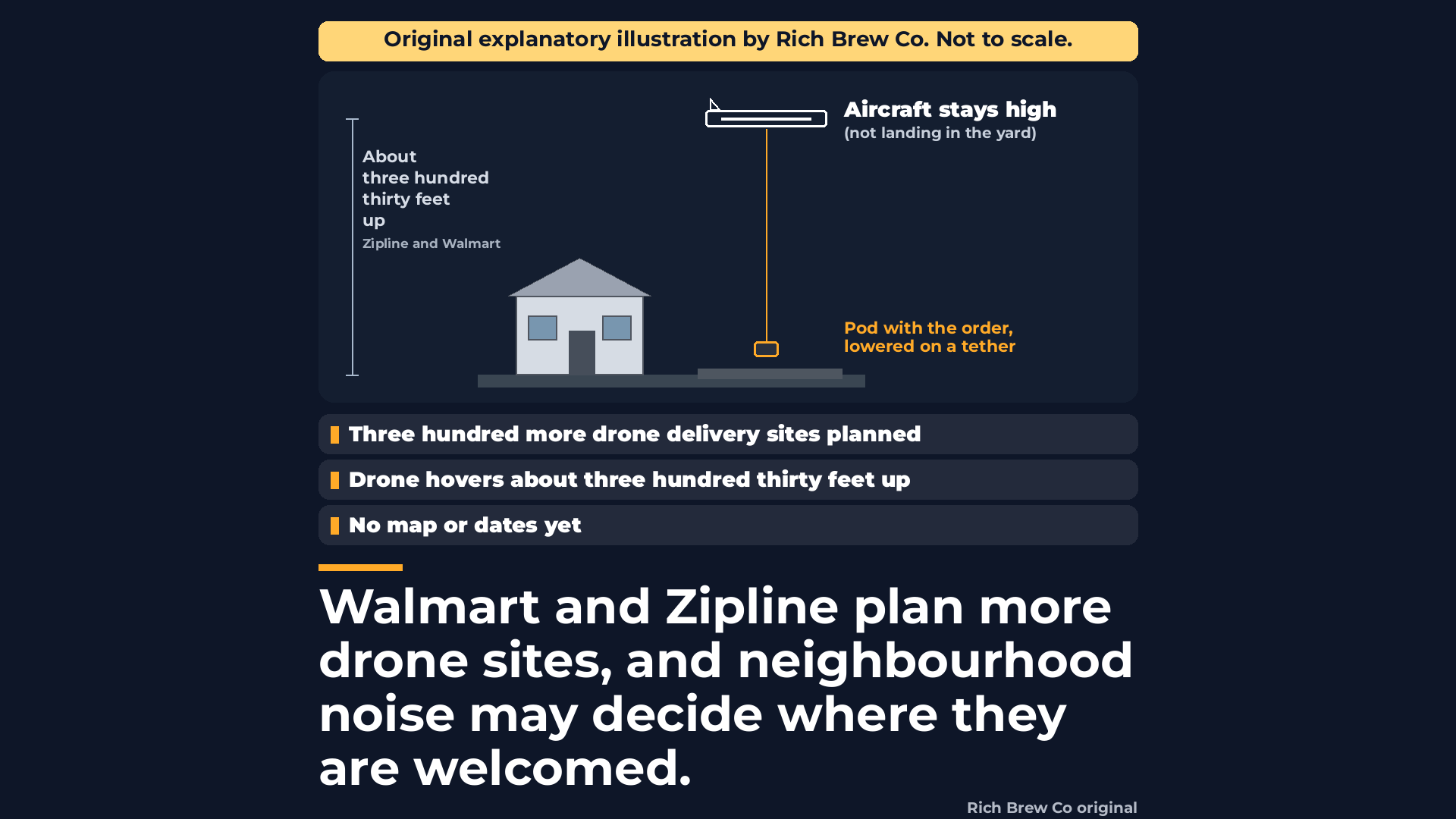
A Walmart drone does not land in the yard. It stays roughly 330 feet up, and a small pod lowers the order on a tether. For some families in Texas, that is already part of daily life. Walmart and drone company Zipline now plan to add 300 more drone delivery sites across the United States.
But there is a second half to this story. The people who get the deliveries are not the only people who live under the flight paths. Whether neighbours can live comfortably with the sound may decide how far this spreads.
Walmart and Zipline announced the plan on November 5, so this is not breaking news. It is a good moment, though, to explain what is actually changing on ordinary streets.
What was announced
Walmart says it signed a new multi-year agreement with Zipline to add 300 drone delivery sites across the country, "with the potential to expand," according to Walmart's announcement. The two companies have worked together on drone deliveries since 2021.
Neither company's announcement gives today's number of sites. Three independent news outlets do: TechCrunch, FreightWaves and Axios each report that Walmart and Zipline have 21 active sites together today. If those 21 sites remain and all 300 planned sites are added, the network would total 321. That is still a plan, not a finished network. Axios describes the expansion as "up to 300 new sites."
On the same day, Zipline said it raised 1.5 billion dollars from investors, valuing the company at 21.5 billion dollars. Zipline says it will spend the money to expand its factories in the United States and hire more people. For now, by the company's own account, this is a building-and-hiring story.
A note on how we found this story: it first reached us through a newsletter from ARK Invest, an investment firm. Zipline lists ARK Invest among the investors in this new funding round, and TechCrunch and Axios report the same. We checked every fact here against Walmart, Zipline and independent reporting, not the newsletter.
Walmart already has experience to build on. It says its drone program has completed more than two million deliveries so far. That figure is for Walmart's drone program as a whole, not Zipline alone. FreightWaves reports that Walmart also works with Wing, the drone company owned by Alphabet, the parent company of Google.
How a delivery actually works
Here is the process, as Walmart and Zipline describe it.
1. You find out if you can use it. Walmart says drone delivery shows up as an option in the Walmart app or on Walmart.com only if the address on your account is inside a delivery range. Eligible addresses can also place Walmart orders through the Zipline app.
2. You order like any other delivery. You add items to your cart, check out and track the order as it flies to your home. Walmart says customers can choose from tens of thousands of eligible items. It describes drone delivery as a service "for when customers need a handful of items."
3. The drone stays high. Zipline's drone stays roughly 330 feet above the ground during delivery, according to both Walmart and Zipline.
4. A small pod comes down on a tether. While the drone waits up high, a separate pod holding the order is lowered on a line to the front yard, backyard or driveway. Think of someone on a balcony lowering a basket on a rope to a friend on the street. The basket comes down; the person stays up. In Axios's description, once the order is dropped off, the pod goes back up into the drone's belly and the drone flies away.
This difference matters. The aircraft you might hear and the pod you see landing are two separate parts. The large aircraft stays high above the house. Only the small pod comes close to the ground.
5. The trip is short. TechCrunch reports that Zipline's home delivery drones are designed to carry up to eight pounds and serve customers within a 10-mile radius. (We found those two figures in one outlet only.)
Zipline's design is also different from many drones you may have seen. Most small drones keep several propellers spinning the whole time. Zipline says its drone has a fixed wing, like a small plane, and turns off all but one motor once it reaches cruising speed and height.
How fast it is
The answer depends on who is talking, so here are the numbers side by side.
- Walmart says drone orders can arrive "in as fast as 30 minutes" where available.
- Zipline says its median order in October arrived 19 minutes after checkout, compared with "30+ minutes for traditional delivery." Median means half of orders were faster and half were slower. Zipline says median bakery orders arrived in 10 minutes.
- Zipline's chief executive and co-founder, Keller Cliffton, said in Walmart's announcement: "When you can get what you need in 10-30 minutes it takes a huge amount of anxiety out of life."
These are company figures. We did not find an independent measurement of delivery times.
The people on both sides of the line
Walmart's announcement quotes Melanie Millsap, a mother of four in Royse City, Texas. "It's nice when I'm cooking dinner and I forget an ingredient, and I can order it, and it's here before dinner's even done, or dinner's even halfway done," she said. "Zipline is now a part of my everyday life."
Now meet the neighbours. In July, the Lake Highlands Advocate, a local publication in Dallas, reported on a meeting where homeowners near a Walmart store raised concerns about Zipline deliveries. Based on comments and applause, people who chose to attend were overwhelmingly against the drones, the paper reported. They talked about cameras and privacy, wildlife and the fear of a crash. Mostly, they talked about the constant hum.
One woman captured both sides in a single sentence. She told the meeting she has a young child and finds the service "incredibly beneficial." Then she added: "I use it, and I hate it. I'd like to go to my backyard and not hear it every five minutes." She also said she had noticed a positive change after Zipline made adjustments over the previous few months. Another resident, Michele Brockette, said, "I agree that I've noticed we have less noise."
At the same meeting, Zipline staff said the company had already raised its typical height to 330 feet, flew with only one of five motors running and had removed noisier aircraft from the fleet, according to the paper. On cameras, a Zipline representative said the onboard cameras are used for positioning and avoiding obstacles, do not share "live feeds," and come on only when the drone is hovering and ready to deliver.
The concerns are not limited to one company. On October 30, Amazon asked the Planning Board in Westborough, Massachusetts, to let it withdraw its application for a drone delivery launch site, after weeks of opposition, Boston.com reported. Amazon requested withdrawal "without prejudice," which would allow it to apply again. An Amazon spokesperson said the company plans to submit a revised proposal. The town's project page lists residents' concerns including noise, how often flights happen, flight paths, operating hours, privacy and safety. As of the morning of November 10, that page still said the Planning Board would consider the withdrawal request at its meeting that evening, at 6:30 p.m. Eastern. The town had not posted a board decision. This was an Amazon project, not a Zipline one, but it shows the same neighbourhood questions are being raised elsewhere too.
What "quieter" really means
On October 27, Zipline announced what it calls "sound-optimized dynamic flying", a software upgrade it says is now used across its fleet. Instead of following a fixed path, each drone measures the wind as it takes off and uses a sound model to pick the quietest way to speed up and slow down. Zipline compares it to dipping the nose "like a bike going downhill."
Zipline says that this upgrade, together with other hardware and software changes, cut two different things compared with its 2025 fleet:
- Overall sound exposure per flight: down 68 percent. This is about the total sound of a flight from start to finish. It counts how long the noise lasts, not just how loud it gets.
- Peak volume: down 24 percent. This is about the loudest moment of a flight.
Those are two separate measures. It would be wrong to say the drones are now "68 percent quieter." The loudest moment dropped by about a quarter, by Zipline's count. A shorter, smoother flight helps bring down the total.
Just as important: Zipline says these results are "based on internal modeling." That means the company's own calculations, not an independent test with microphones on a real street. Axios also described the figures as "according to Zipline's modeling." We found no independent measurement.
Zipline also says flights are now 53 seconds shorter on average and use 21 percent less energy. And it says other delivery drone services hover at an average of about 32 feet during delivery, compared with its roughly 330 feet. Those are company claims too.
Axios added a fair reminder: "Quieter doesn't necessarily mean quiet." Even a less noisy flight can be unwelcome if it happens repeatedly. The frequency of deliveries is part of what residents in Dallas raised.
What this does not mean yet
Ink, not pencil: Walmart and Zipline have signed a multi-year deal for 300 new drone delivery sites, but neither company has published a list of places or a start date.
A Walmart spokeswoman told FreightWaves the company does not have a timeline or a list of areas for the Zipline expansion. So a few things are still unknown:
- Living near a Walmart does not mean you will get drone delivery. Walmart says 90 percent of Americans live within 10 miles of one of its stores. That explains why Walmart thinks it can grow. It does not tell you whether your address will be in range, or when.
- There is no public map or schedule for the new sites.
- We are not reporting a price. The announcements do not set out what drone delivery will cost at new sites.
Why regular people should care
If the expansion is completed, drone delivery would reach many more neighbourhoods. For a busy parent, someone without a car or someone who cannot easily get to a store, a small order in minutes could be a real help. That is the hopeful part, and it is worth taking seriously.
It is also worth knowing that your street may have a say. In Dallas, residents raised concerns about noise, privacy and flight paths at a public meeting, and some later said they had noticed less noise after Zipline made changes. In Westborough, residents raised similar questions about an Amazon proposal, and Amazon has asked to withdraw that application while saying it plans to come back with a revised one. Zipline has said it wants people to "love having Zipline available, not just tolerate it," in the words of its co-founder and chief technology officer, Keenan Wyrobek. That is a high bar, and the people who live under the flights will be the ones who judge it.
What's next
- Watch the Walmart app. Walmart says the option appears only if your address is in range. That is the most reliable sign it has reached you.
- Watch for independent sound tests. Zipline's noise figures come from its own modelling. Measurements by local officials or independent researchers would tell us much more.
- Watch the next aircraft. Zipline says it has introduced a next-generation aircraft designed to fly higher and quieter while carrying heavier orders over longer distances. The company has not said whether that aircraft is already making deliveries.
- Watch local meetings. If a site is planned near you, public sessions like the Dallas meeting, and the Westborough hearings on Amazon's proposal, are where neighbours ask questions and companies explain their plans.