
By Casey Forge
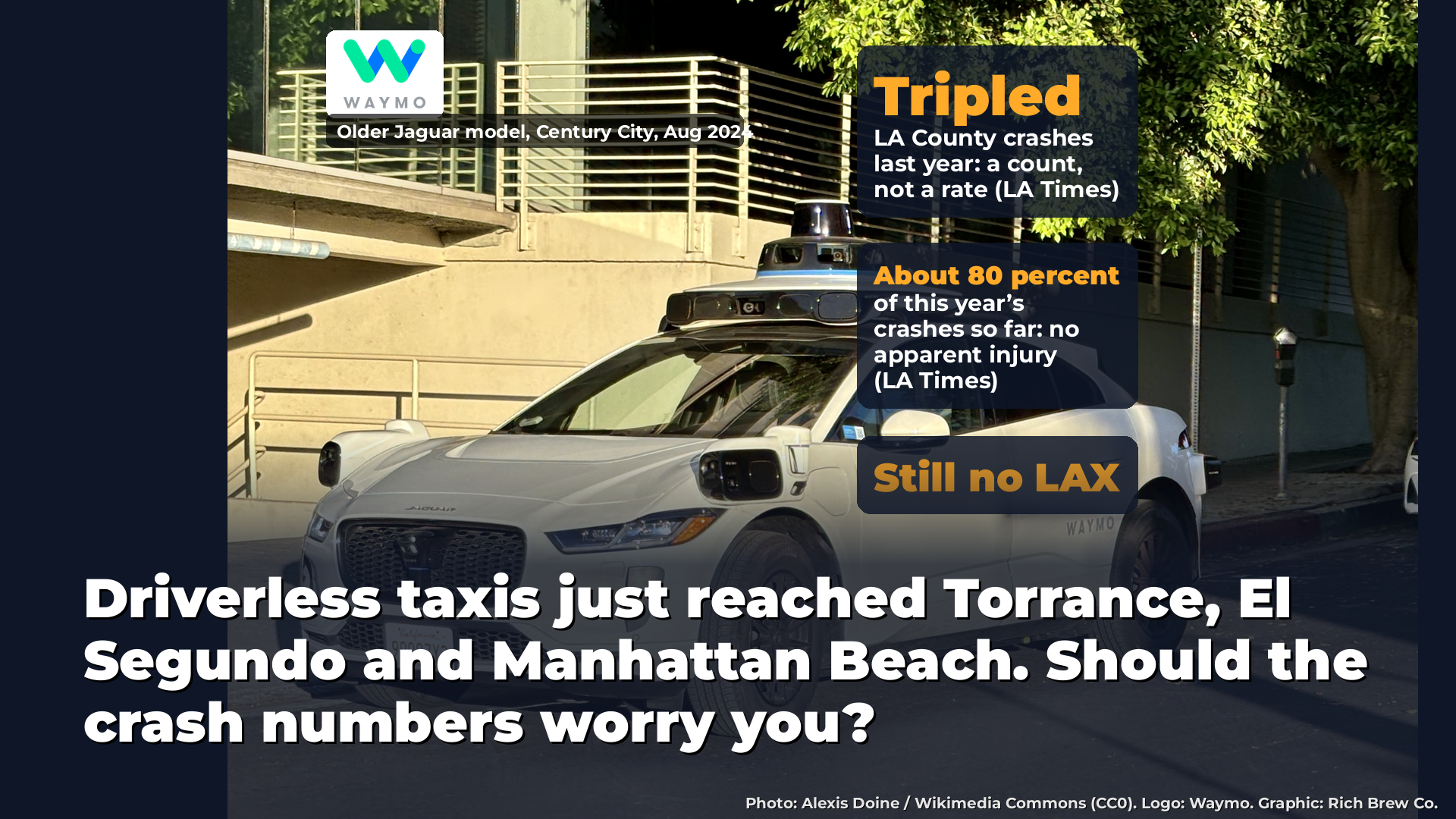
If you live in the beach cities south of Los Angeles, the car waiting at your crosswalk may now have no one in the driver's seat. Waymo expanded its Los Angeles service area on Tuesday, November 3, adding Torrance, El Segundo and Manhattan Beach, according to the Los Angeles Times. Here is what changed, and what the crash numbers do and don't say.
Where the robotaxis go now
The Los Angeles Times reports that the three South Bay cities join a service area of about 210 square miles. Waymo also added popular stops such as Universal Studios and the Beverly Hills Hotel, the paper says. Riders still can't take a Waymo to or from LAX; Waymo told the paper it is in talks with airport officials.
Waymo announced the move on its blog on October 27, saying it would add "nearly 250 square miles" across five cities over the following week. Its post names Torrance in LA, plus new areas in Nashville, Orlando, San Diego (north to La Jolla) and the San Francisco Bay Area, including a BART (Bay Area Rapid Transit) connection at Berryessa Station. NBC Los Angeles reported on October 28 that Waymo's updated map runs through Manhattan Beach and Redondo Beach to Torrance.
Waymo offers fully driverless rides in 15 U.S. cities, the Times says, and has done so in Los Angeles since 2024.
What the crash numbers say
This is the part to read slowly. The Times reviewed crash reports filed with the National Highway Traffic Safety Administration (NHTSA), the U.S. road-safety agency. It found that crashes involving Waymo taxis in LA County tripled last year. The paper adds that the vehicles "still had relatively few incidents, and most were fender benders."
For crashes reported in the county this year, the Times says:
- around 80 percent caused no apparent injury
- 15 percent caused possible injuries
- fewer than 1 percent caused a suspected serious injury
Two things matter here. First, "tripled" is a count, not a rate, and Waymo's LA service has grown. The article does not give the raw numbers. Second, "involving" does not mean Waymo caused the crash; the article does not say who was at fault.
Think of a community pool. Put three times as many swimmers in the water and you expect more bumps, even if each swimmer is careful. The better question is how often each swimmer bumps someone.
On that question, the Times notes that Waymo reports fewer crashes per million miles driven each year since 2023. That figure comes from Waymo itself.
Ink, not pencil: the "tripled" figure covers last year, while the injury breakdown covers this year so far. They are two different time periods, both from the Times' own review.
The human side
For someone commuting to an office in El Segundo, or a family heading to dinner in Manhattan Beach, this is one more way to get around without owning a car or driving home late at night. For pedestrians and cyclists, it means sharing the road with a new kind of driver.
The Times also notes that Waymo's newer vehicle, the Ojai, launched in May. The paper says it is cheaper to deploy and better equipped for extreme weather.
Why regular people should care
Driverless taxis are moving from novelty to ordinary traffic in more neighbourhoods. Knowing how to read crash headlines helps: a rising count can sit alongside a falling rate. If you share these streets, the honest picture so far is that most reported crashes have been minor, and the full safety story is still being written.
What's next
Watch for news on LAX. The Times reports that an airport official said last year that LAX would bring in Waymo once its Skylink people mover is finished, and that project now opens in February at the earliest. Also look for new NHTSA crash data, and for Waymo's own safety figures as its fleet grows.