
By Casey Forge
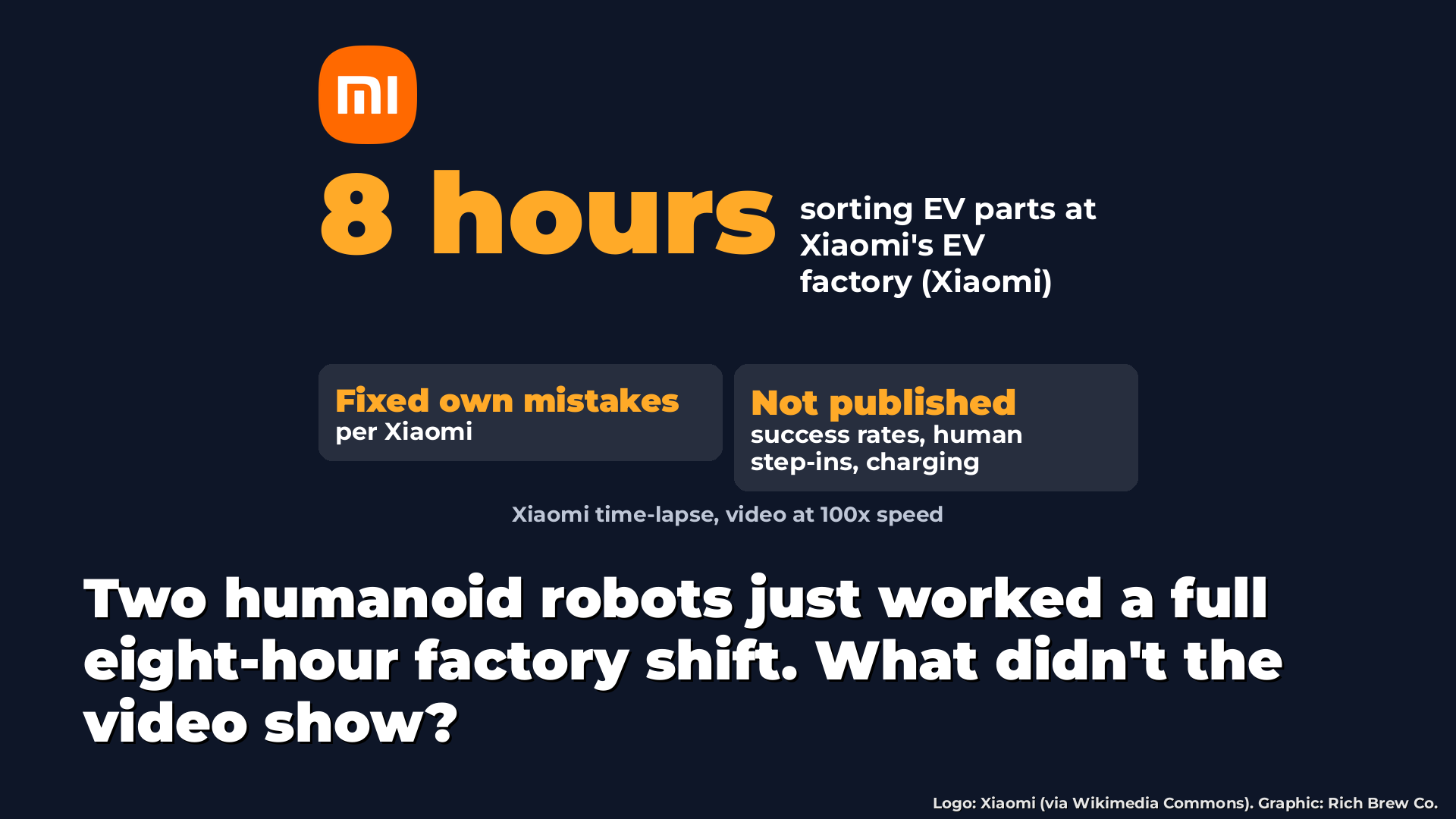
Most of us know what an eight-hour shift feels like by the last hour. Now a car company says two of its humanoid robots made it through one. Xiaomi, the Chinese phone and electric-car maker, has posted a sped-up video of two humanoid robots sorting car parts for a full eight-hour shift at its car factory. It is an eye-catching step. It also leaves out the numbers that would tell us how well it really went.
What the video shows
Xiaomi's tech account posted the video on X on November 3. According to Electrek, it shows the robots pulling centre-console side covers, plastic trim pieces for Xiaomi's cars, out of bins, carrying them to storage racks and placing them into slots. A running clock counts up their working time, and a corner label reads "Autonomous, 100x Speed."
At 100 times speed, a full shift fits into a few minutes. That is a bit like watching a time-lapse of someone painting a house: you see the work get done, but not every slip or coffee break.
Humanoids Daily says the video also shows playback at five times speed in places. Electrek points out a moment, in a segment Xiaomi labels "Dropped Material: Multi-Robot Collaboration," where a robot upper body on a wheeled base rolls in to help the two legged robots. Wheeled robots also move the bins around.
What Xiaomi says, in its own words
These claims come only from Xiaomi. Per Xiaomi, the robot:
- covered that workstation's full day of production needs,
- could "autonomously detect and correct anomalies," meaning it spotted and fixed its own mistakes,
- worked together with the production line's control system.
Xiaomi called it "another step toward real-world industrial deployment," Electrek reports. No outside group has checked the run.
What the video doesn't show
Xiaomi did not say how many parts the robots sorted, what share they got right over eight hours, or how many times a person had to step in. It also did not explain how the robots stayed powered for a whole shift, whether by battery swaps, a cable or charging breaks, according to Electrek and Humanoids Daily.
Those details matter. Electrek reminds readers that "autonomous" in a robot video can mean many things, and that some past humanoid demos from other companies, such as Tesla's Optimus at a 2024 event, used people operating robots remotely. Humanoids Daily adds that an eight-hour task should not be read as eight hours on a single charge.
To be fair to Xiaomi, it has shared real numbers before. In March, per Xiaomi, a robot had a 90.2 percent success rate installing nuts over three hours in its Beijing electric-car factory. By July, Xiaomi said that rate had reached 98 percent, Electrek reports. Those are Xiaomi's own figures, for a different job, not this sorting shift.
Ink, not pencil: Xiaomi showed two humanoid robots handling parts over an eight-hour shift. It has not published success rates, human help counts or charging details, so we can't yet call them reliable co-workers.
Why regular people should care
Factory and warehouse jobs touch millions of families. If the run holds up, a robot that can last a whole shift is a real milestone, and robots may one day take on repetitive or tiring tasks. But the hopeful version of this story needs evidence: how often robots make mistakes, how often people help, and what happens when one breaks down. Asking those questions is fair to workers and to the robot makers.
What's next
Xiaomi's chief executive, Lei Jun, said last December that the company plans to use humanoid robots in large numbers across its factories within five years, Electrek reports. The next useful step would be Xiaomi sharing parts per hour, success rates and how often people stepped in during this run.