
By Maya Quill
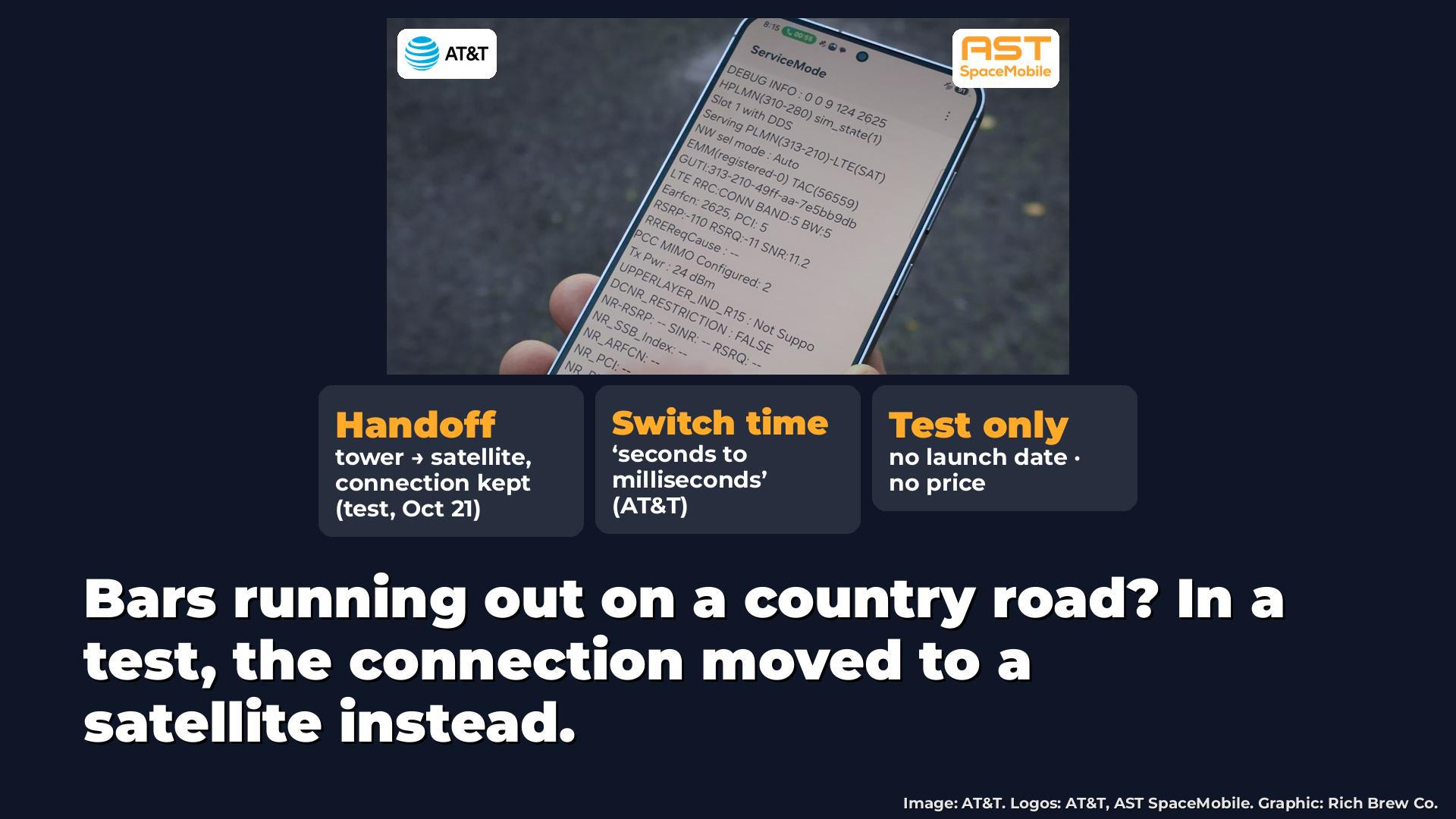
You are driving a quiet country road with your map open, and the bars on your phone start to fall. Then: nothing. AT&T says it and AST SpaceMobile have now tested a fix for that moment, by handing a phone connection from a cell tower to a satellite overhead without breaking it. It is a test, not a service you can sign up for. But it shows where phones are heading.
What happened
In a newsroom post on Monday, November 2, AT&T says it and AST SpaceMobile achieved what they call "the industry's first successful handoff" between a ground-based cellular network and a direct-to-device satellite network. That means satellites that talk straight to ordinary phones, with no special dish or gadget.
The test happened on Wednesday, October 21, at 8:15 a.m. Pacific time, outside Granite Falls, Washington, AT&T says, and was announced 12 days later. Two equipment makers helped, according to AT&T: Ericsson on AT&T's ground network and Nokia on AST SpaceMobile's space network.
AT&T says the work builds on earlier voice calls, text messages and video calls made through AST SpaceMobile's BlueBird satellites using everyday smartphones. The post does not say which phone was used in this handoff test, or how long the connection lasted.
What a "handoff" is
Your phone already does handoffs all day. As you drive, it passes your connection from one tower to the next, and you never notice. The hard part is passing it from a tower on the ground to a satellite moving fast high above, then keeping it going.
Think of a relay race. The runners must pass the baton smoothly, or the race is lost. AT&T says that with other providers, moving between ground and satellite coverage "can mean a dropped call or interrupted connection." It says Ericsson's network automation cuts that switch-over time "from seconds to milliseconds." That is AT&T's description, not an outside measurement.
The human side
AT&T's post leans on a simple promise: "Your phone should just stay connected." In the same post, AST SpaceMobile's chief commercial officer, Wayne Thorsen, says the network is "designed to give people more places to make calls, use their apps, stream content and stay connected with the smartphones they already own."
He also points to people who need it most. The system, he says, "adds a new layer of resilience for first responders who depend on reliable communications when it matters most." Picture a firefighter in a canyon, or a family after a storm knocks out local towers.
Ink, not pencil: this was one test, and everything we know about it comes from AT&T's own post. It is not a service launch. AT&T gives no launch date and no price. "The successful handoff is a significant milestone, but it's not the finish line," said Robert Walters, AT&T's senior vice-president of network.
Why regular people should care
A lot of us live, drive or hike where the signal fades: rural roads, mountain passes, ferry routes, cabins. Today, losing the tower usually means losing your connection. If this works at scale, your phone could quietly lean on a satellite when the towers run out, with nothing for you to do. That could matter most in emergencies, when people need to reach help or family. For now, it is promising, not something to count on.
What's next
AT&T says the next steps are "real-world beta services" and then commercial service, with no dates given. Watch for word on which phones and plans will work, what it costs, and whether it reaches beyond the United States. It is part of a bigger trend: phones that use satellites when there is no signal, from text-only SOS features to full connections like this one.