
By Maya Quill
Harvest time is busy on a farm. You drive the combine up and down the rows, hour after hour.
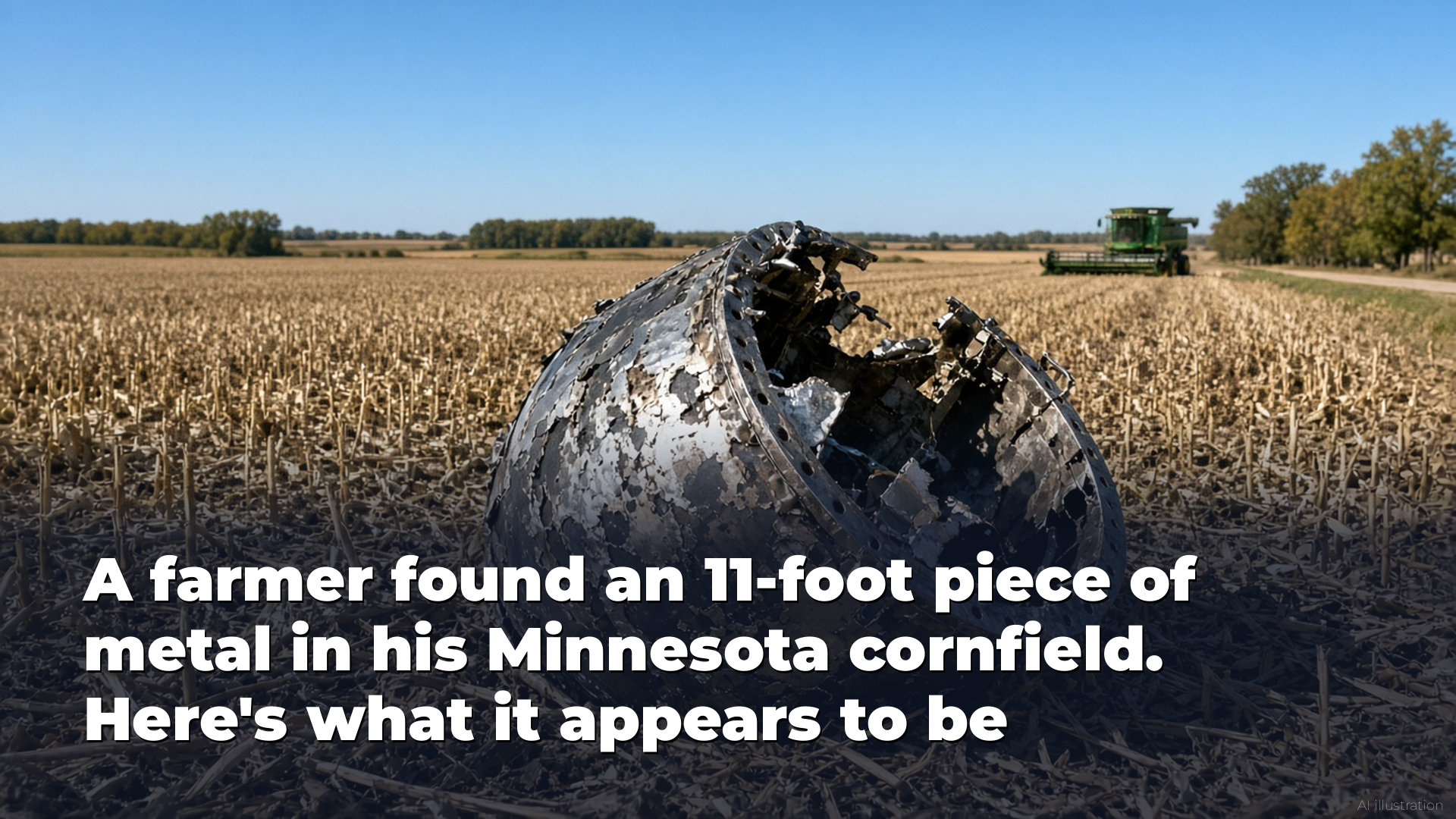
Then, one day last week, a farmer in west-central Minnesota came across something that does not grow in a cornfield: a burnt, round piece of metal about 11 feet wide.
Space can feel very far away. Last week, a piece of it was sitting among the corn stalks.
The news. The farmer was combining corn in Scott Township, Stevens County, Minnesota. The Stevens County Sheriff's Office got the call around 3:30 p.m. local time on October 14 (1:30 p.m. PT).
Deputies found "a large, metallic object, approximately 11-feet in diameter, presumably a space object," the sheriff's office said. It said there was no danger to the public.
On October 19, Ars Technica reported that the evidence points to the upper stage of a Zhuque-2E rocket, built by the Chinese company LandSpace. So the object appears to be part of that rocket.
The upper stage is the top part of a rocket. It carries satellites the last part of the way to orbit.
How it works
A launch, then a fall the same day. Ars Technica reports that the rocket launched on September 15 from northwestern China. It released 10 internet satellites about half an hour after liftoff.
Then its upper stage fired its engine to slow down and drop out of orbit. That night, people posted videos of fiery streaks falling north over Kansas toward Minnesota.
Why experts link it to this rocket. The time, place and direction of those streaks matched the launch. The rocket's upper stage is 11 feet (3.35 meters) wide, the same size as the object in the field.
Officials have not publicly named the object's owner. LandSpace has not publicly acknowledged the debris fall, Ars Technica says.
Where it should have gone. Bringing an old rocket stage down on purpose is a responsible practice. It keeps space cleaner. But the usual aim is a reentry over the ocean.
Ars Technica says this one may have come down over land "perhaps" because of a deorbit burn that went wrong.
Why regular people should care
First, the calm part. Ars Technica notes that "no one has ever been seriously injured by falling space junk," though there have been a few cases of property damage.
Space junk falls out of orbit routinely. Only some pieces survive the heat of reentry, and this one is bigger than most that do.
Second, the practical part. If you ever find something strange that might have fallen from the sky, leave it alone. NASA's advice for people who think they've found space debris is to call local authorities. NASA says such pieces can have sharp edges and should not be touched or handled. In Minnesota, the sheriff's office then brought in state and federal agencies.
Third, the bigger picture. Under international law, Ars Technica explains, the country that launches an object is liable for damage it causes on the ground. That is one reason rocket makers aim old stages away from where people live and work.
Ink, not pencil: The Zhuque-2E link comes from timing, path and size. It has not been officially confirmed.
What's next
Identification and removal. The sheriff's office says it is working with several state and federal agencies to identify and notify the owner, and to plan how to remove the object from the field. For the farmer, the hope is simple: get it out, and get back to the harvest.